Anxiety & Bad Dreams from a Chinese Medicine Perspective
You know the tools. You understand your thoughts. You can name the patterns before they fully arrive. And yet, every single month, about ten days before your period, anxiety appears. Sleep becomes disturbed. Dreams take a darker turn. Your calves fill with fluid. You reach for sugar or salt. And the person you are for the rest of the month quietly steps aside.
That is the question I received recently from a cognitive behavioural health practitioner in her fifties who still has a regular 27-day cycle and who described, with remarkable precision, exactly where in the month her body changes. She feels completely well for the larger part of the month. Then the window opens, and all of this arrives together.
The timing is the most important piece of information here. When anxiety, disturbed sleep, cravings and fluid retention appear and disappear in rhythm with a menstrual cycle, they are not random. They are the body communicating something about a particular phase of that cycle. That does not make the anxiety less real. It makes it more specific, which means we have somewhere to begin.
What Chinese Medicine Sees in This Pattern
Western medicine tends to treat each of these symptoms separately. Chinese medicine looks at the pattern they form together, particularly the timing.
In Chinese medicine, the Shen, which we might translate as spirit or awareness, rests in the Heart and is anchored by the Blood. When the Blood is sufficiently nourishing, the Shen settles at night. Sleep is generally steady, dreams are ordinary, and the mind feels quiet enough.
In the days before a period, the body is already beginning to gather and prepare Blood for menstruation. If the Blood is relatively depleted, or is not moving smoothly through the system, there may be less available to nourish the Heart and hold the Shen. The result can be vivid or distressing dreams, a kind of ambient restlessness that has no obvious cause, and anxiety that arrives not from a thought but from the body itself.
This is not a diagnosis. It is the pattern I would want to explore more fully in a proper consultation. But it does offer a useful lens.
Alongside this, the grief she mentioned deserves attention. In Chinese medicine, grief affects the Lung energy system. When grief sits unresolved in the chest, the breath can become shorter and remain high. The body interprets that as threat. Fight-or-flight rises, and this adds another layer to the anxiety already present.
These are not separate problems. They are the same system under pressure.
The Bao Mai: Connecting Chest and Lower Abdomen
I want to introduce a concept I have written about before, because it feels directly relevant here.
The Bao Mai is described in Chinese medicine as a connection between the uterus and the Heart. You can think of it as the channel of communication between the lower physical centre of the body and the emotional centre in the chest.
When that communication is flowing, emotions can be felt without flooding the whole system. The body can change without the mind going immediately into alarm.
When the connection feels congested, the lower abdomen can feel heavy or stuck while the chest becomes tight and restless. That description maps quite closely onto what was described in the question.
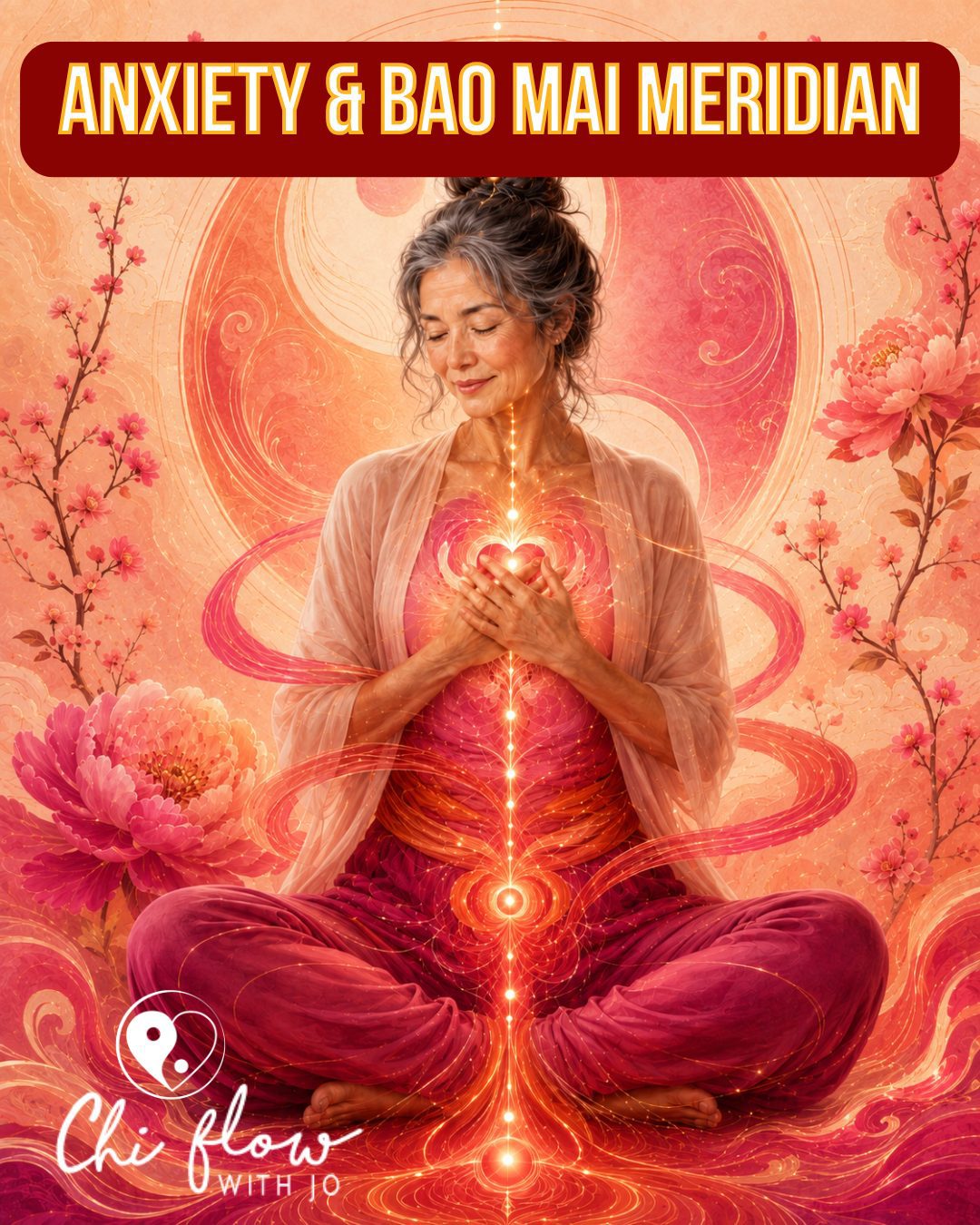
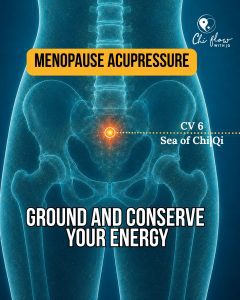
For the acupressure practice, we work with two points along this central line: CV6 and CV17. Although there are two locations, this is one joined practice. You are simply restoring awareness along the connection.
CV6 sits on the midline of the lower abdomen, approximately two finger widths below the belly button. Place a palm or two or three soft fingertips there. Use enough pressure to create a comfortable sense of contact, never sharp, never forceful.
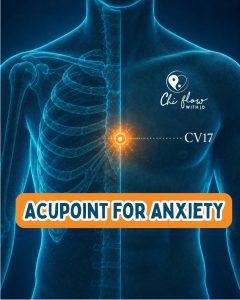
CV17 sits in the centre of the breastbone, level with the centre of the chest. Place the other palm or a few relaxed fingertips there.
Now allow your attention to travel between your hands. Inhale and let the belly rise, allowing the energy to travel upward towards the chest.
Exhale and allow the energy to descend back into the lower abdomen, the lower Dantian. Stay with gentle, steady contact for between thirty seconds and three minutes. Consistency matters far more than duration.
This is particularly useful as a pre-sleep practice during the ten days when the pattern tends to appear. If you wake from a distressing dream, return to the same position rather than analysing the dream in the dark. You are reminding the body that the chest and lower abdomen are still connected.
The Movement: Embrace Mountain
The Qi Gong movement I am choosing here is Embrace Mountain, the second movement from Shibashi.
Stand with feet comfortably apart and knees soft. Allow the arms to float forwards and open as though you are gently holding the shape of a wide mountain.
Three things matter. Keep the feet rooted and the knees easy. Let the arms remain rounded, with space under the armpits and no strain in the shoulders. Let the movement follow an unhurried breath, opening without reaching, returning without collapsing.

As the arms open, inhale into the lower belly and feel the centre of the chest becoming spacious. As they return, exhale and allow the attention to gather towards the lower abdomen. Hold the awareness of the Bao Mai the whole time, energy rising on the inhale, descending and settling on the exhale.
Two to five minutes is enough. Stop before fatigue. The felt outcome you are looking for is a little more room in the chest, more weight through the feet, softer shoulders and a sense that the energy which had been gathering upward can settle.
This movement is fitting for someone who already spends much of their working life holding space for others. When your own system becomes overwhelmed, the mountain offers a different model. The mountain does not argue with the weather. It stays present while the weather passes.
The Food: Barley Water
Barley water. In Five Element food medicine, barley has a gently cooling, moistening quality. It supports the Kidney and Bladder energetic system, which governs fluids, hormones and bones. It addresses that dragging, heavy, full feeling that can accompany the days before a period.
To make it: approximately 50 grams of wholegrain pot barley or pearl barley, two litres of water, half a lemon, a small pinch of salt. A little wakame or dillisk seaweed is optional. Bring it to the boil with the lid on, reduce the heat and simmer gently for about an hour. Strain through a fine sieve, pressing the barley lightly to let the cloudy liquid through. Keep it in the fridge for up to five days. Take roughly one part barley water topped with two parts hot water, warm enough to drink comfortably. One measure in the morning and one later in the day is enough. Save the cooked barley for soup, salad or stew.

Begin without sweetening it. Because cravings for sweet things are already part of the pattern, keep this as a neutral, nourishing drink rather than something that triggers more wanting.
She mentioned that salt makes things worse. Salt can contribute to fluid retention, but there is a meaningful difference between a small pinch used in cooking and the larger amounts hidden in processed foods, crisps and savoury snacks. The aim is awareness, not fear. In Chinese medicine, the salty flavour belongs to the Kidney and Bladder system. It has a gathering, descending quality. Your body may be craving it precisely because the energy needs anchoring downward.
A Note on the Calves and Timing
The swelling in the calves deserves proper attention. Premenstrual fluid retention is common, but please do not assume that is the only possible cause. Mention the exact timing, the anxiety, the disturbed sleep, the cravings and the calf swelling to your GP as a connected pattern rather than separate complaints. A clear picture helps them consider premenstrual disorder, perimenopause and other possible causes. If one calf becomes more swollen than the other, or becomes hot, red, painful or tender, seek urgent medical help.
These practices are supportive. They are not a replacement for a proper medical review, and they are not a test of whether you are applying Chinese medicine correctly.
The rest of the month, you feel like yourself. That matters. Begin the acupressure, the movement and the barley water a few days before the usual window opens. Let the body recognise what is coming and already have something familiar to meet it with.
And please offer yourself some kindness around the grief eating. Grief changes appetite. Food may have been helping you survive a hard time. We can respect that while slowly building
Final thought
To every woman in peri-menopause, menopause or post-menopause: your body is giving you feedback about flow, cooling, nourishment, boundaries, rest and rhythm. You do not have to decode it perfectly. You only have to begin responding more kindly.
And if you would like to practise this kind of work with me in a steady, supported way, come into the Chi Flow membership. It is €39 a month, and after the three-month trial it becomes €20 a month, so you can keep building these small rhythms through the seasons with guidance, community and practice.
Ready to Start?
Join Chi Flow with Jo and begin restoring your energy, and feeling more like yourself again.

Frequently Asked Questions
Why do I get anxiety before my period?
Anxiety before a period may be linked to changes taking place during the premenstrual phase of the cycle. Some women notice anxiety, disturbed sleep, cravings, irritability or physical tension in the days before bleeding begins. From a Chinese medicine perspective, this may also suggest that Blood is not sufficiently nourishing and settling the Heart and Shen.
Why do I have bad dreams before my period?
Bad dreams or vivid dreams before a period may appear alongside disrupted sleep, anxiety and emotional sensitivity. In Chinese medicine, the Shen, or spirit, is said to rest in the Heart and be anchored by the Blood. When the Blood is not strong enough to settle the Shen, sleep may become restless and dreams may feel more intense.
Can menopause cause anxiety and bad dreams?
Menopause can be associated with changes in mood, sleep and the menstrual cycle. Some women experience anxiety, vivid dreams, night waking or a stronger reaction to stress even while their periods remain regular. New or worsening symptoms should be discussed with a GP.
Can I be in menopause if my periods are still regular?
Yes, it is possible to experience perimenopausal symptoms while periods are still arriving regularly. The transition is different for every woman, so age and symptoms should be considered alongside changes in the cycle, sleep, temperature, mood and general wellbeing.
What is Heart Blood deficiency in Chinese medicine?
Heart Blood deficiency is a traditional Chinese medicine pattern associated with insufficient nourishment of the Heart and Shen. It may be considered when symptoms include anxiety, disturbed sleep, vivid dreams, palpitations, tiredness, poor concentration or a sense of emotional vulnerability. A full Chinese medicine diagnosis normally considers the complete symptom picture, tongue and pulse.
Why do I crave sugar and salt before my period?
Cravings may become stronger when the body is tired, stressed, grieving or approaching menstruation. Sugar may offer a quick sense of comfort or energy, while salty foods can feel grounding. Rather than relying only on willpower, regular nourishing meals, adequate protein, rest and hydration may help reduce the intensity of cravings.
Can stress and grief cause emotional eating?
Stress and grief can change appetite, sleep and the need for comfort. Emotional eating is often an attempt to regulate distress rather than a simple lack of self-control. Exploring what the grief needs, while adding supportive food, breath and movement practices, may be more helpful than strict restriction.
Why do my calves retain water before my period?
Fluid retention can occur before a period and may affect the legs, abdomen or breasts. In Chinese medicine, heaviness and fluid accumulation may be considered in relation to the Kidney, Bladder and Spleen energy systems. Persistent, painful or one-sided swelling should always be medically assessed.
Which acupressure points may support anxiety before a period?
CV17, at the centre of the chest, and CV6, below the navel, can be used together as a gentle calming practice. One hand rests over each area while the breath moves softly into the chest and then descends towards the lower abdomen. Pressure should remain gentle and comfortable for around 30 seconds to three minutes.
What is the Bao Mai in Chinese medicine?
The Bao Mai is traditionally described as a connection between the uterus and the Heart. It offers a way of understanding communication between the lower abdomen, menstrual cycle and emotional life. When this connection feels obstructed, there may be lower abdominal tension alongside anxiety, chest tightness or emotional unrest.
How do I breathe to help settle anxiety?
Place one hand over the centre of the chest and the other below the navel. Allow the inhale to open the chest gently, then lengthen the exhale and imagine the breath descending towards the lower hand. Keep the jaw soft, shoulders relaxed and breathing unforced.
Can barley water help with water retention?
Barley water is traditionally used as a gentle, hydrating food drink. From a Five Element food perspective, it may support the Kidney and Bladder energy systems and encourage fluid movement. It is not a medical diuretic or a treatment for unexplained swelling.
How can I build Blood in Chinese medicine?
Regular nourishing meals, adequate protein, leafy greens, beans, lentils, eggs, beetroot, broths and slow-cooked foods may be included as part of a balanced diet. Rest, good digestion and avoiding excessive restriction are also important. Heavy periods, persistent tiredness, dizziness or breathlessness should be discussed with a GP.

Go Deeper with Our Books
For those wanting to understand how movement, breath, and Chinese Medicine principles, Jo’s books provide practical guidance rooted in lived experience and clinical wisdom.
👉 Buy Five Element Wisdom cookbooks
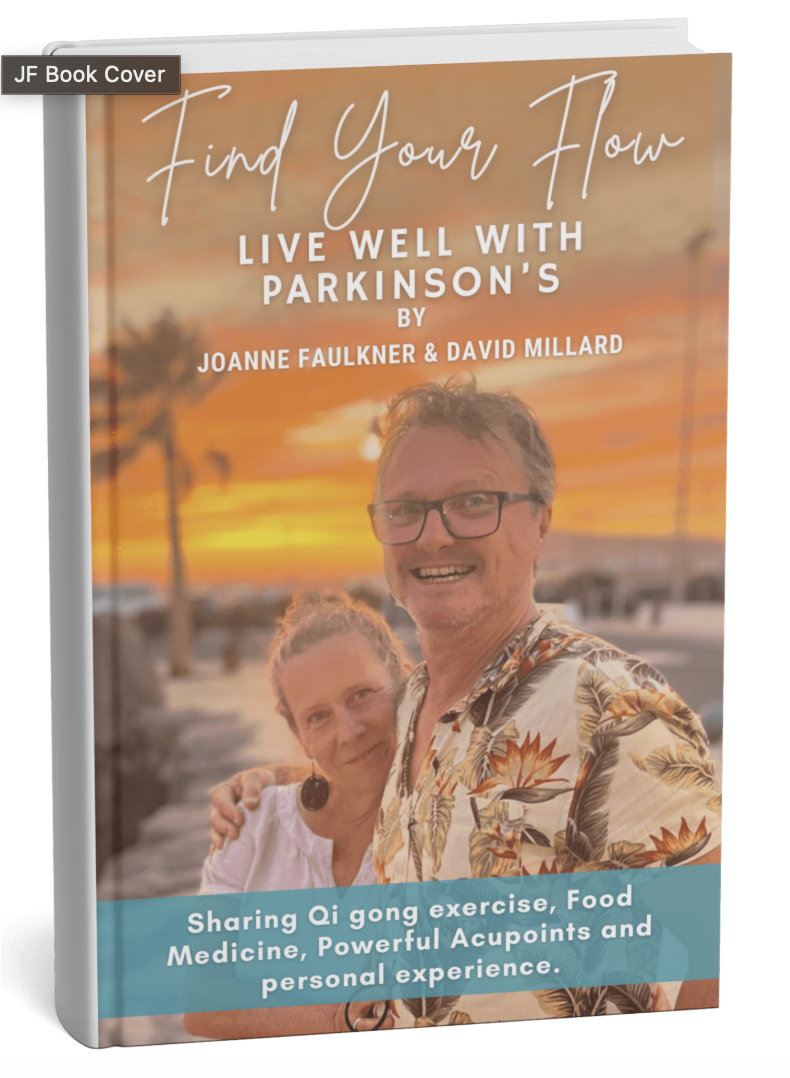
Explore how to Find Your Flow and Live Well with Parkinson’s.
Movement does not need to be extreme to be powerful.
Small daily expansion reshapes the body.
Steady breath reshapes the nervous system.
Gentle repetition rebuilds confidence.
Every human body carries extraordinary capacity for renewal when given the right rhythm.
If you want to soften into strength, come and practice with us.
When to seek medical help
Please speak to your GP or specialist if symptoms worsen or spread, if pain, itching, heat or anxiety starts waking you at night, if you notice new skin changes, lumps, thickening, ulceration or bleeding, if your prescribed treatment is not helping, or if there is any change in medication.
And if you ever have chest pain that feels severe, crushing, unusual, or comes with breathlessness, sweating, faintness, jaw pain or arm pain, seek urgent medical help.
Chinese medicine and home practices can support the terrain of the body, but they do not replace diagnosis or medical treatment.
Self-administered acupressure or Chinese Medicine is not a substitute for visits to qualified healthcare practitioners.
Knowing how to treat yourself and your loved ones with complimentary therapies like acupressure can be greatly beneficial and convenient. However, for serious and chronic conditions, you’ll want to visit an Shiatsu therapist / Acupuncturist or other qualified healthcare practitioner who can develop a treatment plan based on your unique medical history and combination of symptoms.
The information provided should not be considered medical advice.
Topics: Breathwork, Parkinson’s support, sleep practices, Qi Gong, acupressure.