Anxiety & Bad Dreams from a Chinese Medicine Perspective

Anxiety & Bad Dreams from a Chinese Medicine Perspective

You know the tools. You understand your thoughts. You can name the patterns before they fully arrive. And yet, every single month, about ten days before your period, anxiety appears. Sleep becomes disturbed. Dreams take a darker turn. Your calves fill with fluid. You reach for sugar or salt. And the person you are for the rest of the month quietly steps aside.

That is the question I received recently from a cognitive behavioural health practitioner in her fifties who still has a regular 27-day cycle and who described, with remarkable precision, exactly where in the month her body changes. She feels completely well for the larger part of the month. Then the window opens, and all of this arrives together.

The timing is the most important piece of information here. When anxiety, disturbed sleep, cravings and fluid retention appear and disappear in rhythm with a menstrual cycle, they are not random. They are the body communicating something about a particular phase of that cycle. That does not make the anxiety less real. It makes it more specific, which means we have somewhere to begin.

What Chinese Medicine Sees in This Pattern
 

Western medicine tends to treat each of these symptoms separately. Chinese medicine looks at the pattern they form together, particularly the timing.

In Chinese medicine, the Shen, which we might translate as spirit or awareness, rests in the Heart and is anchored by the Blood. When the Blood is sufficiently nourishing, the Shen settles at night. Sleep is generally steady, dreams are ordinary, and the mind feels quiet enough.

In the days before a period, the body is already beginning to gather and prepare Blood for menstruation. If the Blood is relatively depleted, or is not moving smoothly through the system, there may be less available to nourish the Heart and hold the Shen. The result can be vivid or distressing dreams, a kind of ambient restlessness that has no obvious cause, and anxiety that arrives not from a thought but from the body itself.

This is not a diagnosis. It is the pattern I would want to explore more fully in a proper consultation. But it does offer a useful lens.

Alongside this, the grief she mentioned deserves attention. In Chinese medicine, grief affects the Lung energy system. When grief sits unresolved in the chest, the breath can become shorter and remain high. The body interprets that as threat. Fight-or-flight rises, and this adds another layer to the anxiety already present.

These are not separate problems. They are the same system under pressure.

The Bao Mai: Connecting Chest and Lower Abdomen

I want to introduce a concept I have written about before, because it feels directly relevant here.

The Bao Mai is described in Chinese medicine as a connection between the uterus and the Heart. You can think of it as the channel of communication between the lower physical centre of the body and the emotional centre in the chest.

When that communication is flowing, emotions can be felt without flooding the whole system. The body can change without the mind going immediately into alarm.

When the connection feels congested, the lower abdomen can feel heavy or stuck while the chest becomes tight and restless. That description maps quite closely onto what was described in the question.
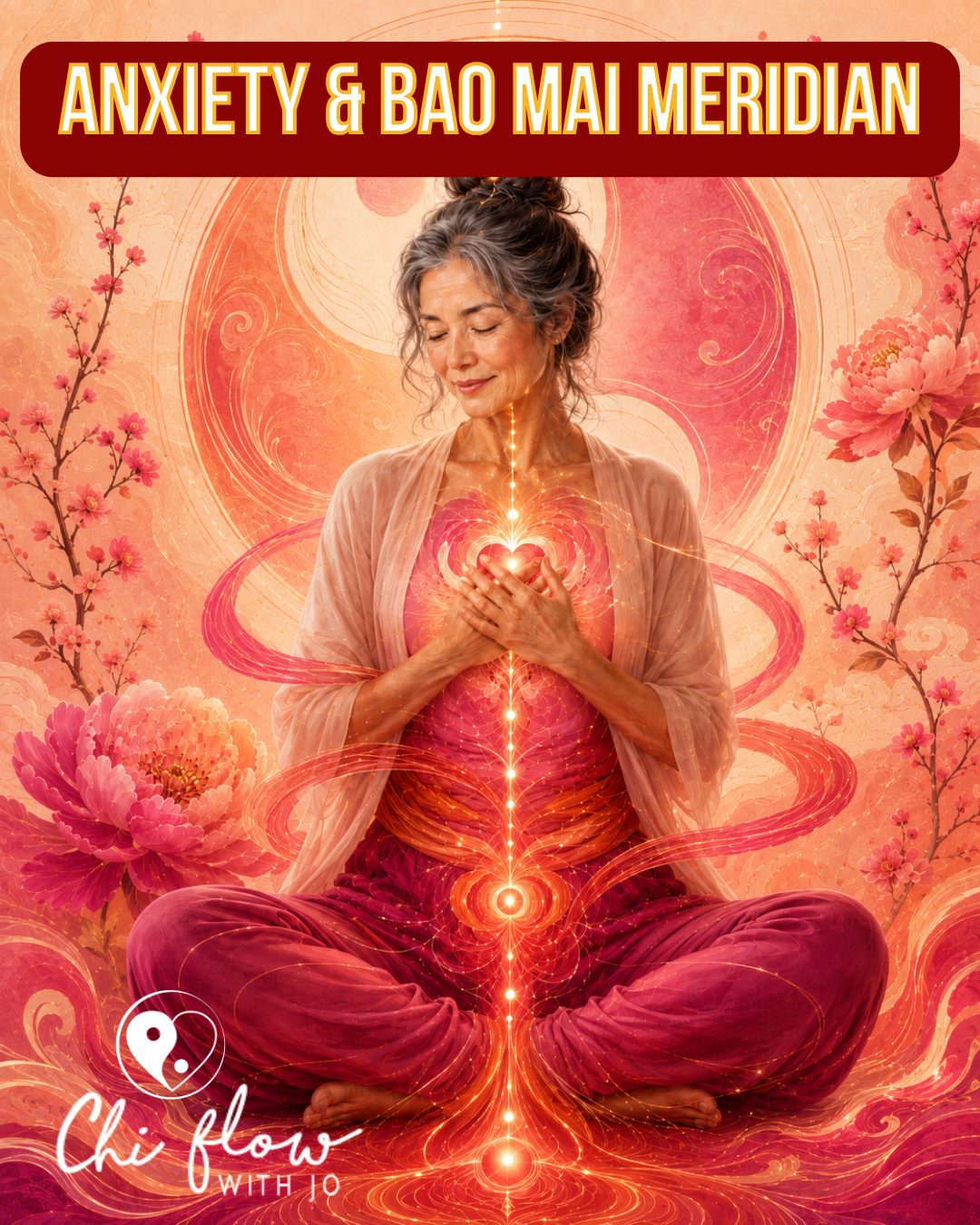
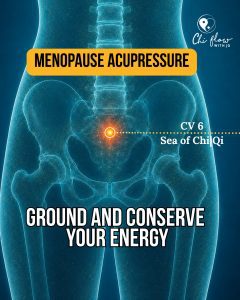
For the acupressure practice, we work with two points along this central line: CV6 and CV17. Although there are two locations, this is one joined practice. You are simply restoring awareness along the connection.

CV6 sits on the midline of the lower abdomen, approximately two finger widths below the belly button. Place a palm or two or three soft fingertips there. Use enough pressure to create a comfortable sense of contact, never sharp, never forceful.
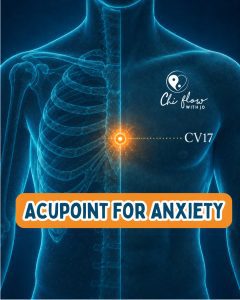
CV17 sits in the centre of the breastbone, level with the centre of the chest. Place the other palm or a few relaxed fingertips there.

Now allow your attention to travel between your hands. Inhale and let the belly rise, allowing the energy to travel upward towards the chest.

Exhale and allow the energy to descend back into the lower abdomen, the lower Dantian. Stay with gentle, steady contact for between thirty seconds and three minutes. Consistency matters far more than duration.

This is particularly useful as a pre-sleep practice during the ten days when the pattern tends to appear. If you wake from a distressing dream, return to the same position rather than analysing the dream in the dark. You are reminding the body that the chest and lower abdomen are still connected.

The Movement: Embrace Mountain

The Qi Gong movement I am choosing here is Embrace Mountain, the second movement from Shibashi.

Stand with feet comfortably apart and knees soft. Allow the arms to float forwards and open as though you are gently holding the shape of a wide mountain.

Three things matter. Keep the feet rooted and the knees easy. Let the arms remain rounded, with space under the armpits and no strain in the shoulders. Let the movement follow an unhurried breath, opening without reaching, returning without collapsing.

As the arms open, inhale into the lower belly and feel the centre of the chest becoming spacious. As they return, exhale and allow the attention to gather towards the lower abdomen. Hold the awareness of the Bao Mai the whole time, energy rising on the inhale, descending and settling on the exhale.

Two to five minutes is enough. Stop before fatigue. The felt outcome you are looking for is a little more room in the chest, more weight through the feet, softer shoulders and a sense that the energy which had been gathering upward can settle.

This movement is fitting for someone who already spends much of their working life holding space for others. When your own system becomes overwhelmed, the mountain offers a different model. The mountain does not argue with the weather. It stays present while the weather passes.

The Food: Barley Water

Barley water. In Five Element food medicine, barley has a gently cooling, moistening quality. It supports the Kidney and Bladder energetic system, which governs fluids, hormones and bones. It addresses that dragging, heavy, full feeling that can accompany the days before a period.

To make it: approximately 50 grams of wholegrain pot barley or pearl barley, two litres of water, half a lemon, a small pinch of salt. A little wakame or dillisk seaweed is optional. Bring it to the boil with the lid on, reduce the heat and simmer gently for about an hour. Strain through a fine sieve, pressing the barley lightly to let the cloudy liquid through. Keep it in the fridge for up to five days. Take roughly one part barley water topped with two parts hot water, warm enough to drink comfortably. One measure in the morning and one later in the day is enough. Save the cooked barley for soup, salad or stew.

Begin without sweetening it. Because cravings for sweet things are already part of the pattern, keep this as a neutral, nourishing drink rather than something that triggers more wanting.

She mentioned that salt makes things worse. Salt can contribute to fluid retention, but there is a meaningful difference between a small pinch used in cooking and the larger amounts hidden in processed foods, crisps and savoury snacks. The aim is awareness, not fear. In Chinese medicine, the salty flavour belongs to the Kidney and Bladder system. It has a gathering, descending quality. Your body may be craving it precisely because the energy needs anchoring downward.

A Note on the Calves and Timing

The swelling in the calves deserves proper attention. Premenstrual fluid retention is common, but please do not assume that is the only possible cause. Mention the exact timing, the anxiety, the disturbed sleep, the cravings and the calf swelling to your GP as a connected pattern rather than separate complaints. A clear picture helps them consider premenstrual disorder, perimenopause and other possible causes. If one calf becomes more swollen than the other, or becomes hot, red, painful or tender, seek urgent medical help.

These practices are supportive. They are not a replacement for a proper medical review, and they are not a test of whether you are applying Chinese medicine correctly.

The rest of the month, you feel like yourself. That matters. Begin the acupressure, the movement and the barley water a few days before the usual window opens. Let the body recognise what is coming and already have something familiar to meet it with.

And please offer yourself some kindness around the grief eating. Grief changes appetite. Food may have been helping you survive a hard time. We can respect that while slowly building

Final thought

To every woman in peri-menopause, menopause or post-menopause: your body is giving you feedback about flow, cooling, nourishment, boundaries, rest and rhythm. You do not have to decode it perfectly. You only have to begin responding more kindly.

And if you would like to practise this kind of work with me in a steady, supported way, come into the Chi Flow membership. It is €39 a month, and after the three-month trial it becomes €20 a month, so you can keep building these small rhythms through the seasons with guidance, community and practice.
Ready to Start?

Join Chi Flow with Jo and begin restoring your energy, and feeling more like yourself again.

Clear

EUR (€) ^

Frequently Asked Questions 

Why do I get anxiety before my period?

Anxiety before a period may be linked to changes taking place during the premenstrual phase of the cycle. Some women notice anxiety, disturbed sleep, cravings, irritability or physical tension in the days before bleeding begins. From a Chinese medicine perspective, this may also suggest that Blood is not sufficiently nourishing and settling the Heart and Shen.

Why do I have bad dreams before my period?

Bad dreams or vivid dreams before a period may appear alongside disrupted sleep, anxiety and emotional sensitivity. In Chinese medicine, the Shen, or spirit, is said to rest in the Heart and be anchored by the Blood. When the Blood is not strong enough to settle the Shen, sleep may become restless and dreams may feel more intense.

Can menopause cause anxiety and bad dreams?

Menopause can be associated with changes in mood, sleep and the menstrual cycle. Some women experience anxiety, vivid dreams, night waking or a stronger reaction to stress even while their periods remain regular. New or worsening symptoms should be discussed with a GP.

Can I be in menopause if my periods are still regular?

Yes, it is possible to experience perimenopausal symptoms while periods are still arriving regularly. The transition is different for every woman, so age and symptoms should be considered alongside changes in the cycle, sleep, temperature, mood and general wellbeing.

What is Heart Blood deficiency in Chinese medicine?

Heart Blood deficiency is a traditional Chinese medicine pattern associated with insufficient nourishment of the Heart and Shen. It may be considered when symptoms include anxiety, disturbed sleep, vivid dreams, palpitations, tiredness, poor concentration or a sense of emotional vulnerability. A full Chinese medicine diagnosis normally considers the complete symptom picture, tongue and pulse.

Why do I crave sugar and salt before my period?

Cravings may become stronger when the body is tired, stressed, grieving or approaching menstruation. Sugar may offer a quick sense of comfort or energy, while salty foods can feel grounding. Rather than relying only on willpower, regular nourishing meals, adequate protein, rest and hydration may help reduce the intensity of cravings.

Can stress and grief cause emotional eating?

Stress and grief can change appetite, sleep and the need for comfort. Emotional eating is often an attempt to regulate distress rather than a simple lack of self-control. Exploring what the grief needs, while adding supportive food, breath and movement practices, may be more helpful than strict restriction.

Why do my calves retain water before my period?

Fluid retention can occur before a period and may affect the legs, abdomen or breasts. In Chinese medicine, heaviness and fluid accumulation may be considered in relation to the Kidney, Bladder and Spleen energy systems. Persistent, painful or one-sided swelling should always be medically assessed.

Which acupressure points may support anxiety before a period?

CV17, at the centre of the chest, and CV6, below the navel, can be used together as a gentle calming practice. One hand rests over each area while the breath moves softly into the chest and then descends towards the lower abdomen. Pressure should remain gentle and comfortable for around 30 seconds to three minutes.

What is the Bao Mai in Chinese medicine?

The Bao Mai is traditionally described as a connection between the uterus and the Heart. It offers a way of understanding communication between the lower abdomen, menstrual cycle and emotional life. When this connection feels obstructed, there may be lower abdominal tension alongside anxiety, chest tightness or emotional unrest.

How do I breathe to help settle anxiety?

Place one hand over the centre of the chest and the other below the navel. Allow the inhale to open the chest gently, then lengthen the exhale and imagine the breath descending towards the lower hand. Keep the jaw soft, shoulders relaxed and breathing unforced.

Can barley water help with water retention?

Barley water is traditionally used as a gentle, hydrating food drink. From a Five Element food perspective, it may support the Kidney and Bladder energy systems and encourage fluid movement. It is not a medical diuretic or a treatment for unexplained swelling.

How can I build Blood in Chinese medicine?

Regular nourishing meals, adequate protein, leafy greens, beans, lentils, eggs, beetroot, broths and slow-cooked foods may be included as part of a balanced diet. Rest, good digestion and avoiding excessive restriction are also important. Heavy periods, persistent tiredness, dizziness or breathlessness should be discussed with a GP.

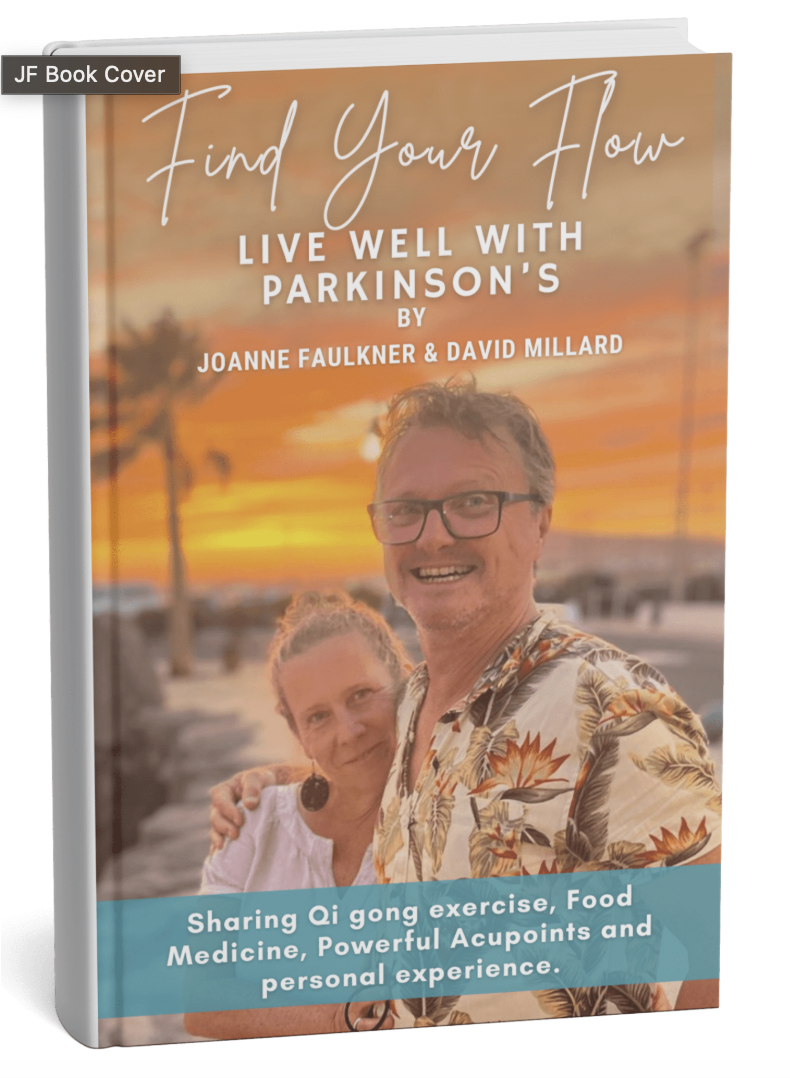
Go Deeper with Our Books

For those wanting to understand how movement, breath, and Chinese Medicine principles, Jo’s books provide practical guidance rooted in lived experience and clinical wisdom.

👉 Buy Five Element Wisdom cookbooks

Explore how to Find Your Flow and Live Well with Parkinson’s.

Movement does not need to be extreme to be powerful.
Small daily expansion reshapes the body.
Steady breath reshapes the nervous system.
Gentle repetition rebuilds confidence.

Every human body carries extraordinary capacity for renewal when given the right rhythm.

If you want to soften into strength, come and practice with us.

When to seek medical help

Please speak to your GP or specialist if symptoms worsen or spread, if pain, itching, heat or anxiety starts waking you at night, if you notice new skin changes, lumps, thickening, ulceration or bleeding, if your prescribed treatment is not helping, or if there is any change in medication.

And if you ever have chest pain that feels severe, crushing, unusual, or comes with breathlessness, sweating, faintness, jaw pain or arm pain, seek urgent medical help.

Chinese medicine and home practices can support the terrain of the body, but they do not replace diagnosis or medical treatment.

Self-administered acupressure or Chinese Medicine is not a substitute for visits to qualified healthcare practitioners.

Knowing how to treat yourself and your loved ones with complimentary therapies like acupressure can be greatly beneficial and convenient. However, for serious and chronic conditions, you’ll want to visit an Shiatsu therapist / Acupuncturist or other qualified healthcare practitioner who can develop a treatment plan based on your unique medical history and combination of symptoms.

The information provided should not be considered medical advice.

Topics: Breathwork, Parkinson’s support, sleep practices, Qi Gong, acupressure.
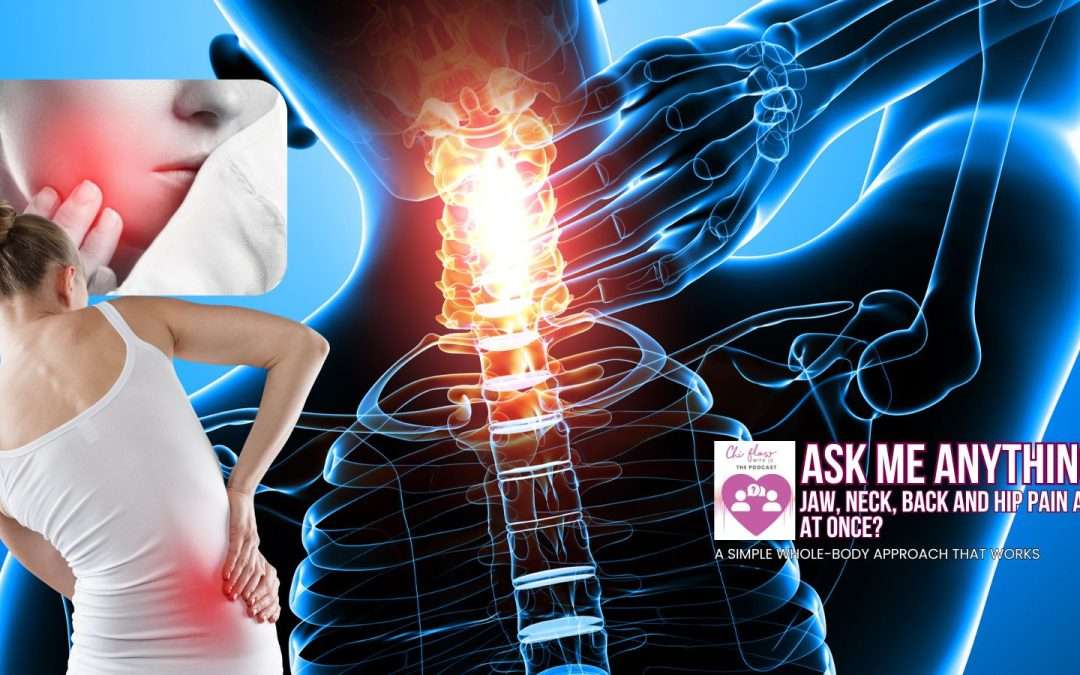
Jaw, Neck, Back and Hip Pain All at Once?

Jaw, Neck, Back and Hip Pain All at Once?

 A Simple Whole-Body Approach That Works

When the jaw, neck, back, and hips all start calling for attention at the same time, it can feel confusing and overwhelming.

It is not just one area.
It is everything, tight yet weak, tired yet wired, with tension that keeps returning no matter what you try.

This pattern and combination is something I see often, especially in people dealing with fatigue, nerve sensitivity, or conditions like TMJ, back pain, or Parkinson’s.

And the truth is, this is not four separate problems. It is one connected system asking for support.

Why Everything Feels Tight and Weak at the Same Time

In Traditional Chinese Medicine, everything comes back to one question.

Is energy flowing, or is it stuck?

When the body is under pressure, it begins to brace.

  • The jaw clenches
  • The neck tightens
  • The shoulders lift
  • The back locks
  • The hips grip

Underneath all of that, the body feels weak because energy is being used to guard, not support.

So instead of chasing each area separately, we look at the whole chain.

Very often, the jaw and base of the skull act like a “top gate.”
If this area is tight, everything below starts compensating.

A Simple Acupressure Practice to Release Tension

Rather than doing more and more, start with less, done consistently.

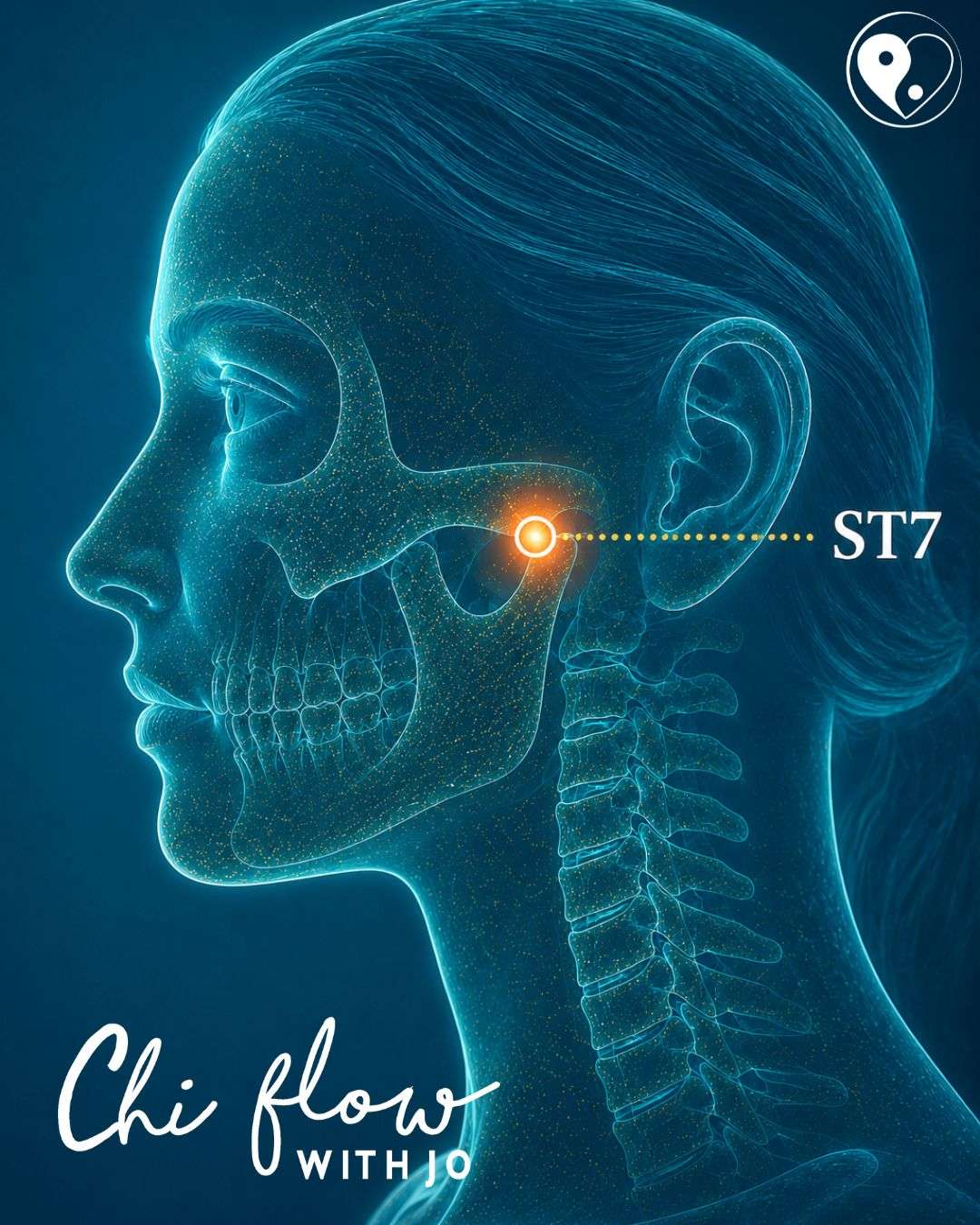
Stomach 7 (Jaw Point)

  • Located just in front of the ear where the jaw moves
  • Gently press into the hollow while relaxing the mouth

Stomach 7 is one of my favourite points because its effects often extend far beyond the jaw itself. While it is commonly used for TMJ discomfort, clenching, grinding, and facial tension, it also helps address the compensation patterns that develop throughout the body when the jaw becomes chronically tight. 

The jaw is closely linked to the muscles of the neck, shoulders, and upper back. When we clench, we rarely do it in isolation. We tend to lift the shoulders, tighten the neck, hold the breath, and brace through the spine. By gently releasing Stomach 7, many people notice not only a softer jaw but also less tension around the temples, improved comfort around the ears, freer neck movement, deeper breathing, and a greater sense of relaxation through the shoulders. 

In Chinese Medicine, the Stomach channel travels through the face and head, making this point particularly useful for reducing the feeling of being “held tight” through the entire upper body. I often find that when the jaw begins to let go, the neck follows, and when the neck softens, the rest of the body has an opportunity to reorganise itself with less effort.

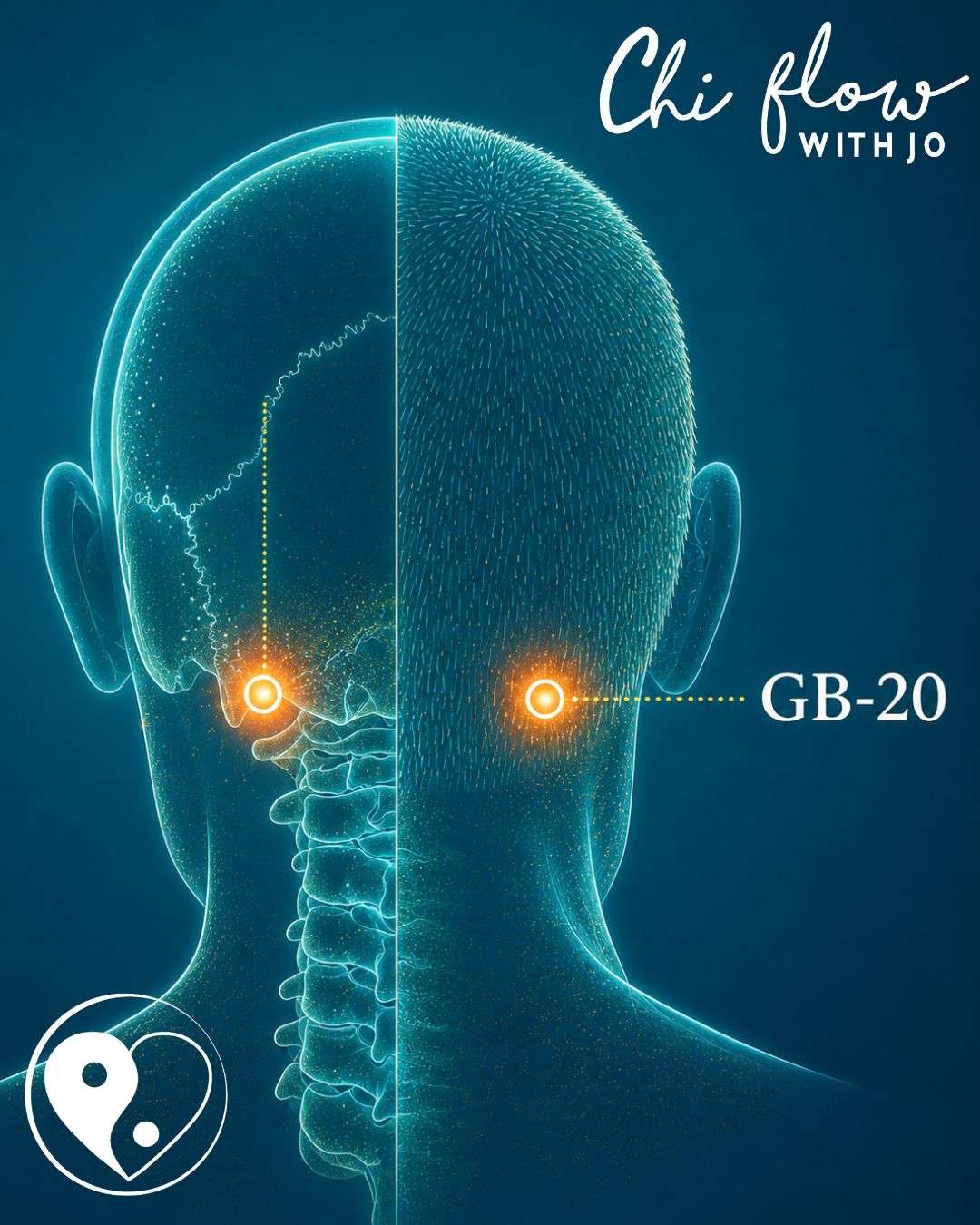
Gall Bladder 20 (Base of Skull)

  • Found at the base of the skull, in two soft hollows either side
  • Apply steady, gentle pressure with the thumbs

Gall Bladder 20 is one of the most important points for people who carry tension in the neck, jaw, shoulders, and head. Located in the two hollows at the base of the skull, it sits at a key meeting point between the head and the rest of the body. When this area becomes tight, it can create a feeling of pressure, pulling, heaviness, or congestion that radiates into the jaw, temples, neck, and upper back. 

In Chinese Medicine, Gall Bladder 20 is traditionally used to encourage the smooth flow of energy through the head and neck, helping to release stagnation and restore movement where things have become stuck. Many people notice reduced head pressure, less neck stiffness, easier head movement, and a greater sense of mental clarity after working this point gently. 

Because so many muscles attach around the base of the skull, releasing this area can also improve posture and reduce the strain travelling down through the spine. I often describe Gall Bladder 20 as opening the “top gate” of the body. When the base of the skull relaxes, the shoulders can drop, the breath can deepen, the jaw can soften, and the back and hips no longer need to work quite so hard to compensate. 

For people experiencing that combination of tightness, fatigue, tension, and a feeling of being pulled out of alignment, Gall Bladder 20 can be one of the most powerful points for helping the entire body feel more connected and at ease.

This complements the Stomach 7 paragraph perfectly because ST7 addresses the front of the jaw mechanism, while GB20 addresses the back of the jaw-neck-head relationship, giving readers a much clearer understanding of why you use the two points together.

How to use them together

  • 30 seconds on Stomach 7 each side

  • 1 minute on Gall Bladder 20
  • Keep the breath slow, jaw relaxed, shoulders soft

This is not about force.
With nerve sensitivity and TMJ, the body responds better to softness.

  • Let the tongue rest softly in the mouth
  • Let the eyes soften, as if looking into the distance
  • Allow the jaw to hang naturally, not clench

Link this practice to something you already do, washing your face, removing earrings, or sitting down in the evening so that it is a daily connection to your body and it’s alignment. That is how the body learns and how it changes.

Food That Supports Nerves, Energy and Release

When the body feels tight but weak, we look at nourishment.

In Chinese Medicine, this often points to a need to support:

  • Blood, which nourishes muscles and nerves
  • Yin and fluids, which calm and soften
  • The Spleen, which creates energy and stability

A simple, powerful option is:

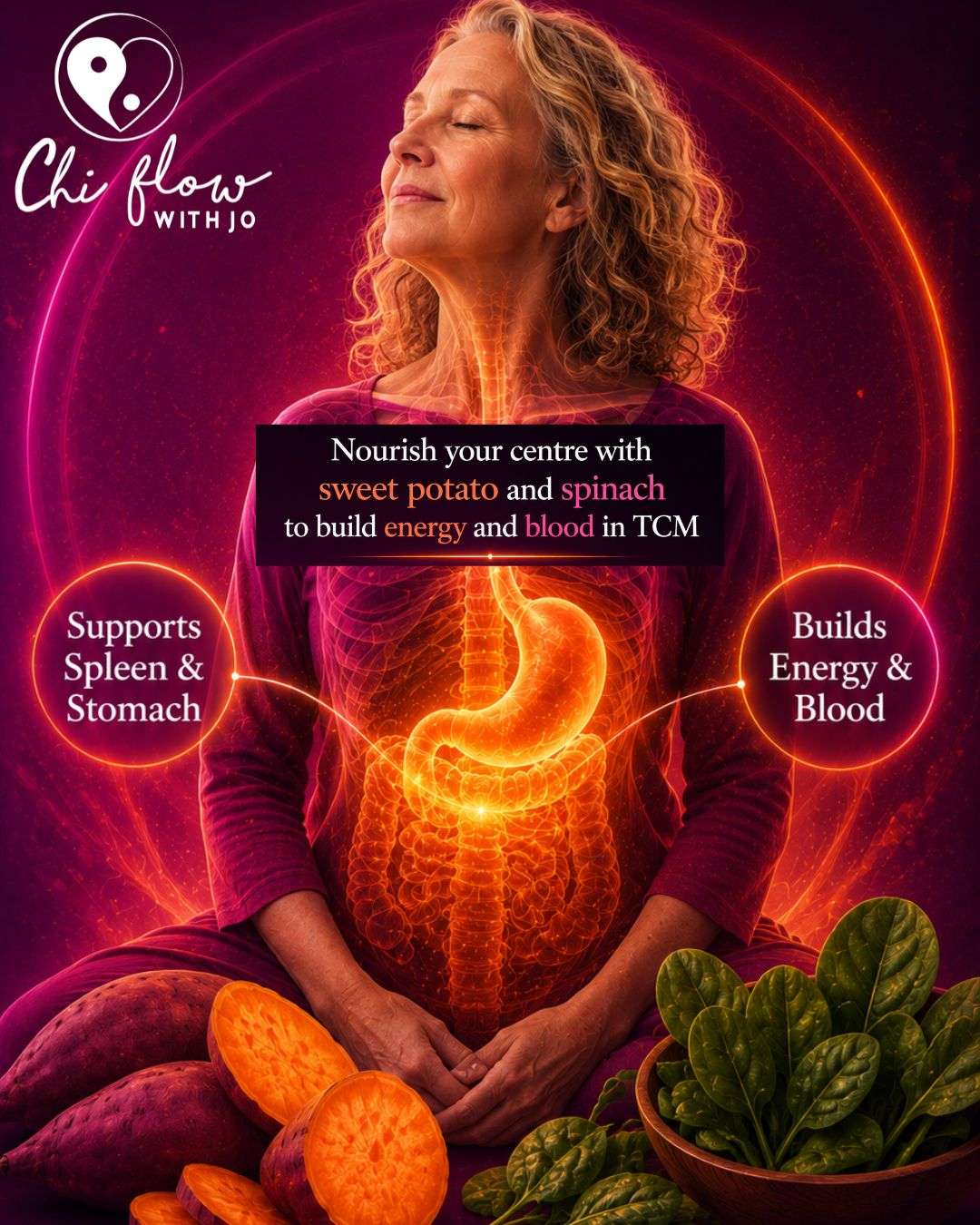
Spinach and Sweet Potato Soup

Why it works

  • Sweet potato supports digestion and energy production
  • Spinach nourishes the blood and tissues
  • Warm, soft food helps the body move out of stress mode.Simple method
    Cook chopped sweet potato in stock until soft, add spinach at the end, blend, and finish with olive oil and a pinch of salt.

If you want to go deeper into how food connects to your body and symptoms, you will find the full Five Element system in my books and if you have Parkinson’s like my husband, Davy, take a look at the dedicated section on food in  Find Your Flow, Live Well with Parkinson’s

Gentle Qi Gong for Alignment and Relief

Watch the movements demonstrated in the full podcast video below

1. Connect Heaven and Earth

This movement gently lengthens the spine and reduces pressure at the base of the skull.

It helps:

  • Ease jaw tension
  • Reduce head pressure
  • Support posture without force

2. Embrace the Tree

This is one of the most powerful ways to feel whole-body alignment.

  • The chest softens / The head lifts gently / The spine lengthens / The weight drops into the feet

Like a tree, strong yet flexible.  This allows the jaw to soften, the neck to decompress, and the back and hips to share the load evenly.

Practice tip
Just 2 to 3 minutes is enough.
Stop before fatigue.
The goal is not effort, it is ease.

“A living being is tender and flexible;  a corpse is hard and stiff.

It is the same with everything; leaves and grasses are tender and delicate, but when they die they become rigid and dry. Those who are hard and inflexible belong to death’s domain; but the gentle and flexible belong to life.”

What Real Alignment Feels Like

Alignment is not about forcing posture.

It is not:  Shoulders back, Chest out, Belly tight

That often increases tension.

Real alignment feels like support with less effort.

  • The head balances over the ribs
  • The ribs soften over the pelvis
  • The pelvis rests over the feet
  • The breath moves freely
  • The jaw lets go

This is where the body begins to feel safe again.

Practise With Me

If this resonates, come and practise with us inside Chi Flow with Jo.

A steady rhythm, simple daily LIVE classes, and a supportive community can help you reconnect with your body without overwhelm.  Because healing does not come from doing more.  It comes from doing the right things, gently, and consistently.

With Chi Flow with Jo, you will get:

  • Weekday live classes
  • Recordings you can follow anytime
  • Q&A support
  • Acupoints, food tips, and guidance
  • A community moving with you

💛 It’s €39/month, reducing to €20 after your first 3 months.

Ready to Start?

Join Chi Flow with Jo and begin restoring your energy, and feeling more like yourself again.

    • Frequently Asked Questions

    • 1. Why do my jaw, neck, back and hips all hurt at the same time?

    • Because the body works as one connected system. When tension builds at the top, especially around the jaw and base of the skull, it creates compensation patterns through the spine, back, and hips.

    • 2. Is it better to stretch or strengthen when I feel tight but weak?
    • Neither aggressively. When the body feels both tight and weak, it is often in a protective state. Gentle acupressure, soft movement, and nourishment help restore balance before stretching or strengthening becomes effective.
    • 3. Can food really help with nerve pain and tension?

    • Yes. In Chinese Medicine, food supports the internal environment of the body. Warm, nourishing foods help build blood, calm the nervous system, and reduce the “tight but weak” feeling by giving the body the resources it needs to relax and repair.

  • When to Seek Medical Support
  • If you are experiencing:
      • High heart rate
      • Persistent head pressure
      • Weakness or nerve symptoms
      • Changes in medication response

      • Please speak with your GP.  These practices work beautifully alongside medical care, not instead of it.

Go Deeper with Our Books

For those wanting to understand how movement, breath, and Chinese Medicine principles, Jo’s books provide practical guidance rooted in lived experience and clinical wisdom.

👉 Buy Five Element Wisdom cookbooks

Explore how to Find Your Flow and Live Well with Parkinson’s.

Movement does not need to be extreme to be powerful.
Small daily expansion reshapes the body.
Steady breath reshapes the nervous system.
Gentle repetition rebuilds confidence.

Every human body carries extraordinary capacity for renewal when given the right rhythm.

If April is asking you to soften into strength, come and practice with us.

Self-administered acupressure or Chinese Medicine is not a substitute for visits to qualified healthcare practitioners.

Knowing how to treat yourself and your loved ones with complimentary therapies like acupressure can be greatly beneficial and convenient. However, for serious and chronic conditions, you’ll want to visit an Shiatsu therapist / Acupuncturist or other qualified healthcare practitioner who can develop a treatment plan based on your unique medical history and combination of symptoms.

The information provided should not be considered medical advice.

Topics: Breathwork, Parkinson’s support, sleep practices, Qi Gong, acupressure.
Inner Guidance On A Stormy Sea

Inner Guidance On A Stormy Sea

The world is beginning to open up, there’s cars on the road, kids in the park, hustle and bustle is back. But where is our place in a new world order?

There’s so much information about how to behave and how to act it can be hard to find what fits for us. It can seem that everybody else is coming out of lockdown, meeting friends, smiling easily and taking everything in their stride and perhaps it doesn’t feel like that for you. Perhaps you feel unsure about this new way of interacting.

Do you embrace friends, Do you have to share a cuppa outside or is having tea together inside ok? Can you stop and talk to strangers, passing the time? Can you go on dates? Mask or no mask? Even though there are written guidelines, how do they apply to your life? Where does lockdown end and normal life begin? I miss smiles with random strangers in supermarkets and on the street. I know the masks are necessary I just feel uncomfortable.

Everybody else seems fine, head down, no contact, keeping distant, getting things done without connecting and heading home. It feels like everyone is getting it right, easily adapting and slotting right into this new way of being. But that’s just a big case of FOMO (Fear Of Missing Out) usually applied to social media, this is where everyone has great kids, tidy house, perfect house and the sun is always shining.

However, that’s never how it is. The truth is everyone is finding their own way. So how can we use Chinese Medicine to help rediscover our internal compass?

Don’t multi-task: Doing too many things at once can mean we become overwhelmed and lose sight of our purpose. The ultimate goal is to be happy and at peace. By taking things slowly we can experience our feelings. Are we at peace and happy or are we ticking off a to-do list that we “think” will make us happy? You have to enjoy the journey not just the destination. So slow down, don’t bite off more than you can chew, you will become irritable and tense, scattered and exhausted.

Touch is often overlooked as a way to feel well but it can simultaneously ease pain, lessen anxiety, promote healing and help you to take the obstacles in life in your stride.

Try this point to calm the mind and release tension.

GOVERNING VESSEL 24.5 – Yin Tang point

This point is often instinctively massaged by people to relieve headaches and eyestrain.

In my book Good Food: Better Sex I use this point for regulating the endocrine system but it can also be used for any facial pain, including those related to sinus congestion.

Find in the midline of the body between the eyebrows.

Close your eyes, rotating and pressing into the area for 30 seconds every day.

Combine it with rubbing your checks and massaging your jaw to release tension in the whole area, relaxing the neck, shoulders, upper chest and clearing the mind.

Slow Food Down: In Traditional Chinese Medicine excessive worry and insecurity is the emotion of the spleen and the stomach, these organs are associated with the earth element.

So eating foods that support these organs such as whole grains, root vegetables, fennel, butternut squash, carrots, parsnips, pumpkin, sweet potato and peas, will help the body navigate the specific emotions that arise.

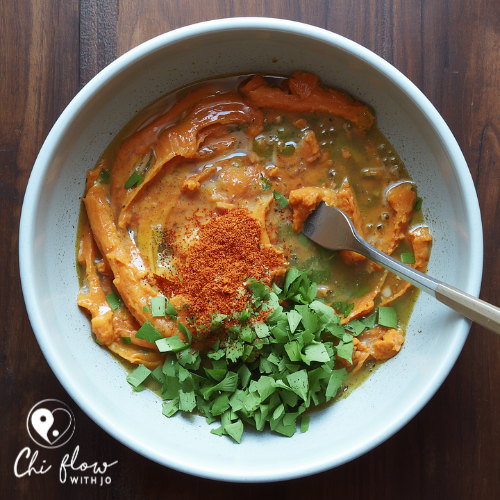
Try a new twist on carrots by cooking 500g in boiling salted water until soft, then mashing them with a fork and mixing in the following ingredients:

1 tsp cumin powder
1 tsp. salt
Juice of 1 lemon
2 tbsp. olive oil
1 tsp. ground black pepper

Aesel to sad sing to arize handfuls of baby spinach leaves to the hot, mashed carrots so that it wits before serving The stomach and spleen don’tlike raw food so even wilting spinach means tis softer on the stomach for digestion.

The grass is rarely greener when we jump the fence so it’s healthier for the mind and body to find things we enjoy right here, right now. Even if we are uncomfortable in this new world, find things that you are thankful for will help. Keep a list, on the fridge, on the table, or even make a gratitude jar, adding at least five things to it every day.

Maybe its that you have food in your fridge, air to breathe, fingers to feel, or a tongue to taste, there is always something to feel grateful for. Be easy on yourself, take time for things to unfold and know that everyone is navigating the same sea just in different boats.

For more information on Shiatsu Conscious Cooking and to buy the books full of recipes, tips and Chinese Medicine visithttps://shop.joannefaulkner.ie/#books

Follow @joannefaulknerShiatsu on Facebook 

Join Us and Try a Free Class


We offer a free class at the end of the month so you can try Chi Flow before you join.

Membership is only €39 per month, with over 20 classes included each month.
After three months, your subscription halves to €20, making it the most affordable Parkinson’s-friendly Qi Gong programme available online.

You are warmly welcome to practise with us and discover your own flow.


💗 Ready to Join?

Click here to become a member of Chi Flow with Jo → CLICK HERE

Or drop in for a class and feel it for yourself (sign up below). Join the Chi Flow with Jo community for live sessions, practice, and support.

You don’t need to have it all worked out.
You just need something gentle to lean into, one day at a time.

Self-administered acupressure or Chinese Medicine is not a substitute for visits to qualified healthcare practitioners.

Knowing how to treat yourself and your loved ones with complimentary therapies like acupressure can be greatly beneficial and convenient. However, for serious and chronic conditions, you’ll want to visit an Shiatsu therapist / Acupuncturist or other qualified healthcare practitioner who can develop a treatment plan based on your unique medical history and combination of symptoms.

The information provided should not be considered medical advice.

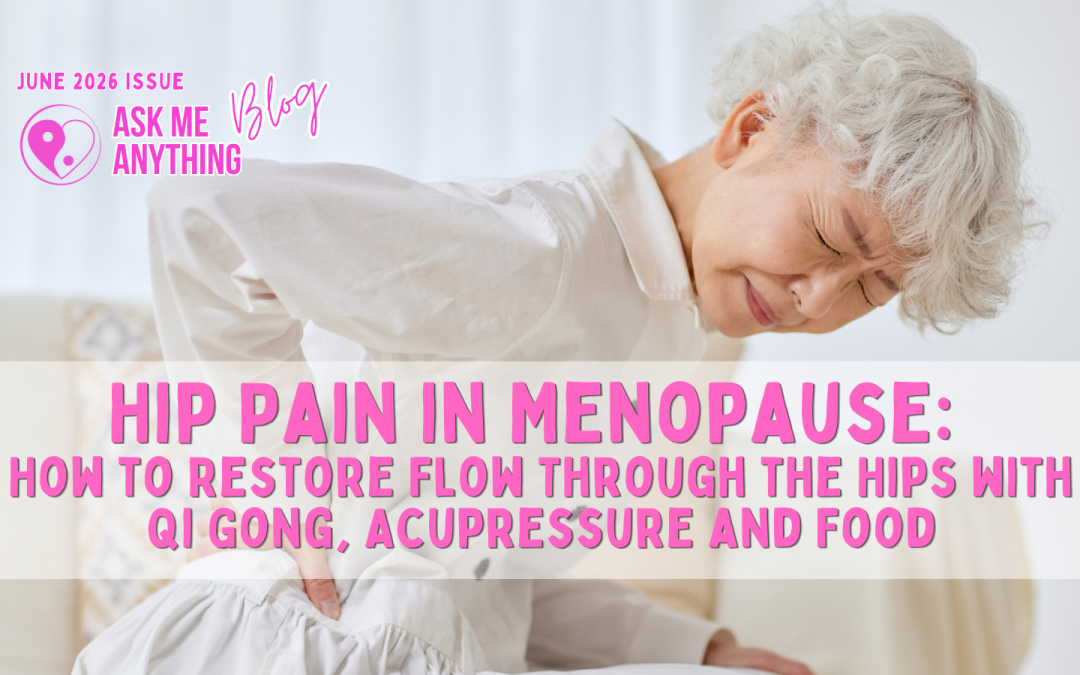
HIP PAIN IN MENOPAUSE

HIP PAIN IN MENOPAUSE

How to Restore Flow Through the Hips with Qi Gong, Acupressure and Food:

Hip pain is often the body whispering that something in the centre of us has stopped moving.

Many women notice new aches appearing around the hips during midlife. Sometimes it begins after lifting something heavy or caring for children. Other times it appears gradually and doesn’t seem to go away.

In this article we explore:

  • Why hip pain can increase during menopause
  • The connection between hormones, the liver and joint health
  • How fascia and the nervous system affect hip tightness
  • Two powerful acupressure points for restoring flow
  • A simple Qi Gong movement to open the hips
  • A food that supports liver function and circulation

These approaches combine Chinese medicine, modern fascia science, and gentle Qi Gong movement to help the body return to balance.

Why Hip Pain Often Appears During Menopause

In Western medicine we are increasingly hearing about the relationship between hormonal changes and connective tissue health.

During menopause, oestrogen levels decline. Oestrogen helps regulate collagen production and tissue elasticity, so when levels drop the body can experience:

  • tendon stiffness
  • joint pain
  • reduced tissue repair
  • inflammation

At the same time, the liver plays a key role in metabolising hormones. If liver function becomes sluggish, hormones may not be processed efficiently, which can influence circulation, inflammation and tissue health.

The result can be stiffness and discomfort in areas such as the hips, shoulders and lower back.

The Chinese Medicine View: The Liver Controls the Tendons

Chinese medicine has described this connection for thousands of years.

In Traditional Chinese Medicine, the Liver system governs the smooth flow of Qi (energy) and Blood throughout the body, particularly through the tendons and joints.

When Liver energy flows smoothly:

  • joints feel flexible

  • muscles move freely

  • circulation is strong

But when Liver Qi becomes stagnant:

  • muscles tighten

  • tendons lose elasticity

  • pain and stiffness appear

The hips are especially important because several major energy pathways pass through them. When the Liver system becomes sluggish, the hips often become one of the first places we feel restriction.

Fascia, Stress and Why Tight Hips Need Safety to Release

Modern research into fascia is beginning to confirm something Chinese medicine has long understood.

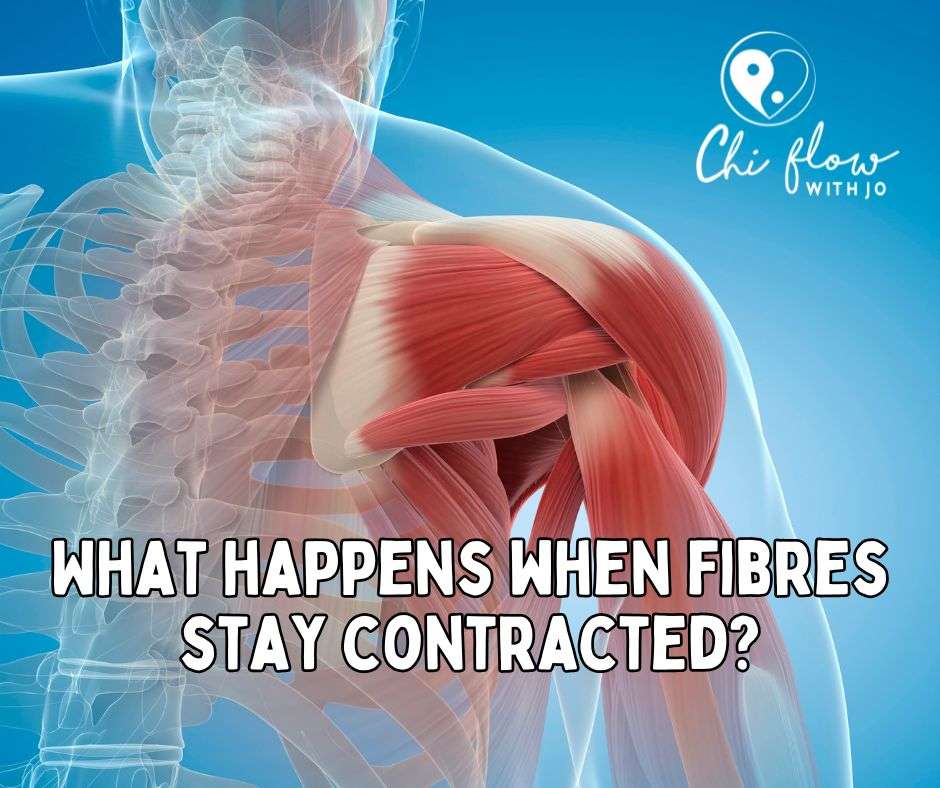
Fascia is the connective tissue web that wraps around muscles and organs throughout the body. When fascia is weak, overstretched or overloaded, it tightens as a protective response.

This can happen when:

  • lifting or carrying heavy loads
  • repetitive movements
  • long periods of fear or stress
  • Lack of movement


  • But fascia does not release when stretched or forced, as ligaments, tendons and muscles can.

    It releases when the nervous system feels safe.

    This is why gentle practices like Qi Gong are so effective. Slow, rhythmic movement combined with relaxed breathing sends signals of safety to the nervous system. Once the body feels safe, the fascia can soften and lengthen again.

Acupressure Point: Liver 3 for Hip Pain and Stagnation

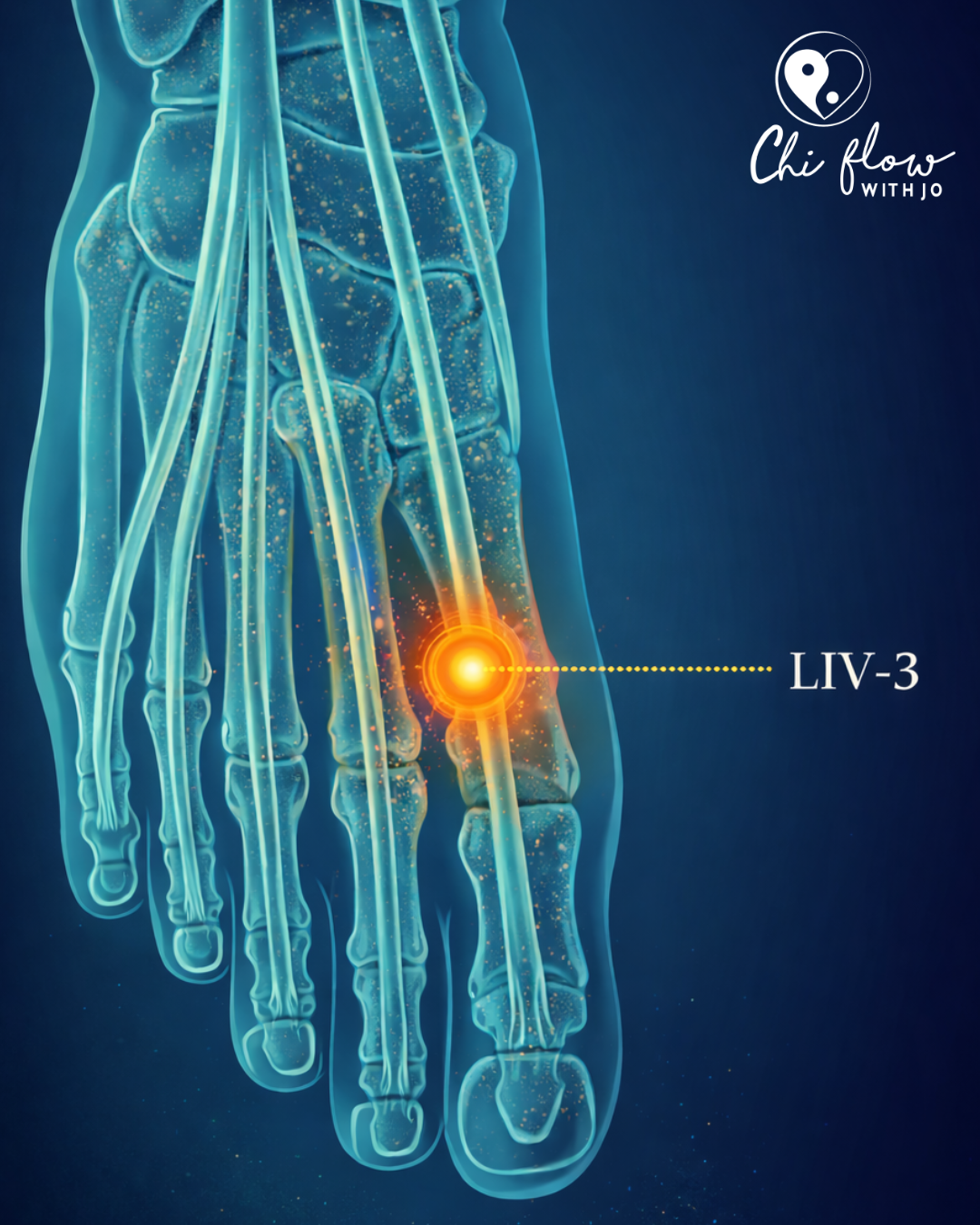
One of the most effective acupressure points for releasing stagnation in the hips is Liver 3 (Taichong).

How to find Liver 3

  1. Look at the top of the foot.
  2. Find the space between the big toe and second toe.
  3. Slide your finger up about an inch from the webbing until you feel a small dip between the bones.

How to use it

Press gently with your thumb until you feel a mild dull ache.

Hold the point while breathing slowly for 1–3 minutes.

This point is widely used in Chinese medicine to:

  • move stagnant Liver Qi

  • improve circulation to the legs and hips

  • reduce tension in the tendons

When this pathway begins to flow again, tightness through the hips often eases.

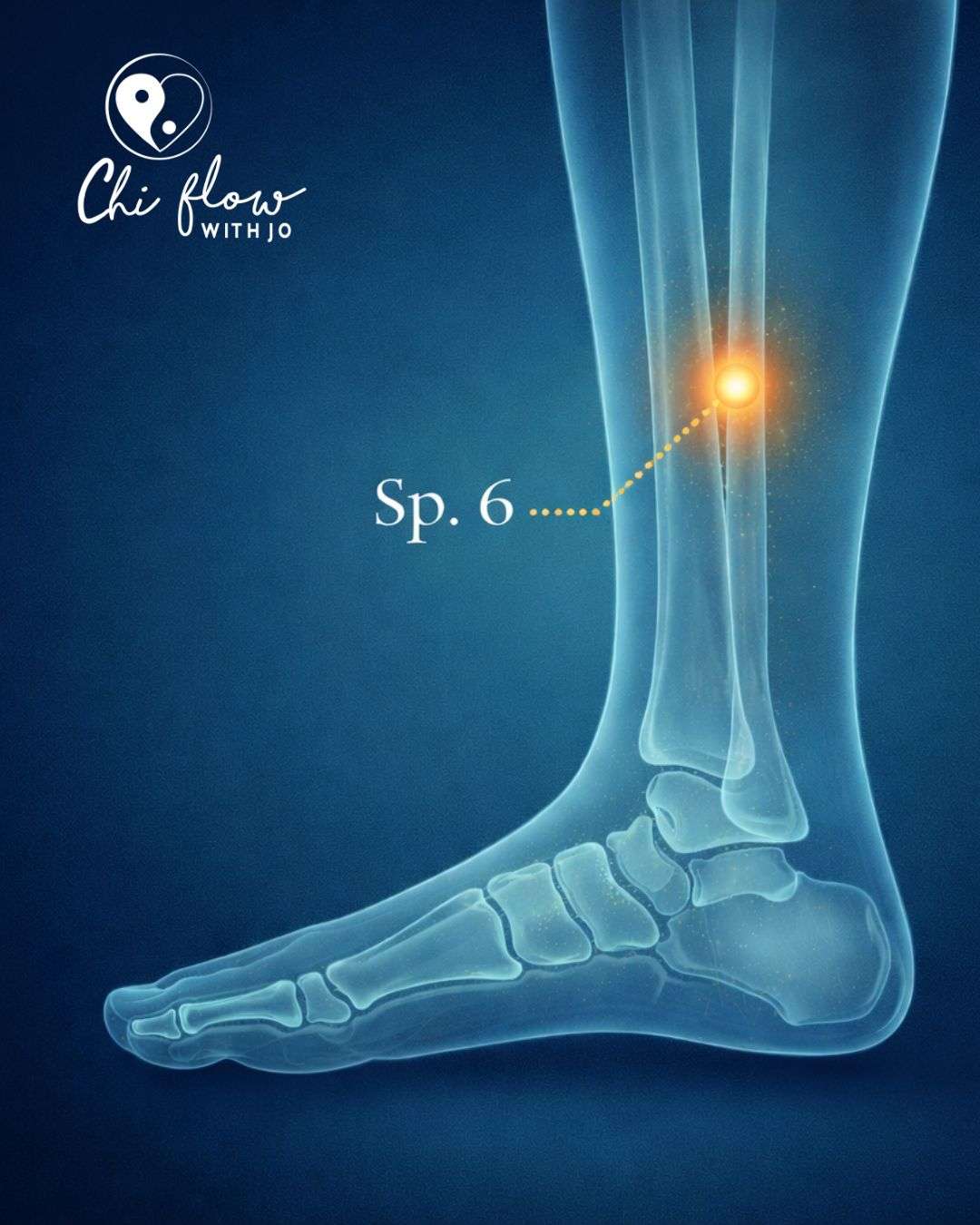
Acupressure Point: Spleen 6 to Increase Blood Flow in the Lower Abdomen

Another powerful point is Spleen 6 (Sanyinjiao).

How to find Spleen 6
Locate the inner ankle bone. 
Measure four finger widths up the leg.
Just behind the shin bone you will find a tender point.

How to use it:
Press gently for about one minute while breathing slowly.
Spleen 6 influences three major energy systems:

  • Liver
  • Spleen
  • Kidney

This point helps increase the movement of blood and energy through the lower abdomen and pelvis, nourishing the hips and lower body.

Because it strongly activates blood flow in the lower abdomen, Spleen 6 should not be used during pregnancy.

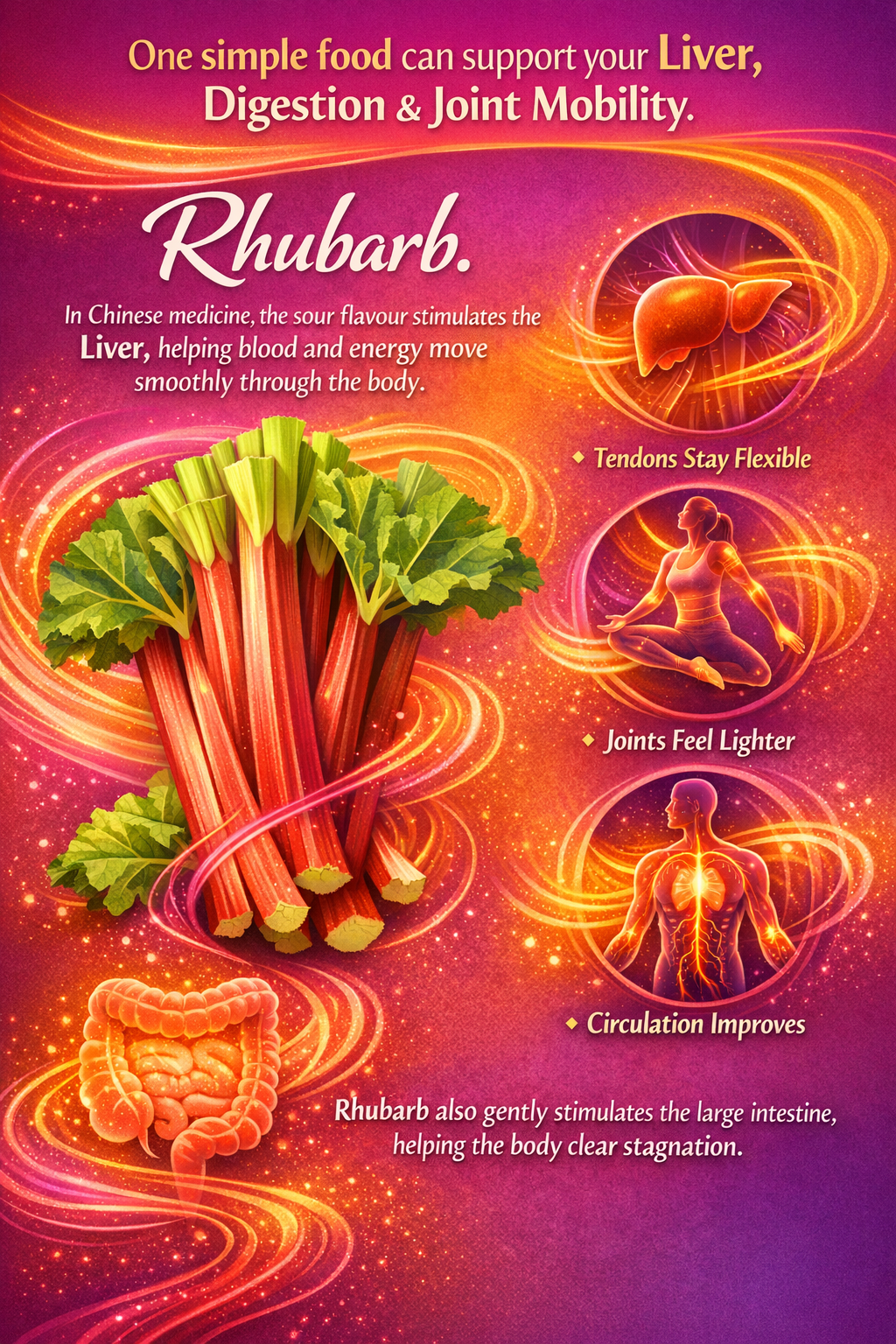
A Seasonal Food That Supports Liver Function: Rhubarb

Food can also help restore flow in the body.

In Chinese medicine the sour flavour stimulates the Liver, encouraging blood and energy to move more smoothly.

Rhubarb is a wonderful seasonal food for this purpose.

Benefits of rhubarb include:

  • supporting liver function
  • encouraging healthy elimination through the large intestine
  • reducing stagnation in the body

Simple Stewed Rhubarb Recipe

  1. Chop several stalks of rhubarb.
  2. Place in a saucepan with a small amount of water.
  3. Simmer gently until soft.
  4. Add a slice of apple if you like a little sweetness.

A small bowl a few times per week can gently support the Liver and digestion.

When digestion flows well, joints often feel lighter and more flexible.

Qi Gong for Hip Mobility: Opening the Kua

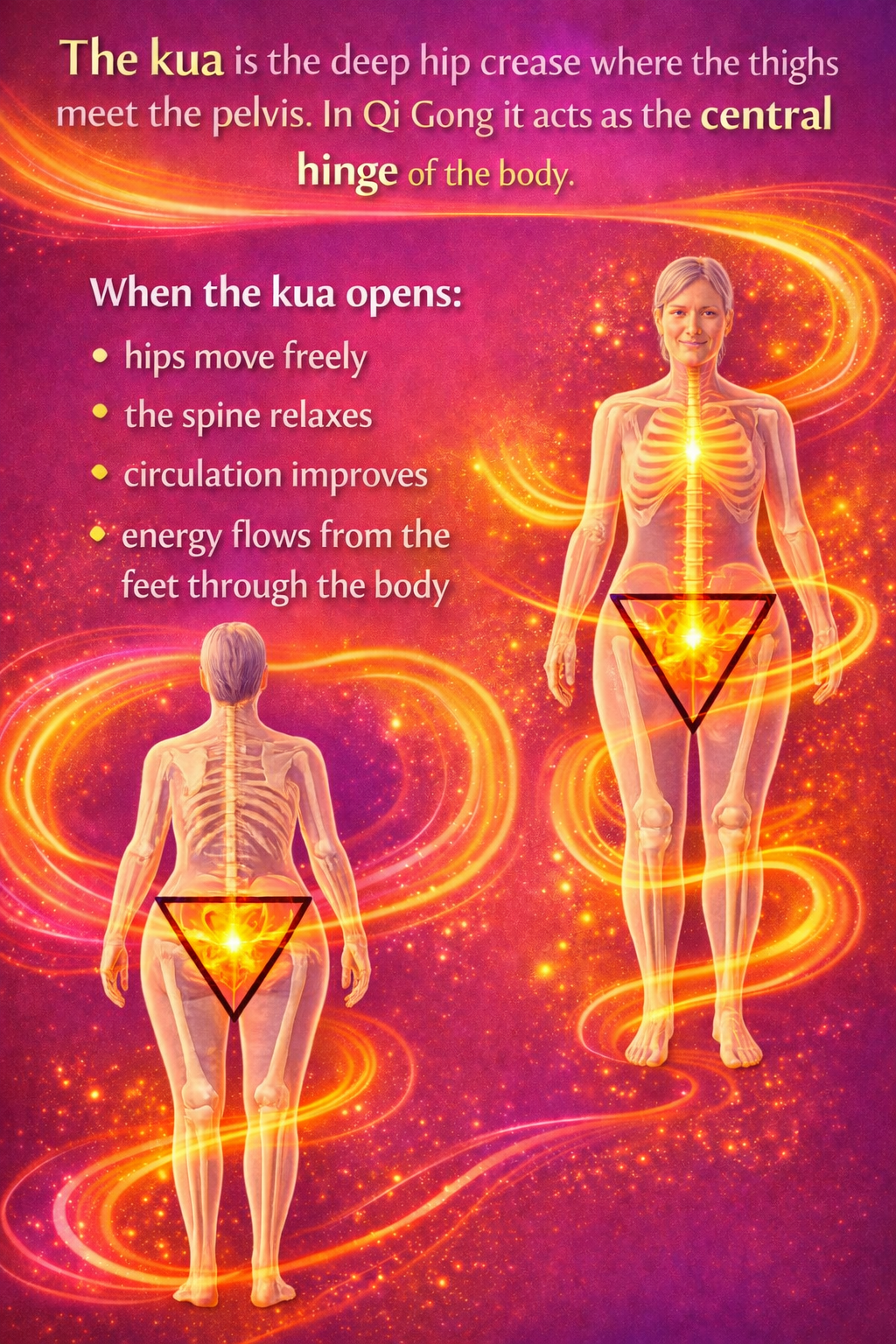
In Qi Gong we often talk about opening the kua.

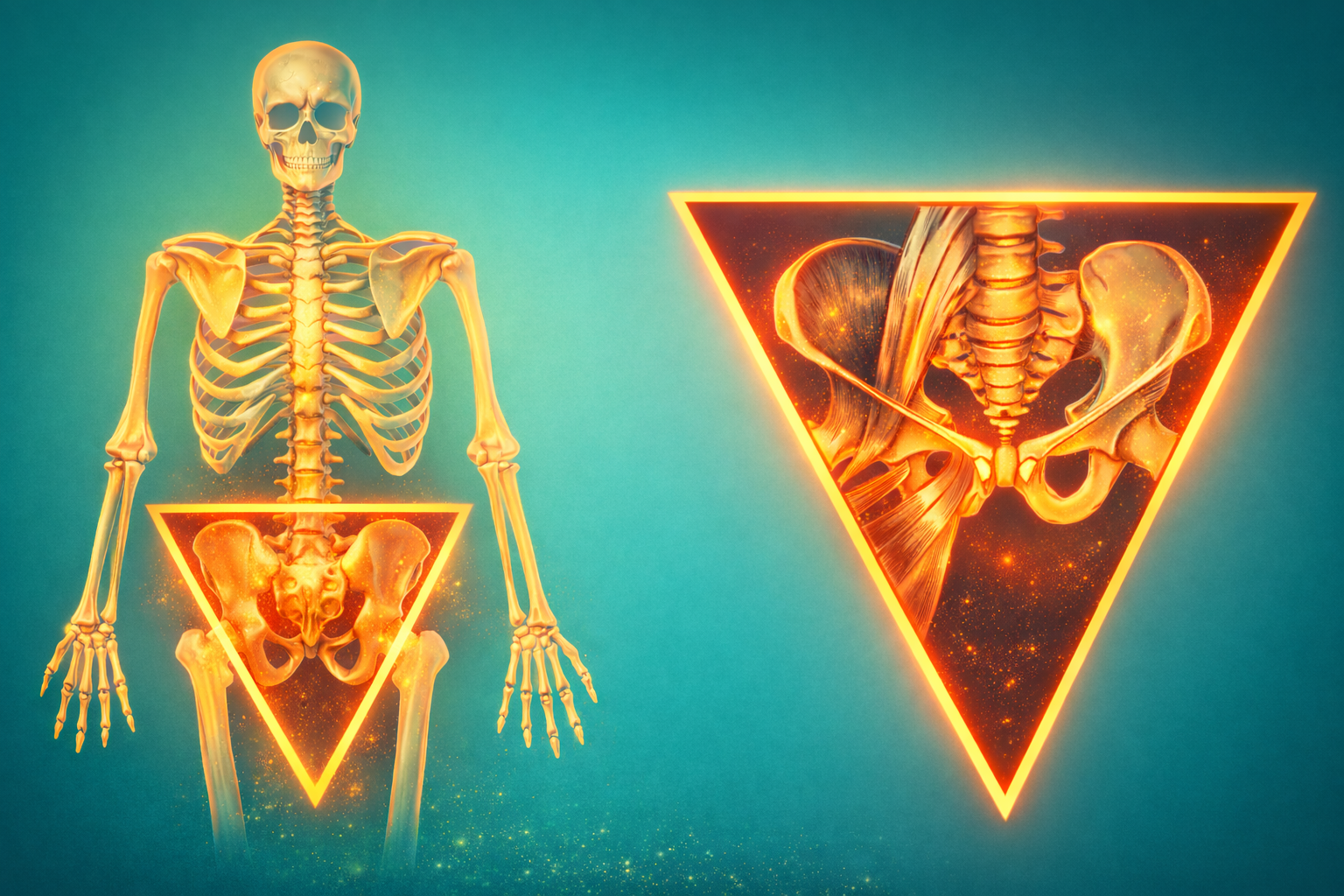
The kua refers to the deep hip crease where the thighs meet the pelvis. It encompasses the surrounding musculature, including the iliopsoas (hip flexors), adductor muscles (inner thigh), and the pelvic floor. It acts as the central hinge of the body, allowing movement to travel between the upper and lower body.

When the kua moves freely:

  • the hips open naturally 
  • walking becomes smoother 
  • the spine and legs coordinate better
  • Qi flows from the feet into the body

Interestingly, the inguinal crease also contains one of the highest concentrations of lymph nodes in the body, so opening the kua can help support lymphatic circulation.

How to Practise the Kua Opening Movement

  1. Stand with your feet wider than shoulder width.
  2. Bend the knees gently and settle into a relaxed horse stance.
  3. Keep the spine upright and the crown of the head lifting lightly upward.
  4. Allow the shoulders to relax.

Now bring awareness to the hip crease.
Turn one foot slightly outward.

As the foot turns outward, allow the waist and hips to rotate gently in the opposite direction.

This creates a spiral through the hips.
You may feel one hip crease opening while the other softly closes.
Return to centre and repeat on the other side.
Continue slowly from side to side.

Three key cues

  • Keep the knees soft so the hips can release.
  • Let the waist guide the movement rather than the shoulders.
  • Move slowly enough to feel the hip crease opening and closing.

Just one or two minutes of this gentle turning can release significant tension through the hips and pelvis.

Over time it helps:

  • soften fascia
  • improve pelvic circulation
  • increase Qi flow in the lower dantien

When Movement Isn’t Enough: Releasing Tension Through Safe Touch

Sometimes hips feel extremely tight or guarded.

This can happen because the pelvis often stores emotional memory and protective tension.

In these cases, gentle physical touch can help the nervous system relax.

Some people find practices such as yoni massage or pelvic self-massage helpful. This involves bringing respectful, loving touch to the lower abdomen and pelvic area.

Safe physical touch can:

  • reduce shame held in the pelvis
  • calm the nervous system
  • release stored tension or trauma

The goal is not forcing change but allowing the body to feel safe enough to soften.

A Simple Weekly Routine for Hip Pain Relief

Try this gentle routine for one week:

  • Press Liver 3 once daily on each foot
  • Press Spleen 6 for one minute on each leg
  • Eat stewed rhubarb a few times during the week
  • Practise kua opening Qi Gong for a few minutes daily

Small daily signals like these can gradually restore circulation and ease hip stiffness.

When to Seek Medical Advice

If hip pain:

  • worsens significantly
  • spreads down the leg
  • wakes you at night
  • causes difficulty walking

you should consult your GP or physiotherapist to rule out structural issues.

Restore Flow and Ease Through the Hips

Many cases of hip pain are not simply mechanical problems. They reflect stagnation in circulation, fascia tension, and nervous system protection.

When we nourish the liver, move gently, and help the body feel safe, the hips often begin to soften naturally.

As I often say:

When the liver flows, the hips follow.

If you’d like to learn more gentle practices like this, you can join the Chi Flow membership, where we practise Qi Gong movements for mobility, energy and longevity together each week.

Sometimes the biggest healing begins when the body finally feels safe enough to soften.

Join the Free Class

If you are curious about Qi Gong for Parkinson’s, chronic illness, fatigue, or healthy ageing, you are warmly invited to try a free class.

You do not need experience. You do not need flexibility. You simply begin where you are.

👉 Join the Free Class and experience the Eight Brocades for yourself.

Continue the Journey

If you would like ongoing support, Chi Flow with Jo offers:

  • Weekday live classes
  • Full Eight Brocades training
  • Acupressure guidance
  • Food medicine insights
  • Monthly health talks
  • Community gatherings

It is €39 per month, reducing to €20 per month after three months. Just €1 per class.

👉 Join Chi Flow with Jo HERE.

Self-administered acupressure or Chinese Medicine is not a substitute for visits to qualified healthcare practitioners.

Knowing how to treat yourself and your loved ones with complimentary therapies like acupressure can be greatly beneficial and convenient. However, for serious and chronic conditions, you’ll want to visit an Shiatsu therapist / Acupuncturist or other qualified healthcare practitioner who can develop a treatment plan based on your unique medical history and combination of symptoms.  

The information provided should not be considered medical advice.

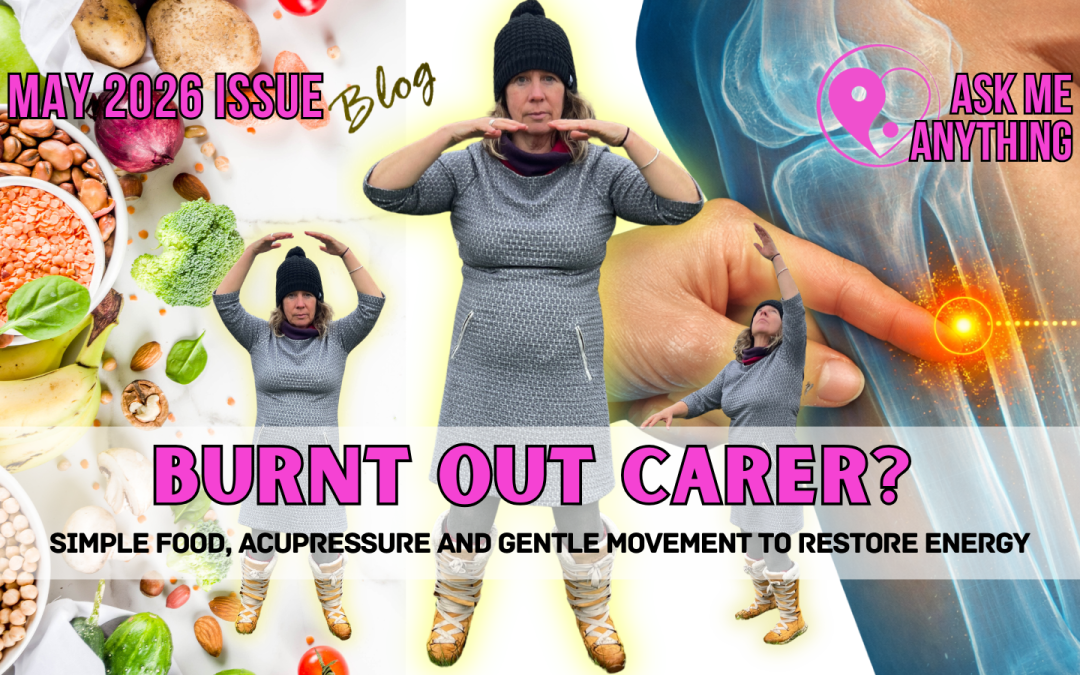
Burnt Out Carer? Simple Food, Acupressure and Gentle Movement to Restore Energy

Burnt Out Carer? Simple Food, Acupressure and Gentle Movement to Restore Energy

Caring for someone you love can be one of the most meaningful roles in life. It can also be one of the most exhausting.

Many carers quietly carry physical pain, emotional stress and constant responsibility while trying to support a partner, parent or family member. Over time this can lead to caregiver burnout, where the body and mind simply run out of energy.

Recently I received a deeply moving question on the Ask Me Anything podcast.

“I have a fused spine, cervicogenic headaches, neuropathy and mild cauda equina syndrome and PTSD. But I’m living with my 91 year old Dad who has an inoperable gallstone, vascular dementia and now his prostate cancer has spread. So I’m looking for dietary advice for us both and exercise advice primarily for me but him too. Please help a burnt out carer.”

This question will resonate with many people caring for elderly parents or loved ones with chronic illness. When you are constantly caring for someone else, your own health can quietly move to the bottom of the list.

In Chinese medicine we look at this through the lens of energy flow.

When life becomes overwhelming the body’s energy slows down. Muscles tighten. Sleep becomes lighter. Pain becomes more noticeable. Over time the deeper reserves that support resilience become depleted.

The goal is not to fix everything at once. The goal is to gently restore movement, nourishment and calm to the body so energy can begin flowing again.

Below are three simple practices that can help support carers who are feeling exhausted or overwhelmed.

A Gentle Acupressure Point for Stiffness and Tension

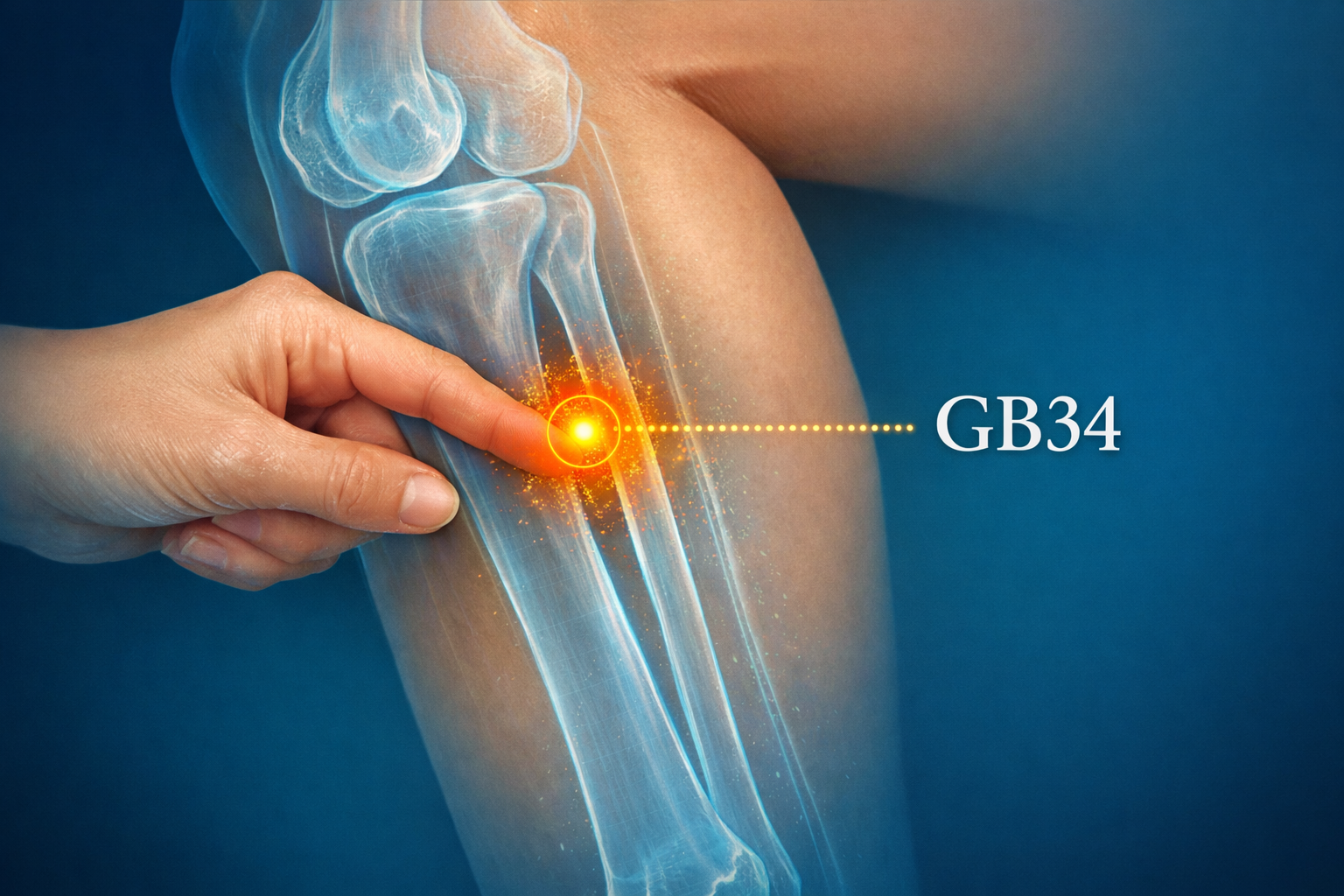
One helpful point is Gall Bladder 34 (GB34).

This acupressure point is traditionally used to support the muscles and tendons of the body and can help when stiffness builds up from stress or overwork.

You will find it on the outside of the lower leg just below the knee.

Run your hand down the outside of your thigh and stop just below the knee joint. Slightly forward of the small bone on the outside of the leg you will feel a soft dip. This is GB34.


Using your thumb, apply gentle steady pressure until you feel a comfortable ache. Hold for about one to two minutes on each side while breathing slowly.

The pressure should feel soothing rather than painful.

Doing this once a day can help the body soften and restore circulation through the muscles and joints.

Many people notice their legs, hips and back begin to feel slightly freer over time.

A Simple Nourishing Food For Enery and Nerves 

When someone is exhausted from caring responsibilities, food should be warm, simple and nourishing.

One of the most supportive foods in this situation is bone broth.

In traditional Chinese medicine the bones and nervous system are linked to the Kidney system, which supports deep reserves of energy and resilience.

Bone broth provides minerals and nutrients that support the joints, nerves and immune system. It is also gentle on digestion, which is important when someone is under long term stress.

A simple way to make it is to simmer chicken bones or beef bones in water with a slice of ginger and a splash of apple cider vinegar for several hours.

The broth can then be stored in the fridge and enjoyed as a warm drink or used as the base for soups.

Even one small cup a day can provide nourishing support for both carers and elderly family members.

A Gentle Qi Gong Movement To Release Tension

When the body feels overwhelmed, the best exercise is often simple rhythmic movement rather than intense workouts.

A traditional Qi Gong practice called arm swinging (Ping Shuai) is particularly helpful for restoring circulation and relaxing the nervous system.

Stand with your feet about shoulder width apart.

Let your knees soften slightly and allow your arms to hang loosely by your sides.

Begin gently swinging your arms forward and back like pendulums.

Keep three things in mind:

Relax your jaw
Let your shoulders stay loose
Keep your knees soft

Start with two minutes and gradually increase to five minutes if it feels comfortable.

This gentle movement helps circulate energy through the body, warm the hands and relax the neck and shoulders.

For elderly people or those with limited mobility, a gentle seated version can also be calming.

Small Daily Practices for Burnt Out Carers

Caregiver burnout often develops slowly. The body adapts to long periods of stress until eventually it feels depleted.

Small daily practices can help restore balance over time.

Try creating a simple daily rhythm:

Press the GB34 acupressure point for a minute on each leg
Enjoy a warm cup of bone broth or nourishing soup
Spend two to five minutes doing gentle arm swinging

These small actions send a powerful signal to the nervous system that it is safe to soften and recover.

Support for Carers

If symptoms worsen, spread, begin waking you at night, or if medications change, it is always important to check in with your GP.

Supportive practices like acupressure, nourishing food and gentle movement work best alongside professional medical care.

If you are caring for a loved one while trying to maintain your own health, you are very welcome inside our Chi Flow community, where we practise gentle Qi Gong, breathwork and acupressure together each month.

Sometimes the smallest practices can make the biggest difference when energy begins to return.

What helps caregiver burnout naturally?

Gentle movement, nourishing warm foods, stress reduction and simple acupressure techniques can help support energy levels and reduce tension in the body. You can check  acupressure resources in our new book Find Your Flow: Live Well With Parkinson’s.

What exercise is best for carers with chronic pain?

Low impact movements such as Qi Gong, walking and gentle stretching are often more supportive than intense exercise when the body is under long term stress.

What foods help restore energy when exhausted?

Warm nourishing foods such as soups, bone broth, stews and mineral rich vegetables can help support the body when energy is depleted.

Join the Free Class

If you are curious about Qi Gong for Parkinson’s, chronic illness, fatigue, or healthy ageing, you are warmly invited to try a free class.

You do not need experience. You do not need flexibility. You simply begin where you are.

👉 Join the Free Class and experience the Eight Brocades for yourself.

Continue the Journey

If you would like ongoing support, Chi Flow with Jo offers:

  • Weekday live classes
  • Full Eight Brocades training
  • Acupressure guidance
  • Food medicine insights
  • Monthly health talks
  • Community gatherings

It is €39 per month, reducing to €20 per month after three months. Just €1 per class.

👉 Join Chi Flow with Jo HERE.

Self-administered acupressure or Chinese Medicine is not a substitute for visits to qualified healthcare practitioners.

Knowing how to treat yourself and your loved ones with complimentary therapies like acupressure can be greatly beneficial and convenient. However, for serious and chronic conditions, you’ll want to visit an Shiatsu therapist / Acupuncturist or other qualified healthcare practitioner who can develop a treatment plan based on your unique medical history and combination of symptoms.  

The information provided should not be considered medical advice.

Food Medicine for Parkinsons

Food Medicine for Parkinsons

For the month of May, in Chi Flow with Jo we are going to be covering Qi Gong, Acupressure and Chinese Medicine that can help you manage Parkinson’s or caring for someone with Parkinson’s. At present there’s no known cure for Parkinson’s and there’s no pinpoint diagnosis that they can give as to why Parkinson’s occurs. 

What we’re going to do in Chi Flow with Jo is give you Qigong, acupressure and food medicine to help alleviate some of the symptoms and find ease in your body.  (find list of foods at the end of this blog and more in my five element cookbooks)  

Plus read to the end and receive the free mini ebook dedicated to living well with Parkinsons.

My husband, Davy was diagnosed with Parkinson’s nine years ago; as a Qi Gong teacher and Chinese Medicine Practitioner, he and I work together so that he sleeps well, maintains flexibility, balance and strength plus working on the emotional aspects that are not so visible. 

He practices Qi Gong every day in Chi Flow with Jo which helps him live with ease, confidence and flow, physically and emotionally.

As his partner, I find strength and support in having my own practice, which strengthens loving compassionate kindness, knowing my limits and how to stay healthy.

From a Chinese medicine point of view, Parkinson’s, stroke, and other neurological disorders such as dizziness, vertigo, bell’s palsy, and uncontrollable spasms would be a symptom of invading wind. 

Western medicine is not familiar with climates such as wind and dampness affecting the body but TCM is a holistic medicine. It considers the human body and how it interacts with its environment as a whole. Diseases are attributed to an imbalance between the five different elements found in nature and in the body. 

In Taoism and Chinese Medicine our life force energy is made manifest in this particular body for this particular lifetime. We are no different to a tree or a blade of grass.  Same life force energy, just different collection of cells and therefore manifestation.  To promote flow and even flow of energy we can use this life force energy when working with the body.

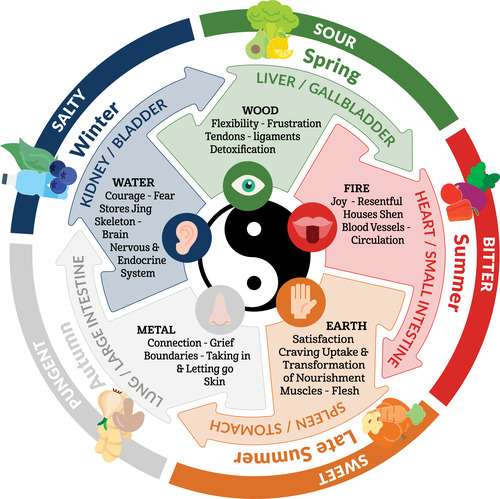
The term ‘climate’ in traditional Chinese medicine (TCM), refers to internal and external agents that can cause disease.  Each of these climatic forces has a specific action on the body, depending upon their characteristics. Balance and harmony of these climates means good emotional and physical health. 

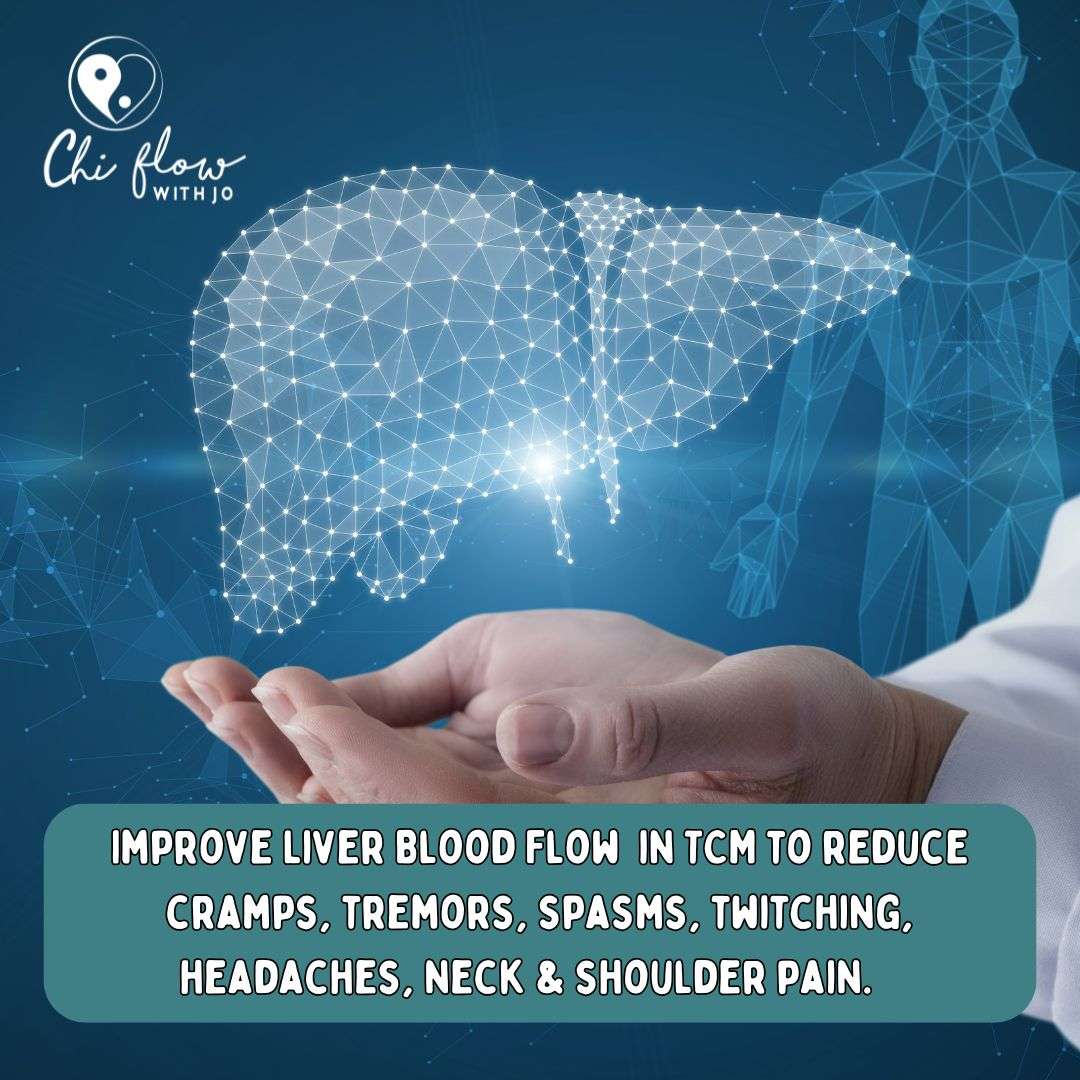
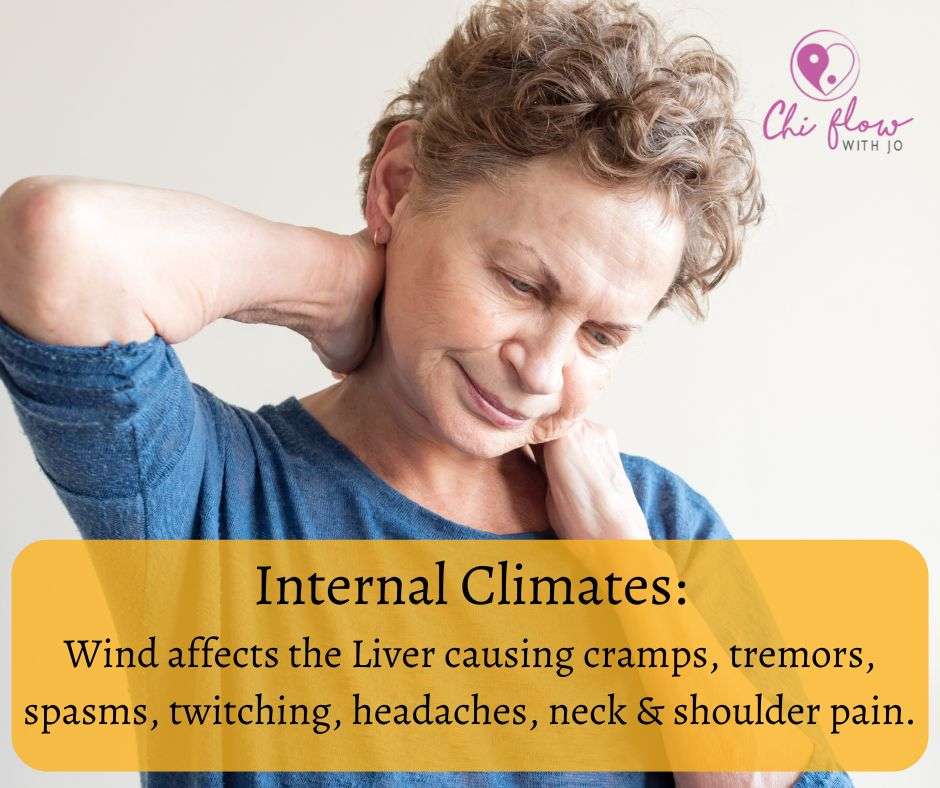
Wind affects the Liver often working with the other internal climates to invade the body, moving energy, pathogens and symptoms erratically causing tremors, spasms and twitching. 

Cold affects the Kidney creating contraction, obstructions and slow movement of Chi causing cramps and sharp pain. 

Heat affects the Heart causing erratic movement of Chi and often associated with inflammation, redness of skin, irritability and inability for the Shen/Spirit to settle. 

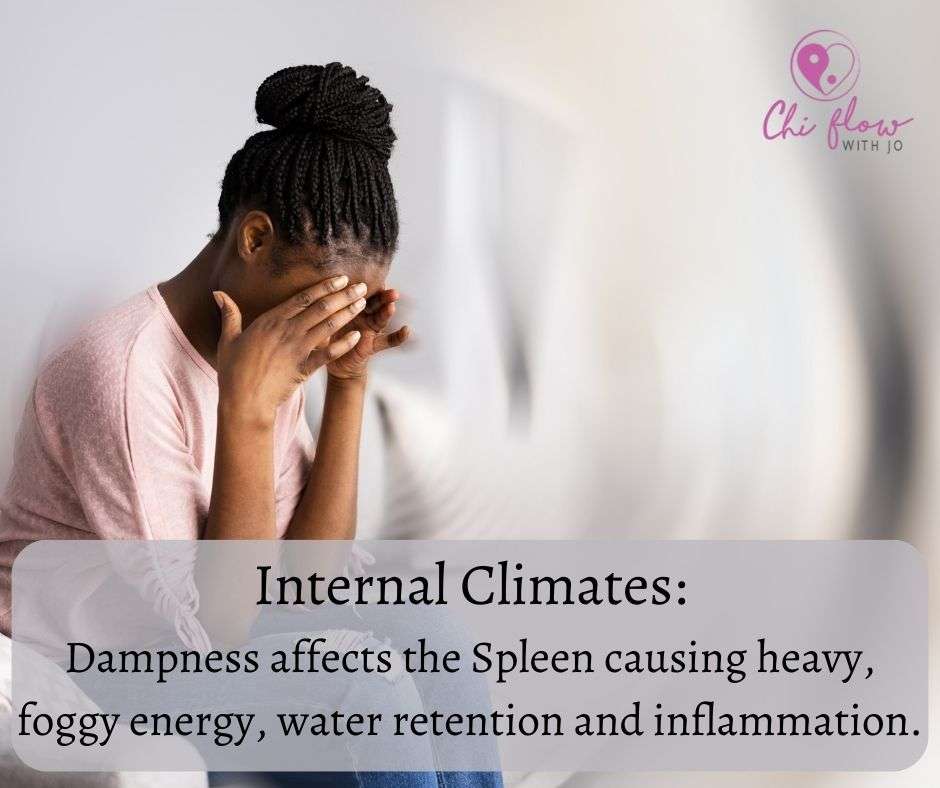
Dampness affects the Spleen causing heavy and foggy energy, generating sticky secretions and protracted, dense pain especially in the middle and lower burner, inability to transform and transport food into energy. 

Dryness affects the Lung causing dehydration and scant body fluids especially in the mucous membranes of the body including lungs, nasal cavities, digestive tract, skin, hair and nails.

Wind can bring great chaos to the body.  Symptoms come and go without warning.

If you have ever been out on a very windy day you will know it can be difficult to think straight.  Wind moves and shakes things that should be still. It produces change and acceleration in what otherwise should be steady and slow. 

With wind, things appear and disappear quickly. It causes tremors and spasms. You can’t control the muscles; the sinews contract leading to cramps and tightness and that can give you kind of vertigo. Any kind of dizziness and headaches and even a stiff neck are also included in the symptoms of wind. 

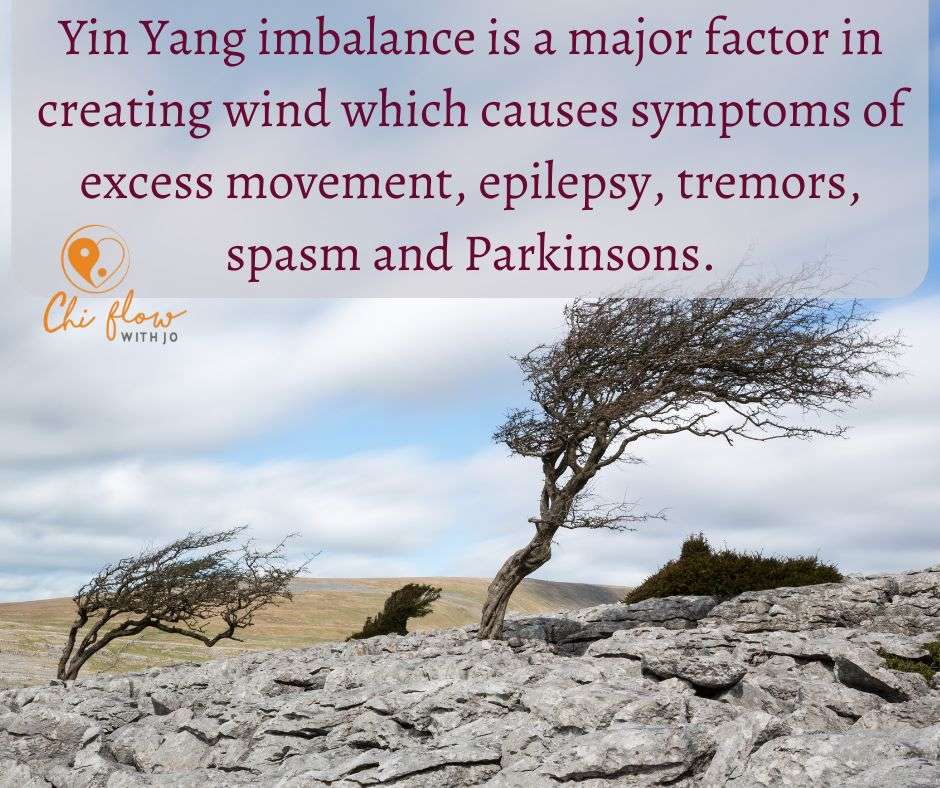
Wind is an exhilarating force.  It shows us how unpredictable and unstoppable nature can be.  You can’t trap wind in a box; it will have its flow and move where it wishes.  However, only when the Yin Yang balance is weak can this pernicious force enter and cause damage to the body.

In terms of Chinese Medicine we can translate this as a yin deficiency/weakness causes a rise in excess yang.

Yang is hot and active whereas Yin is cool and calm.  This imbalance is a major factor in creating internal wind which causes symptoms of excess movement, epilepsy, tremors, spasm and Parkinson’s.

So how can we calm this crazy demon wind?  Firstly by strengthening the YIN in the body.  Blood is a YIN FLUID nourishing, cooling and calming. 

In TCM we not only focus on the functions and cellular make up of blood but the very quality of blood itself which cool and nourishes all the organs.  

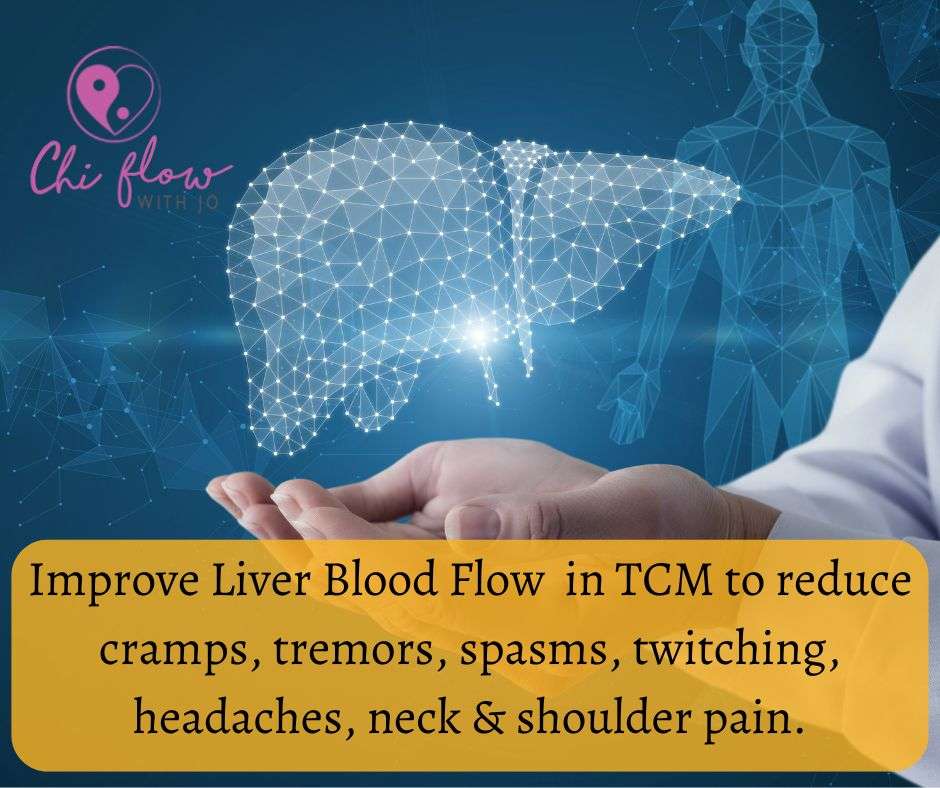
In Chinese Medicine the function of the Liver is to nourish, purify and stores the blood. It also enhances  Qi/chi(energy) which moves the blood smoothly around the body. 

THE LIVER

If the Liver is functioning properly, the blood will move around the body easily without obstruction, nourishing, cooling and calming.

However in our Western lifestyle it is very easy to overwork the Liver.

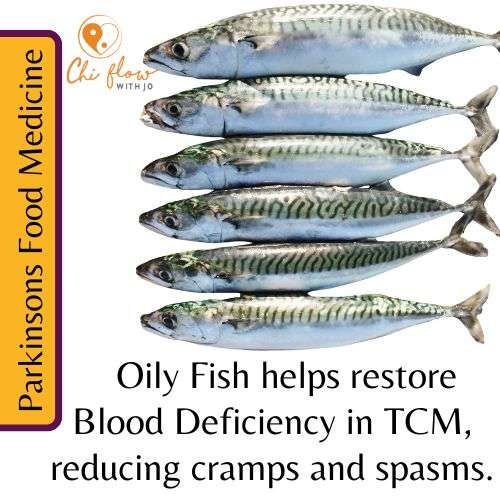
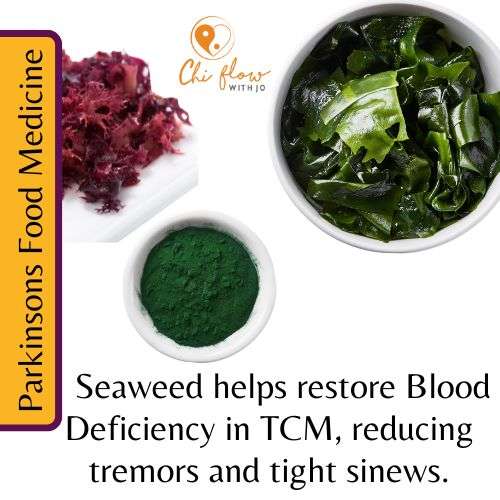
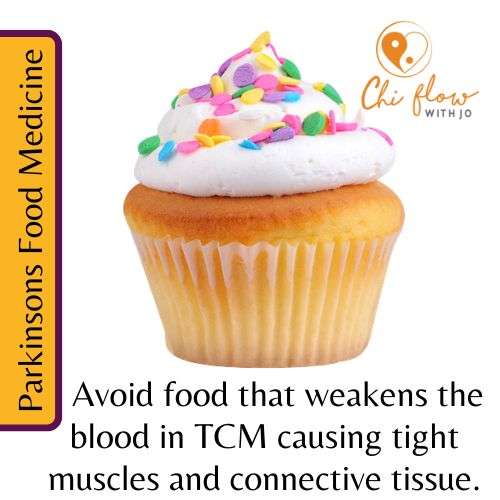
Too many saturated fats, chemical additives, alcohol, caffeine and stimulants make the Liver slow, leading to “stagnation” in the system and weakening of the blood causing symptoms of fatigue, headaches, problems concentrating, night terrors, spasms and tightness of the ligaments and tendons.

Here are some five element food medicine guides to follow and include in your diet.  Use the books to find recipes in which to use these ingredients on a daily basis:

LIVER BOOSTING FOODS

  • ☯️ Dark leafy greens including

  • ☯️ Nettles

  • ☯️ Spinach

  • ☯️ Kale

  • ☯️ Broccoli

  • ☯️ Sprouted seeds and legumes

  • ☯️ Good oils in seeds and nuts 

  • ☯️ Oily fish

  • ☯️ Aubergines

  • ☯️ Kimchi

  • ☯️ Fresh & raw food
  • ☯️ Lemon & limes
  • ☯️ Apple cider vinegar
  • ☯️ Plums & gooseberries
  • ☯️ Turmeric
  • ☯️ Avocado’s
  • ☯️ Seaweed
  • ☯️ Umeboshi plum

For recipes showing you how to use these foods and the five element system, sign up for the FREE mini ebook below or take a look at the cook books.

Every day in Chi Flow with Jo you receive a recording of the Qi Gong class if you can’t make the LIVE plus a 5 element food recipe, acupressure point of Traditional Chinese Medicine Tip to set you up for the day.

FOODS TO AVOID

  • ☯️ Ice cream

  • ☯️ Heavy cream

  • ☯️ Cheese

  • ☯️ Fried food

  • ☯️ Saturated fats

  • ☯️ Alcohol

  • ☯️ Processed meats

  • ☯️ Ready meals

  • ☯️ Refined Carbohydrates

  • ☯️ Refined Sugars

Following the 5 element system, the nourishment of blood by the liver relies on kidney jing to nourish it 

When kidney jing is weak liver energy and the strength of the blood becomes weak. 

Read more in my next blog about how to use acupressure and Qi Gong to strengthen Kidney energy helping vital blood to flow and nourish organs, ligaments, muscles and tendons, relieving spasms, cramps, twitching, improving sleep and ease of the body.

I share an Acupressure point and a Qi Gong move to help you feel at ease in your body.  It’s important to not feel isolated and alone.  There are things you can do and a whole community in Chi Flow to support your Parkinsons journey.

Chi Flow with Jo uses natural and easy Qi Gong movements, acupoints and food medicine every weekday to nourish the blood, clear the liver and calm your nervous system.  Plus daily Q&A helps you to return to deep acceptance and ease with a community full of support.

Doors open the last few days of the month so that we begin the new moves together at the beginning of the new month.

HOW CAN QI GONG HELP REVITALISE YOUR LIFE?

If you’re eager to revitalise your daily routine and prioritise self-care for both your mind and body, consider exploring Qi Gong as a transformative practice.

Qi Gong is all about being well and loving yourself with gentle exercise, and the best part is that everyone can benefit from it.

Hope to see you in the Chi Flow.

Self-administered acupressure or Chinese Medicine is not a substitute for visits to qualified healthcare practitioners.

Knowing how to treat yourself and your loved ones with complimentary therapies like acupressure can be greatly beneficial and convenient. However, for serious and chronic conditions, you’ll want to visit an Shiatsu therapist / Acupuncturist or other qualified healthcare practitioner who can develop a treatment plan based on your unique medical history and combination of symptoms.  

The information provided should not be considered medical advice.

Feeling flat? I can see the future

Feeling flat? I can see the future

What do we do when all plans are out of the window? Perhaps you had arrangements for this summer. Maybe you were getting married, going abroad on your dream holiday, finishing your leaving cert or celebrating a big number birthday but now all those plans are gone. Even as lockdown loosens and restrictions ease, we can be left feeling flat. Without working towards a hopeful future we had planned, we can feel despondent in the present.

Good news, Traditional Chinese Medicine with a focus on diet and acupressure points can help us appreciate this period of uncertainty and even guide us into a more balanced, happier future.

Firstly when you are lacking mental brightness and positivity don’t push yourself. Simply be where you are. Notice what is around you, name five things that you see or hear that are beautiful. This can be hearing birdsong, seeing how green the grass is or, sensing how the breeze moves the leaves in the trees. When you prepare food, do it with love. Arrange your meal on the plate so it looks beautiful, clear and set the table with care so you eat with appreciation. These are small simple tips that in Chinese Medicine that feed the heart.

This organ is the emperor of the body, it stores our spirit and is represented by a flame. Don’t let your fire dwindle, feed the flame and lift your spirit by seeing and creating beauty right here, right now. The season of the Heart is the summer so choosing all those fantastic summer foods such as watermelon, strawberries, raspberries, redcurrants, beetroot, tomato, radish and red peppers benefit the heart physically and emotionally. Try experimenting and put them together in a new way so you see your food as alluring and elegant.

A physical exercise to shift stagnant downturned emotions is to make loose fists and lightly pummel the front of the thighs. Bring the fists up and down over the quads, which are a group of four large muscles at the front of the legs between the knees and hips, for about 30 seconds. This stimulates the Stomach and Spleen channels, responsible for harmony and comfort in the body. So rather than reaching for something sweet to raise the spirits try a little light pummeling which after a couple of days, works wonders in lifting despondent spirits.

It can be hard to appreciate the present when the future feels uncertain but being in the heart in the present moment can transform tragedy to inner strength.  Be kind to yourself. I cant assure you there are better things on the way but there will be different things and if we can keep the eyes open appreciating the beauty in life, right here right now it will help glide us easily along the path to a bright, balanced tomorrow.

For more information on Shiatsu Conscious Cooking visit www.joannefaulkner.ie @joannefaulknerShiatsu on Facebook and Instagram
Buy the book full of recipes, tips and Chinese Medicine at www.joannefaulkner.ie

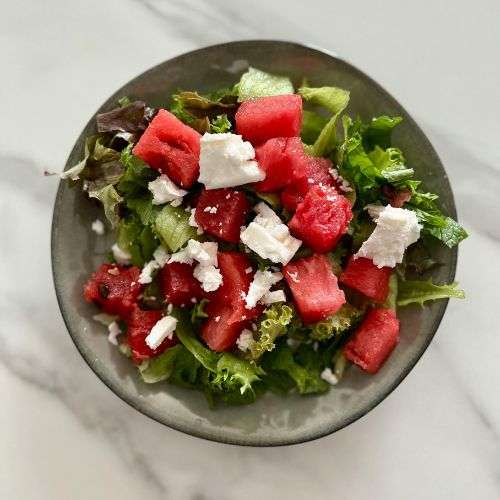
 Watermelon works well in a salad dish and complements a barbeque splendidly. In Traditional Chinese Medicine this ingredient cools summer heat. When your inner flame is burning too brightly and you are overheating, red in the face or sweating profusely, juice this fruit or munch on segments to move blood, reducing pain and heat around the joints, making this a perfect food for gout, arthritis and fibromyalgia.

1 medium watermelon
100g feta cheese
1 red onion
A handful of fresh basil leaves
2 tbs. extra virgin olive oil

Chop the watermelon into bite-size pieces. Slice the red onions into paper-thin, half-moons and sprinkle them along with the crumbled feta onto the watermelon. Scatter the basil leaves and drizzle the olive oil over the top to finish.
Tip: Choose a watermelon that has wide spaces between the dark green lines – they’re sweeter that way.


💗 Ready to Join?

Click here to become a member of Chi Flow with Jo → CLICK HERE

Or drop in for a class and feel it for yourself (sign up below). Join the Chi Flow with Jo community for live sessions, practice, and support.

Self-administered acupressure or Chinese Medicine is not a substitute for visits to qualified healthcare practitioners.

Knowing how to treat yourself and your loved ones with complimentary therapies like acupressure can be greatly beneficial and convenient. However, for serious and chronic conditions, you’ll want to visit an Shiatsu therapist / Acupuncturist or other qualified healthcare practitioner who can develop a treatment plan based on your unique medical history and combination of symptoms.  

The information provided should not be considered medical advice.

A Wake up for the Liver for Spring

A Wake up for the Liver for Spring

As Spring light grows brighter, it shows the dusty corners and the cobwebs that have gathered over winter it’s time to spring clean.  So why not treat your body just like your house and clear out a sluggish liver. In Western and Chinese Medicine the Liver is the organ and meridian system for detox and regeneration, clearing out and metabolise fats that have been stored during the winter and the liver is the organ to do this.

With its detoxifying abilities, it’s important that we make sure this organ wakes up with Spring so that we don’t suffer from stiff joints, high cholesterol, painful periods and even erectile dysfunction.

Blood has to flow smoothly through the body and if the liver can’t get rid of waste efficiently, the body will become painful and toxic. Emotionally, in Chinese Medicine, this leads to anger and frustration rather than flexible, clear-headed problem-solving.

    It’s easy to fix though.  Here are a few tips:
    1. Try not to eat after 6 pm or before 9 am.  After all, breakfast means breaking of a fast so try not to have snacks after dinner or grazing between meals.
    2. Cutting out milk, cheese, ice-cream and buttery spreads, replacing with olive oil or coconut milk in stews and curries, will ease the congestion on the liver.
    3. As the variety of fresh fruit and vegetable increase, try more salads and raw foods at the table.  Thinly slice courgettes, grate carrots and toss through with lemon juice, olive oil and a sprinkle of salt as an alternative to the hot, cooked dishes that got us through the winter.  These sour flavour dishes stimulate the liver and the raw element helps with the production of enzymes to digest and metabolize foods with ease.

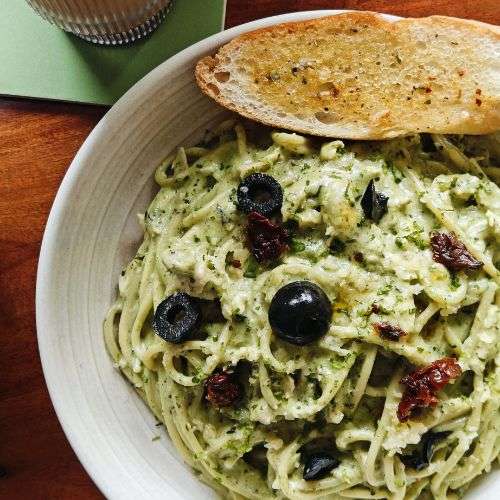
    A favourite recipe of mine from my Good Food: Better Sex Cookbook, replaces heavy, refined carbohydrate pasta with light luscious courgettes.  You don’t have to have a spiraliser for this recipe you can use a potato peeler to shave thin slices then roughly chop lengthways.  Green is the colour for the liver in Chinese Medicine, it helps stimulate the gall bladder to produce bile to further help the liver break down a fatty rich diet.  So keep it clean, keep it green.

    Black Olive and Lemon Courgetti (serves 2)
    2 Spiralized Courgettes

    Dressing
    100g Black Olives
    80g Basil Leaves
    80-120g Flat Leaf Parsley
    1 tbsp thyme leaves
    5 tbsp Extra Virgin Olive Oil
    Juice of 1 Lemon

    Method
    Spiralize the courgettes whilst popping all the other ingredients into a blender and blitzing for 30 seconds so that the olives are still chunky.  When ready toss the tangy, zesty dressing through the courgetti with a fork.

    💗 Ready to Join?

    Click here to become a member of Chi Flow with Jo → CLICK HERE

    Or drop in for a class and feel it for yourself (sign up below). Join the Chi Flow with Jo community for live sessions, practice, and support.

    Self-administered acupressure or Chinese Medicine is not a substitute for visits to qualified healthcare practitioners.

    Knowing how to treat yourself and your loved ones with complimentary therapies like acupressure can be greatly beneficial and convenient. However, for serious and chronic conditions, you’ll want to visit an Shiatsu therapist / Acupuncturist or other qualified healthcare practitioner who can develop a treatment plan based on your unique medical history and combination of symptoms.  The information provided should not be considered medical advice.