Find your Fun & Reduce Anxiety

Find your Fun & Reduce Anxiety

Have you found yourself feeling anxious and foggy-headed this past Winter?

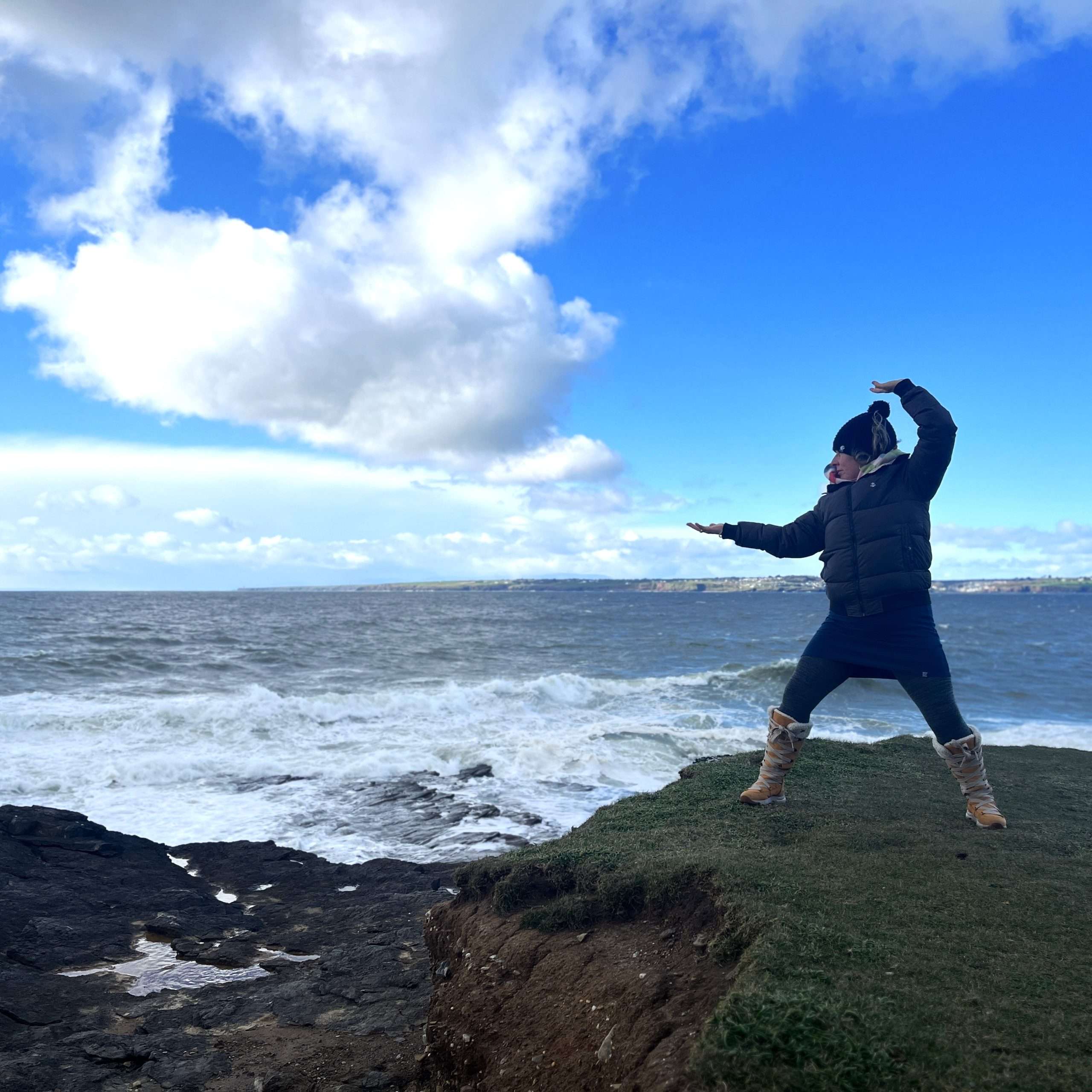
Just in time for Spring, we will delve deep into the energy boosting ancient Toaist form of Qi Gong ; the 5 Animal Frolics. This flow celebrates the energy of animals by mimicking their movements, while bringing our mind and body ease.

Qi Gong is said to originate from the dances of early Wu Shaman in China. In their dances, shamans used animal movements to induce trance states for communicating with the spirit world.

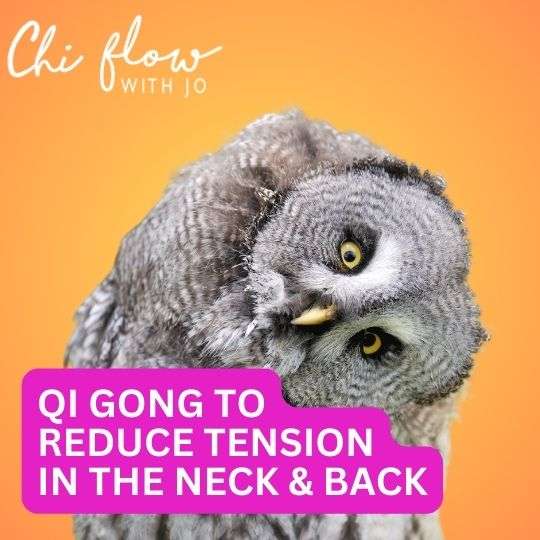
Many of the movements such as “Parting the Clouds”, “Shaking the Wild Horse’s Mane” and “Wise Owl turns Head to eliminate fatigue” specifically reference animals and elements of nature.

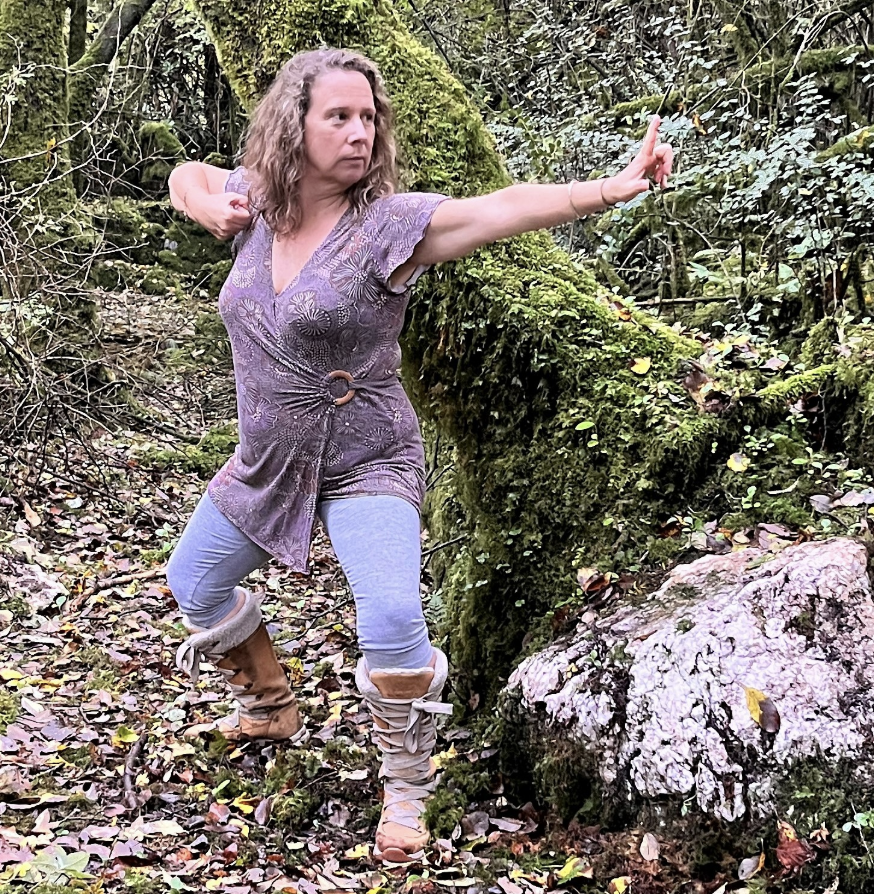
In one exercise such as the “Crane spreads Wings”, you move like a tall elegant bird, finding your balance, feeling its spreading wings and the lightness in your body.

Attuning to the rhythms of nature will amplify our Qi Gong for April.

Even though the exercises can be playful and light, Qi Gong offers some seriously powerful health benefits that are accessible to everyone.
HEALTH BENEFITS

Qi Gong is a gentle movement meditation that is suitable for all ages and fitness levels.

Some of Qi Gong’s physical benefits include boosting metabolism, balancing hormones, improving flexibility and fitness, aiding digestion and increasing your overall energy levels.

Mentally, Qi Gong will help calm your mind and reduce anxiety.

The 5 Animal Frolics allow us to cultivate the animals’ energetic gifts, bringing harmony within all of the body’s energy systems. Using the 5 Element Theory, each of these animals is linked to a season, a time of day, an organ pair, a sense, a flavour, an emotion and much more.

WHAT ARE THE 5 ANIMALS?

Let’s break down the animals, their corresponding organs and some ways your health can benefit from this month’s energy update.
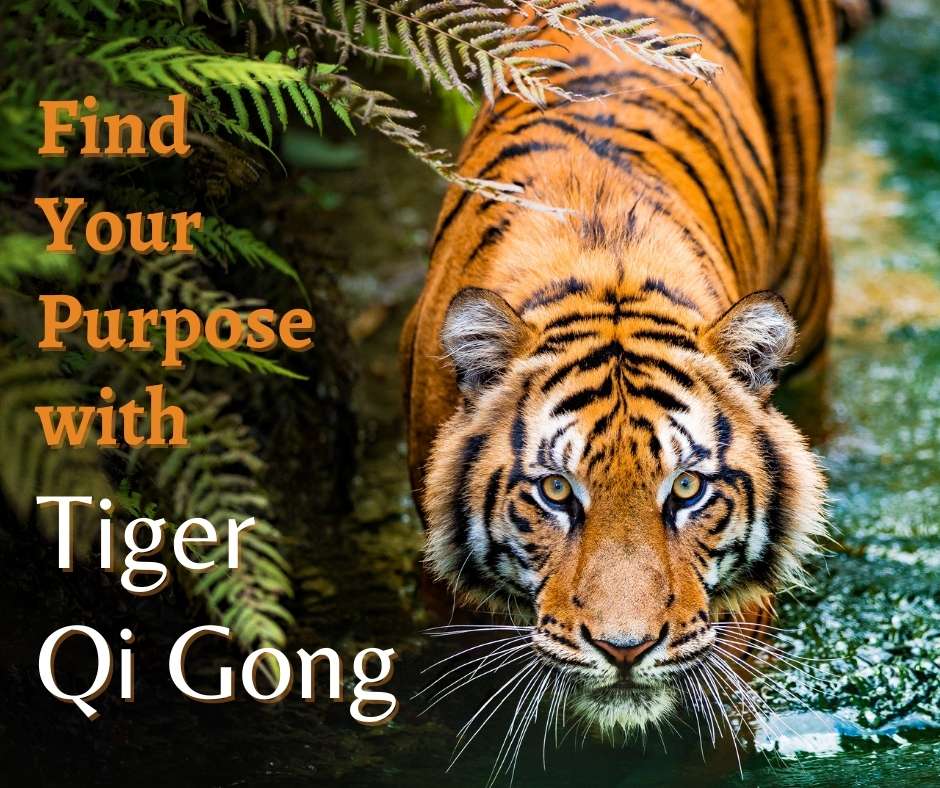
THE TIGER


First, we will draw power, flexibility and flow from the tiger. The tiger is associated with the wood element, which is also linked to the liver and gallbladder. When you practice tiger, you give yourself a healthy and natural way to release anger, becoming confident, powerful and assertive. If you are stuck sitting at a desk all day, and/or looking to prevent arthritis, practicing the tiger will greatly benefit you.

Chi Flow with Jo will give you the tools to use the tiger’s claw to release tension in the shoulders and chest, strengthen tendons and joints in the hand and increase gripping strength by generating a powerful surge of Qi energy in the hands and fingers.
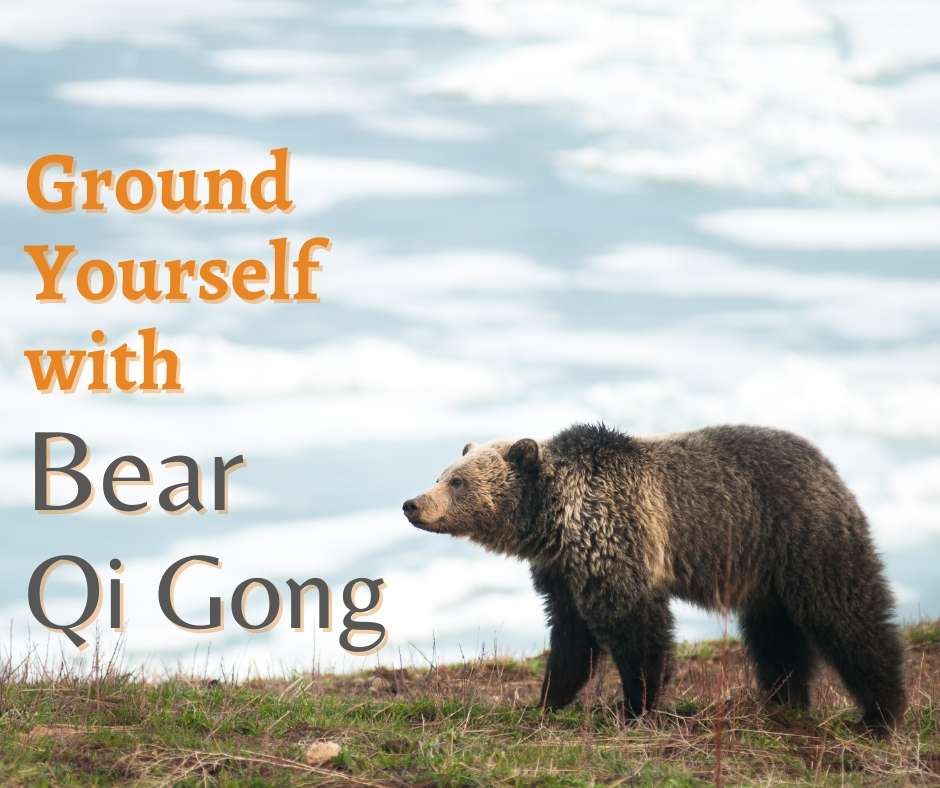
THE BEAR

Next, the Bear. Chi Flow with Jo will teach you how to channel the bear coming out of hibernation by reconnecting with the present moment and releasing anxiety and worry.

The bear’s movements will benefit your spleen and stomach, helping to receive the benefits of the earth’s bounty and easing digestion.

The bear is heavy and grounded to the earth, so its movements will help to balance the earth element. Finding this balance will enable you to start your Spring off by rediscovering your nurturing, relaxed and social self.
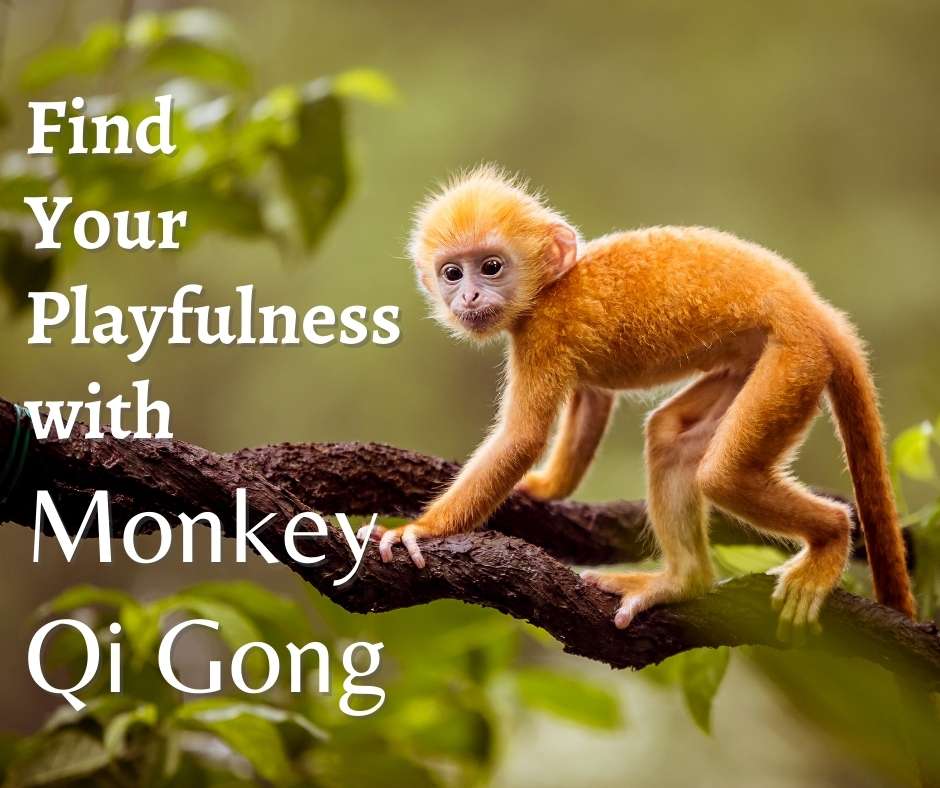
THE MONKEY

Next, the monkey movements will benefit the heart and small intestine with the playful joy and exuberance of the fire element. Mimicking the light and spirited movements of the monkey promotes healthy blood circulation in the vessels and the meridians, while also encouraging your inner child to express itself.

If you are finding yourself weary with the world, Chi Flow with Jo will show you how to return to a state of wonder, optimism, enthusiasm and joy by practising the monkey and improving your heart’s health.
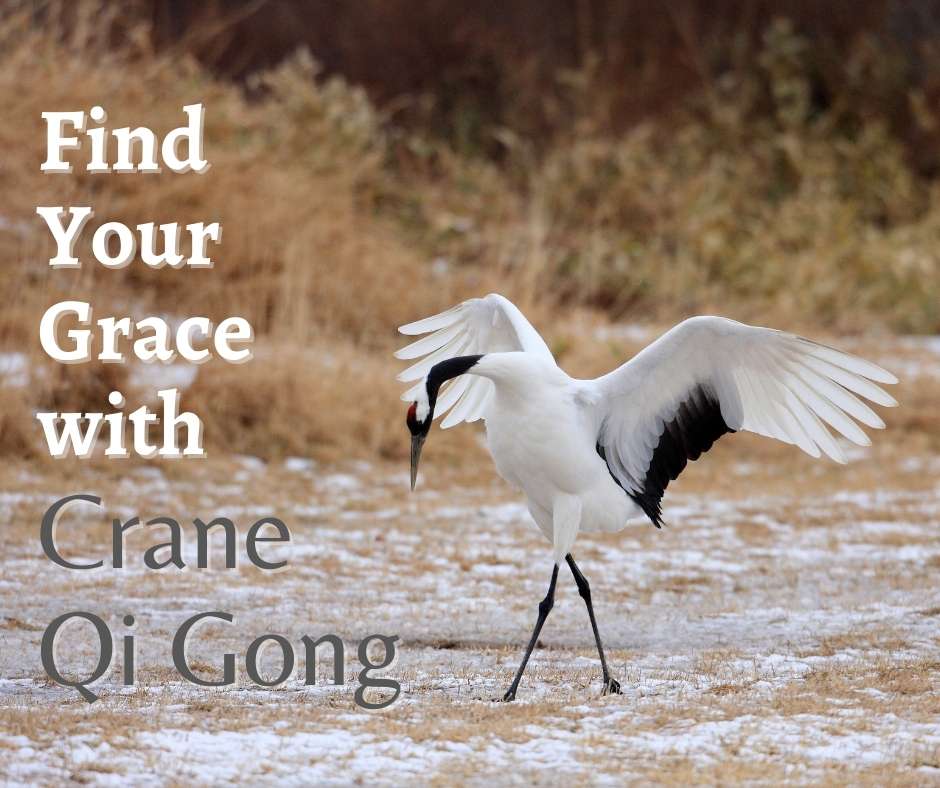
THE CRANE

Next, the lungs are responsible for self protection and self-preservation. The crane’s movements, with its long legs and outstretched wings, benefit the lungs and large intestine, helping expansive openness and deep breathing.

Mirroring the crane opens the lungs, releasing grief and sadness, and enabling you to expand your capacity of breath.

Chi Flow with Jo will teach you to foster the crane’s spirit, so you can strengthen your dignity, integrity and ability to connect with others.
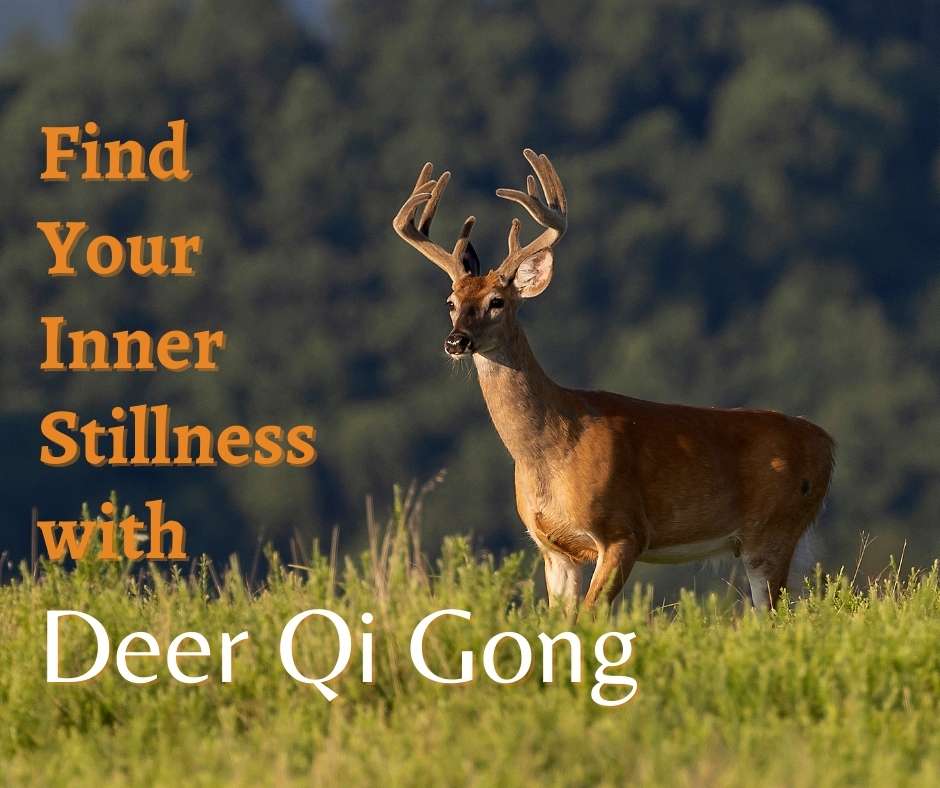
THE DEER

Finally, the deer’s movements benefit the kidney and bladder, as well as bringing quiet and stillness. The deer is a prey animal, always aware of its surroundings yet never overwhelmed; it is calm and curious. The emotion associated with the deer is fear, so practising the deer will allow you to release that fear and become more clear minded. 

Chi Flow with Jo will teach you to practice the deer’s movements to calm your nervous system and return to deep awareness, while also helping with bone density and hormonal balance.

HOW CAN QI GONG HELP REVITALISE YOUR LIFE?

If you’re eager to revitalise your daily routine and prioritise self-care for both your mind and body, consider exploring Qi Gong as a transformative practice.

Qi Gong is all about being well and loving yourself with gentle exercise, and the best part is that everyone can benefit from it.

Hope to see you in the Chi Flow.

Self-administered acupressure or Chinese Medicine is not a substitute for visits to qualified healthcare practitioners.

Knowing how to treat yourself and your loved ones with complimentary therapies like acupressure can be greatly beneficial and convenient. However, for serious and chronic conditions, you’ll want to visit an Shiatsu therapist / Acupuncturist or other qualified healthcare practitioner who can develop a treatment plan based on your unique medical history and combination of symptoms.  

The information provided should not be considered medical advice.
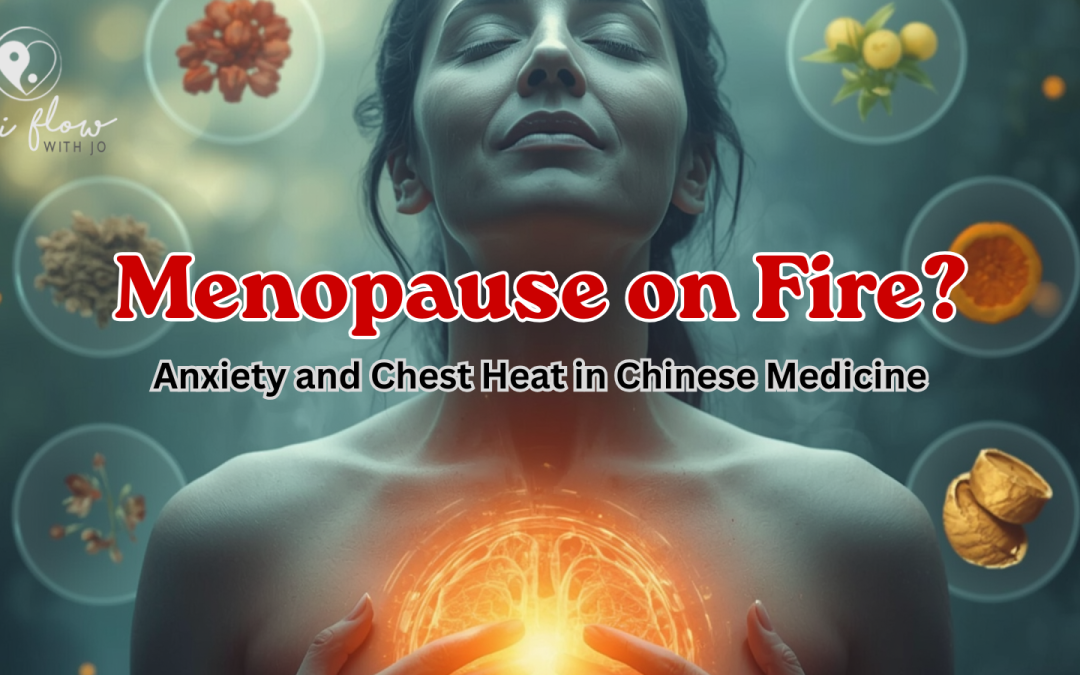
Menopause on Fire? Anxiety and Chest Heat in Chinese Medicine

Menopause on Fire? Anxiety and Chest Heat in Chinese Medicine

There is a very particular kind of heat a woman can feel in midlife.

It rises into the chest and head. It can make the heart race, the mind spin, the sleep thin, and the skin feel itchy, dry or irritated no matter how much water we drink.

A client recently asked:

“I suffer from anxiety, heat in the chest and head, and lichen sclerosus. I am post menopause. I’d like acupressure, food medicine for the autoimmune aspect and anxiety, plus a breathing exercise.”

This is such an important question because many women will recognise some version of it.

It may not be lichen sclerosus for you. It may be hot flushes, burning feet, night sweats, tightness in the chest, palpitations, itchy ears, dry skin, vaginal dryness, bladder sensitivity, brain fog, fear that comes from nowhere, or that awful feeling of being tired and wired at the same time.

This blog is for women in peri-menopause, menopause and post-menopause who feel as though the body has suddenly become louder than it used to be.

The Chinese medicine view: heat, anxiety and menopause

In Chinese medicine, the simple picture is this: energy has to flow.

Qi has to flow. Blood has to flow. Fluids have to flow. Warmth has to move through the body without getting trapped at the top.

Yin and Yang also have to keep talking to each other.

Yin is the cooling, moistening, holding quality. Yang is the warming, moving, active quality. We need both. We do not want a cold, flat life, and we do not want a blazing, restless one.

Symptoms are feedback. They are not moral failures. They are not proof that you have done something wrong. They are the body’s way of saying, “Something in here needs rebalancing.”

When a woman says, “I have heat in my chest and head,” I listen for Fire rising.

When she says, “I am anxious,” I listen for the Heart being unsettled.

When she says, “I am menopausal or post-menopausal,” I listen for Yin and fluids needing more care, especially the Kidney foundation. In Chinese medicine, the Kidneys are not only the two physical kidneys. They are the deep battery, the stored essence, the roots of water in the body.

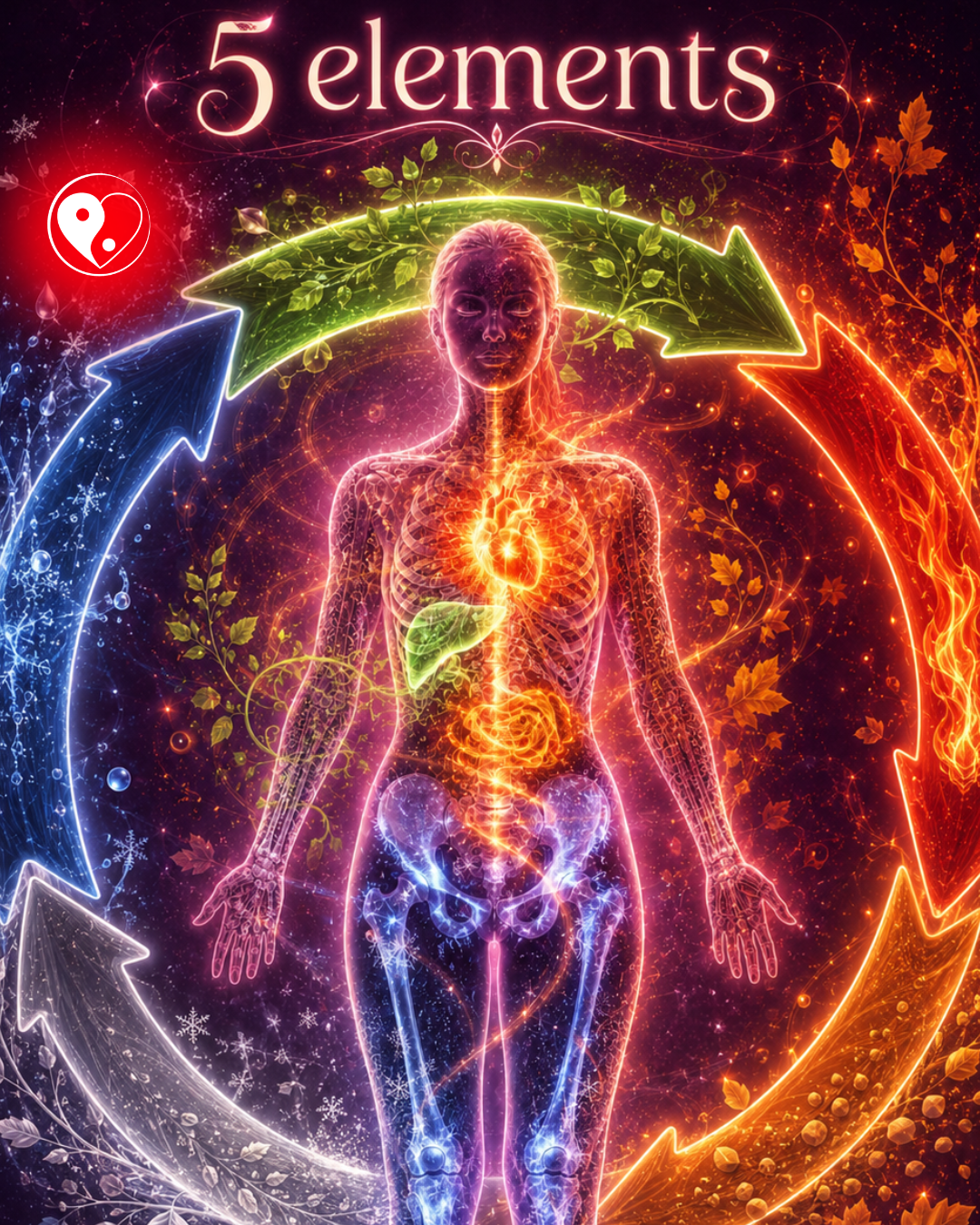
Menopause can bring all Five Elements into one body

The Five Elements help us understand why menopause can feel so confusing.

In spring, we talk about Wood and the Liver: movement, flexibility and letting things flow.

In summer, we talk about Fire and the Heart: joy, connection, heat and sleep.

In late summer, we talk about Earth and digestion: the centre that helps us digest food and life.

In autumn, we talk about Metal, the Lung and Large Intestine: grief, boundaries, skin and letting go.

In winter, we talk about Water and the Kidneys: rest, bones, fear, deep reserves and the wisdom of not spending ourselves empty.

Menopause can bring all of these seasons into one body.

You can have summer heat in the chest, winter depletion in the bones, spring frustration in the Liver, autumn dryness in the skin, and late-summer worry in the belly.

This is why rhythm matters so much. We do not fix the whole woman by attacking one symptom. We help the whole system flow again.

See my books for full food medicine and acupressure for the complete five elements.

What is Bao Mai?

This is where Chinese medicine offers something very special.

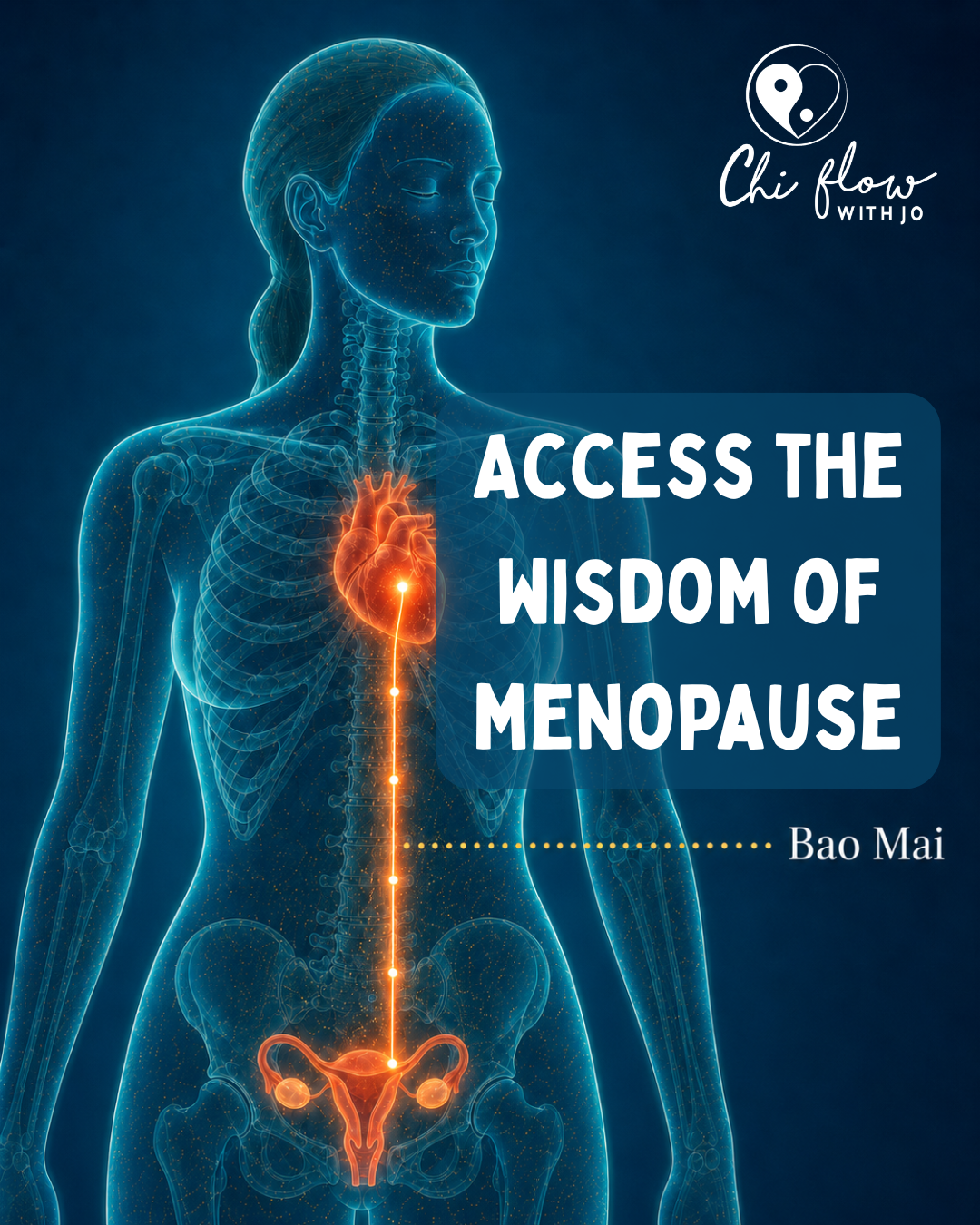
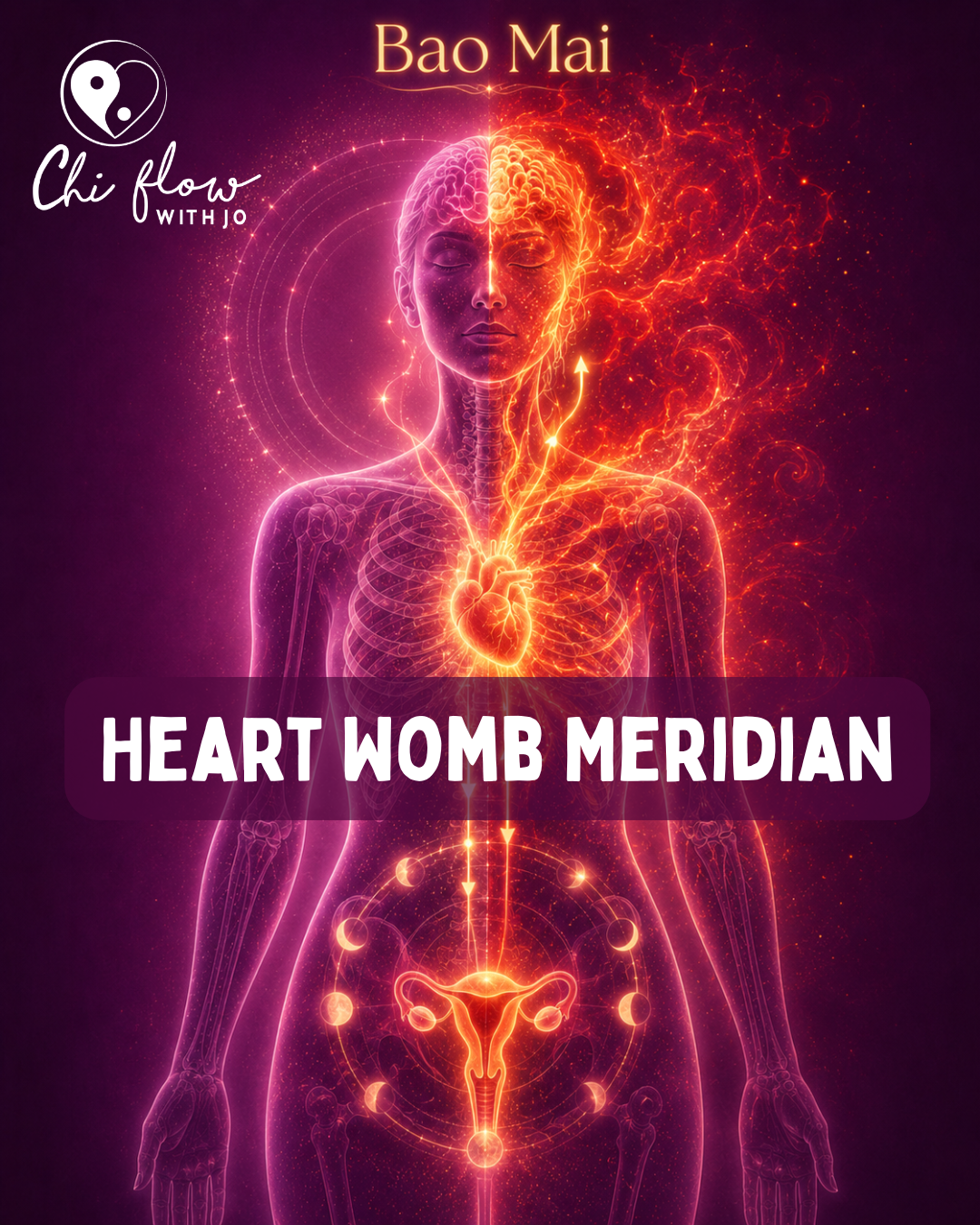
There is a beautiful pathway in women’s health called the Bao Mai. Bao Mai means the Uterus Vessel, or more simply, the Heart and womb connection.

It is not one of the everyday meridians we talk about, like Liver or Kidney. It belongs to the deeper map of the extraordinary vessels, especially the Chong Mai, known as the Sea of Blood.

The Bao Mai is the communication line between the Heart and the uterus. It allows Heart Qi, Heart Blood and Shen, the spirit or mind, to descend and nourish the reproductive organs.

In Chinese medicine practice, the Bao Mai is used to understand ovulation, menstruation, fertility, pregnancy, PMS, irregular cycles, scanty bleeding, and the way stress and emotion can disturb hormonal rhythm.

In the fertile years, Blood and Qi move down from the Heart toward the womb. The monthly cycle opens and closes, and the body has a visible rhythm.

In peri-menopause and menopause, that rhythm begins to change.

The movement starts to return upward toward the Heart and brain. When that upward movement is smooth, it can become clarity, intuition and wisdom. It can become the woman who says, “I know what matters now, and I am not wasting my life putting others first.”

But when that upward movement is too hot, too rushed, or blocked by overwhelm, we may feel heat in the chest, pressure in the head, palpitations, anxiety, irritation, poor sleep or a sense that we cannot come down into ourselves.

Women’s seven-year cycles in Chinese medicine

Chinese medicine also describes women’s lives in seven-year cycles.

Around fourteen, the Conception Vessel, or Ren Mai, begins to flow and menstruation starts.

Around twenty-one, Kidney Qi matures.

Around twenty-eight, Qi and Blood are at their fullest.

Around thirty-five and forty-two, the Yang Ming channels begin to weaken, which may show in skin, hair and vitality.

Around forty-nine, the Conception Vessel weakens, reproductive energy declines, and menstruation begins to stop.

These ages are not rigid rules. They are broad brush strokes. But they give us a beautiful way to understand menopause.

Menopause is not a sudden failure of the body. It is a change in direction.

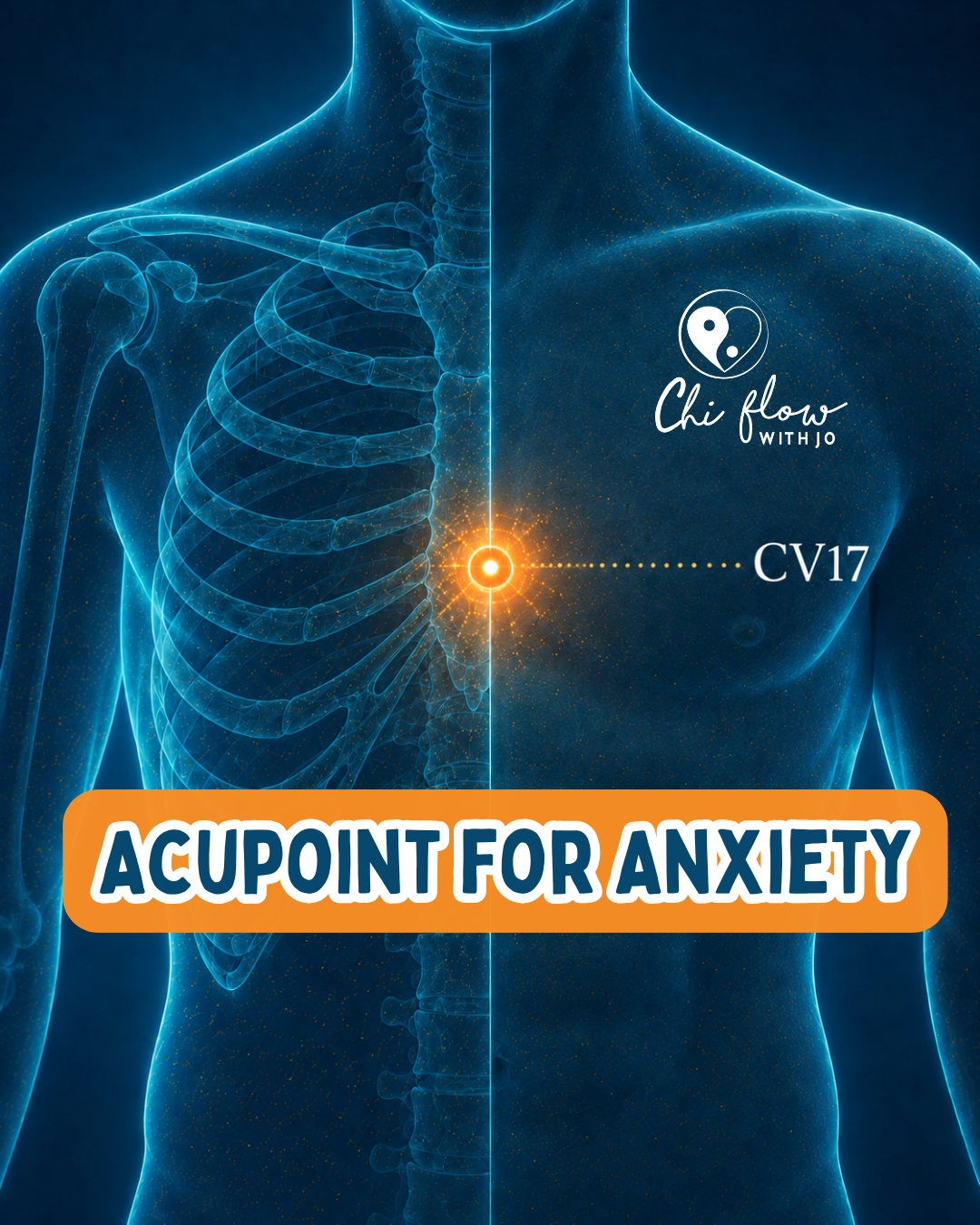
One acupressure point for anxiety and chest heat: CV17

The acupressure point I would use here is Conception Vessel 17, also called CV17.

It is in the centre of the chest, on the breastbone, roughly level with the nipples. Do not press breast tissue. Come to the centre line of the sternum, the flat bone in the middle of the chest.

Use two fingertips or the soft pads of your fingers.

For anxiety, heat, tightness and emotional pressure, CV17 can be a lovely place to make contact. It should not feel sharp. It should not feel like you are bruising yourself. It may feel tender, warm, achy, or as if the breath suddenly notices the space under your hand.

Place two fingers on the centre of the breastbone. Let your shoulders drop. Press gently and steadily. You are not digging. You are saying hello.

Stay for thirty seconds to three minutes. If you are very anxious, start with thirty seconds. Breathe slowly while you hold it. Let the exhale be a little longer than the inhale.

When you finish, smooth the hand down the centre of the chest to the upper belly, as if reminding the heat that there is a whole body below the neck.A simple daily cue is the kettle. Every time you boil the kettle, touch CV17. Tea, coffee, hot water, soup, whatever it is, let the kettle become your reminder.

Consistency matters more than intensity.

A breathing practice: Heart-Womb Breath

The breathing practice I recommend is Heart-Womb Breath.

If you have had a hysterectomy, if you do not have a uterus, or if the word womb does not feel right for you, use “lower belly” or “pelvic bowl.” The body still has a centre.

Think of anxiety as a house with all the lights on upstairs. The energy is in the head, eyes, jaw, temples, throat, chest and heart. The lower floor feels empty.

This breath helps you come downstairs again.

Place one hand on the centre of the chest, around CV17.

Place the other hand on the lower belly, below the navel, over the womb space or pelvic bowl.

Soften the jaw. Breathe in through the nose and out through the mouth. As you exhale, imagine warmth travelling from the chest down into the lower belly, like honey moving slowly down a spoon.

Then gently inhale and imagine Qi flowing from the womb space up to the Heart. On the exhale, let it flow back down to the perineum and pelvic bowl.  Do this for three minutes.

The aim is not to create a mystical experience. The aim is to give your nervous system proof that it is safe to come down.

The felt result may be simple: the chest a little softer, the head a little cooler, the belly a little more present, and the breath less trapped.

Food medicine for anxiety, heat and immune over-alertness

The food medicine I would choose is warm miso with wakame.

Not a complicated protocol. Not a war against the immune system.

For autoimmune patterns, I do not love the phrase “boost the immune system,” because the immune system is not always weak. Sometimes it is confused, over-alert, inflamed, reactive or exhausted from being on guard.

The intention is not to whip it harder. The intention is to steady the terrain.

Miso is fermented and supports the gut environment. Wakame brings a mineral-rich seaweed quality. The warm salty bowl can help the nervous system feel fed, held and less frantic.

The simplest recipe is this:

Boil water, then let it cool for a minute. Put one teaspoon of miso paste in a mug or small bowl. Add a small pinch of wakame. Pour the hot water over, stir, let it sit for a few minutes, and sip slowly.

You can add spring onion or a few cubes of tofu if you want to make it more like a snack, but the basic medicine is miso, wakame, warm water and a pause.

Do not boil the miso hard. Warm is enough.

Warm tells the belly, “You are safe.” Scalding tells the body, “More heat is coming.”

If you are sensitive to soy, choose a miso that suits you or skip this. If you have been told to restrict salt, if you have thyroid issues, or if seaweed has been restricted for you, check with your clinician and keep the wakame tiny.

Lichen sclerosus and the whole-body view

As with many issues around sexual organs, conditions of the vulva can carry so much silence.

Women put up with itching, burning, pain, fear around intimacy, embarrassment around examination, confusion about creams, and sometimes worry that they will not be believed.

Please do not carry that alone.

Good care matters. Clear diagnosis matters. Follow-up matters. Your comfort matters.

You are allowed to ask questions. You are allowed to ask how to use your prescribed ointment properly. You are allowed to say that sex hurts. You are allowed to say that anxiety is part of the picture. You are allowed to want both medical care and whole-body support.

In Chinese medicine, we never separate the local from the whole.

A vulval skin condition needs local medical care. Absolutely. And the whole body can still be supported through fluids, digestion, sleep, breath, stress rhythm and gentle movement of Qi.

This is not either-or. It is both-and.  See my book Good Food Better Sex for explorations of sexual conditions and MENOPAUSE through the lens of Chinese medicine

Final thought

To every woman in peri-menopause, menopause or post-menopause: your body is giving you feedback about flow, cooling, nourishment, boundaries, rest and rhythm. You do not have to decode it perfectly. You only have to begin responding more kindly.

And if you would like to practise this kind of work with me in a steady, supported way, come into the Chi Flow membership. It is €39 a month, and after the three-month trial it becomes €20 a month, so you can keep building these small rhythms through the seasons with guidance, community and practice.

Ready to Start?

Join Chi Flow with Jo and begin restoring your energy, and feeling more like yourself again.

Frequently Asked Questions 

What does heat in the chest and head mean in Chinese medicine?

In Chinese medicine, heat rising into the chest and head can suggest that warmth, Qi or emotional pressure is not moving smoothly through the body. In menopause, this may be linked with Yin and fluids needing support, the Heart being unsettled, and the body needing a calmer rhythm.

What is the Bao Mai?

The Bao Mai is the Heart-womb connection in Chinese medicine. It is linked with the extraordinary vessels, especially the Chong Mai, the Sea of Blood. It helps explain the relationship between emotions, the Heart, the uterus, menstruation, fertility, menopause, hot flushes and anxiety.

Why can menopause cause anxiety and hot flushes in Chinese medicine?

Chinese medicine sees menopause as a change in direction. In the fertile years, Blood and Qi move down toward the womb. In peri-menopause and post-menopause, this movement begins to return upward toward the Heart and brain. If the transition is too hot, rushed or blocked, symptoms may include anxiety, palpitations, poor sleep, heat in the chest and head, or hot flushes.

What acupressure point helps menopause anxiety?

CV17, or Conception Vessel 17, is a useful acupressure point for anxiety, chest tightness and emotional pressure. It is found in the centre of the breastbone. Press gently for thirty seconds to three minutes while breathing slowly.

What food medicine supports menopause anxiety and immune over-alertness?

Warm miso with wakame is a simple food medicine option. Miso is fermented and supports the gut environment. Wakame brings a mineral-rich seaweed quality. Together, they make a warm, steadying bowl that supports the body without overstimulating it.

Can Chinese medicine cure lichen sclerosus?

No. Lichen sclerosus needs medical diagnosis and care from a GP, gynaecologist, dermatologist or vulval clinic. Chinese medicine practices such as acupressure, breathwork, food medicine and Qi Gong may support the whole body alongside medical treatment, but they do not replace it.

Go Deeper with Our Books

For those wanting to understand how movement, breath, and Chinese Medicine principles, Jo’s books provide practical guidance rooted in lived experience and clinical wisdom.

👉 Buy Five Element Wisdom cookbooks

Explore how to Find Your Flow and Live Well with Parkinson’s.

Movement does not need to be extreme to be powerful.
Small daily expansion reshapes the body.
Steady breath reshapes the nervous system.
Gentle repetition rebuilds confidence.

Every human body carries extraordinary capacity for renewal when given the right rhythm.

If you want to soften into strength, come and practice with us.

When to seek medical help

Please speak to your GP or specialist if symptoms worsen or spread, if pain, itching, heat or anxiety starts waking you at night, if you notice new skin changes, lumps, thickening, ulceration or bleeding, if your prescribed treatment is not helping, or if there is any change in medication.

And if you ever have chest pain that feels severe, crushing, unusual, or comes with breathlessness, sweating, faintness, jaw pain or arm pain, seek urgent medical help.

Chinese medicine and home practices can support the terrain of the body, but they do not replace diagnosis or medical treatment.

Self-administered acupressure or Chinese Medicine is not a substitute for visits to qualified healthcare practitioners.

Knowing how to treat yourself and your loved ones with complimentary therapies like acupressure can be greatly beneficial and convenient. However, for serious and chronic conditions, you’ll want to visit an Shiatsu therapist / Acupuncturist or other qualified healthcare practitioner who can develop a treatment plan based on your unique medical history and combination of symptoms.

The information provided should not be considered medical advice.
Topics: Breathwork, Parkinson’s support, sleep practices, Qi Gong, acupressure.

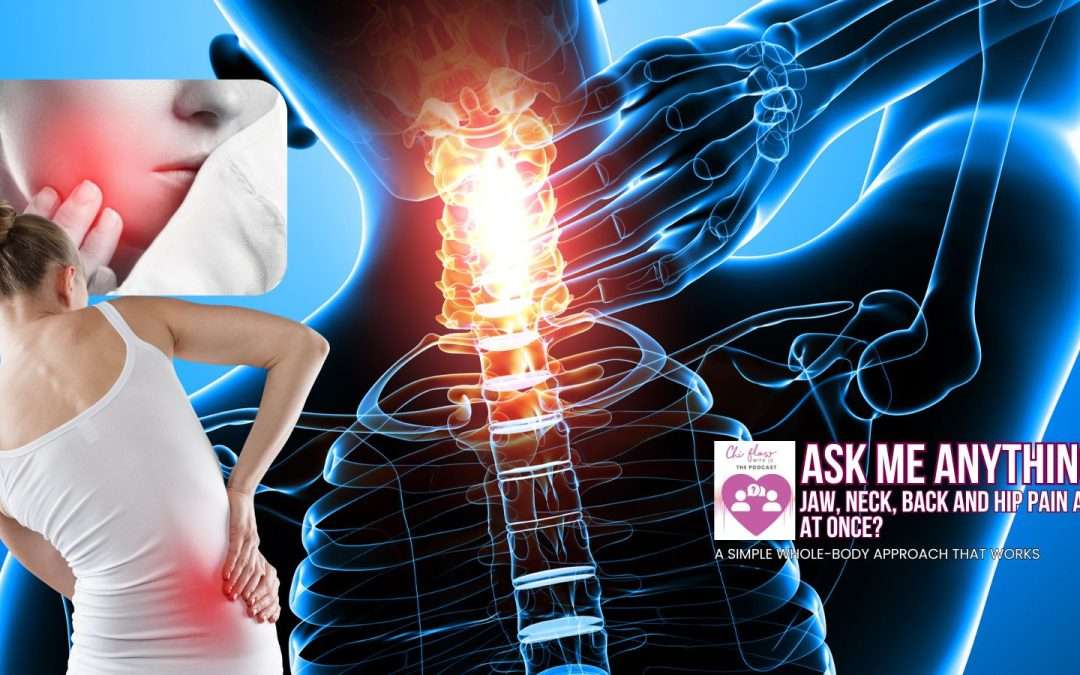
Jaw, Neck, Back and Hip Pain All at Once?

Jaw, Neck, Back and Hip Pain All at Once?

 A Simple Whole-Body Approach That Works

When the jaw, neck, back, and hips all start calling for attention at the same time, it can feel confusing and overwhelming.

It is not just one area.
It is everything, tight yet weak, tired yet wired, with tension that keeps returning no matter what you try.

This pattern and combination is something I see often, especially in people dealing with fatigue, nerve sensitivity, or conditions like TMJ, back pain, or Parkinson’s.

And the truth is, this is not four separate problems. It is one connected system asking for support.

Why Everything Feels Tight and Weak at the Same Time

In Traditional Chinese Medicine, everything comes back to one question.

Is energy flowing, or is it stuck?

When the body is under pressure, it begins to brace.

  • The jaw clenches
  • The neck tightens
  • The shoulders lift
  • The back locks
  • The hips grip

Underneath all of that, the body feels weak because energy is being used to guard, not support.

So instead of chasing each area separately, we look at the whole chain.

Very often, the jaw and base of the skull act like a “top gate.”
If this area is tight, everything below starts compensating.

A Simple Acupressure Practice to Release Tension

Rather than doing more and more, start with less, done consistently.

Stomach 7 (Jaw Point)

  • Located just in front of the ear where the jaw moves
  • Gently press into the hollow while relaxing the mouth

Stomach 7 is one of my favourite points because its effects often extend far beyond the jaw itself. While it is commonly used for TMJ discomfort, clenching, grinding, and facial tension, it also helps address the compensation patterns that develop throughout the body when the jaw becomes chronically tight. 

The jaw is closely linked to the muscles of the neck, shoulders, and upper back. When we clench, we rarely do it in isolation. We tend to lift the shoulders, tighten the neck, hold the breath, and brace through the spine. By gently releasing Stomach 7, many people notice not only a softer jaw but also less tension around the temples, improved comfort around the ears, freer neck movement, deeper breathing, and a greater sense of relaxation through the shoulders. 

In Chinese Medicine, the Stomach channel travels through the face and head, making this point particularly useful for reducing the feeling of being “held tight” through the entire upper body. I often find that when the jaw begins to let go, the neck follows, and when the neck softens, the rest of the body has an opportunity to reorganise itself with less effort.

Gall Bladder 20 (Base of Skull)

  • Found at the base of the skull, in two soft hollows either side
  • Apply steady, gentle pressure with the thumbs

Gall Bladder 20 is one of the most important points for people who carry tension in the neck, jaw, shoulders, and head. Located in the two hollows at the base of the skull, it sits at a key meeting point between the head and the rest of the body. When this area becomes tight, it can create a feeling of pressure, pulling, heaviness, or congestion that radiates into the jaw, temples, neck, and upper back. 

In Chinese Medicine, Gall Bladder 20 is traditionally used to encourage the smooth flow of energy through the head and neck, helping to release stagnation and restore movement where things have become stuck. Many people notice reduced head pressure, less neck stiffness, easier head movement, and a greater sense of mental clarity after working this point gently. 

Because so many muscles attach around the base of the skull, releasing this area can also improve posture and reduce the strain travelling down through the spine. I often describe Gall Bladder 20 as opening the “top gate” of the body. When the base of the skull relaxes, the shoulders can drop, the breath can deepen, the jaw can soften, and the back and hips no longer need to work quite so hard to compensate. 

For people experiencing that combination of tightness, fatigue, tension, and a feeling of being pulled out of alignment, Gall Bladder 20 can be one of the most powerful points for helping the entire body feel more connected and at ease.

This complements the Stomach 7 paragraph perfectly because ST7 addresses the front of the jaw mechanism, while GB20 addresses the back of the jaw-neck-head relationship, giving readers a much clearer understanding of why you use the two points together.

How to use them together

  • 30 seconds on Stomach 7 each side

  • 1 minute on Gall Bladder 20
  • Keep the breath slow, jaw relaxed, shoulders soft

This is not about force.
With nerve sensitivity and TMJ, the body responds better to softness.

  • Let the tongue rest softly in the mouth
  • Let the eyes soften, as if looking into the distance
  • Allow the jaw to hang naturally, not clench

Link this practice to something you already do, washing your face, removing earrings, or sitting down in the evening so that it is a daily connection to your body and it’s alignment. That is how the body learns and how it changes.

Food That Supports Nerves, Energy and Release

When the body feels tight but weak, we look at nourishment.

In Chinese Medicine, this often points to a need to support:

  • Blood, which nourishes muscles and nerves
  • Yin and fluids, which calm and soften
  • The Spleen, which creates energy and stability

A simple, powerful option is:

Spinach and Sweet Potato Soup

Why it works

  • Sweet potato supports digestion and energy production
  • Spinach nourishes the blood and tissues
  • Warm, soft food helps the body move out of stress mode.Simple method
    Cook chopped sweet potato in stock until soft, add spinach at the end, blend, and finish with olive oil and a pinch of salt.

If you want to go deeper into how food connects to your body and symptoms, you will find the full Five Element system in my books and if you have Parkinson’s like my husband, Davy, take a look at the dedicated section on food in  Find Your Flow, Live Well with Parkinson’s

Gentle Qi Gong for Alignment and Relief

Watch the movements demonstrated in the full podcast video below

1. Connect Heaven and Earth

This movement gently lengthens the spine and reduces pressure at the base of the skull.

It helps:

  • Ease jaw tension
  • Reduce head pressure
  • Support posture without force

2. Embrace the Tree

This is one of the most powerful ways to feel whole-body alignment.

  • The chest softens / The head lifts gently / The spine lengthens / The weight drops into the feet

Like a tree, strong yet flexible.  This allows the jaw to soften, the neck to decompress, and the back and hips to share the load evenly.

Practice tip
Just 2 to 3 minutes is enough.
Stop before fatigue.
The goal is not effort, it is ease.

“A living being is tender and flexible;  a corpse is hard and stiff.

It is the same with everything; leaves and grasses are tender and delicate, but when they die they become rigid and dry. Those who are hard and inflexible belong to death’s domain; but the gentle and flexible belong to life.”

What Real Alignment Feels Like

Alignment is not about forcing posture.

It is not:  Shoulders back, Chest out, Belly tight

That often increases tension.

Real alignment feels like support with less effort.

  • The head balances over the ribs
  • The ribs soften over the pelvis
  • The pelvis rests over the feet
  • The breath moves freely
  • The jaw lets go

This is where the body begins to feel safe again.

Practise With Me

If this resonates, come and practise with us inside Chi Flow with Jo.

A steady rhythm, simple daily LIVE classes, and a supportive community can help you reconnect with your body without overwhelm.  Because healing does not come from doing more.  It comes from doing the right things, gently, and consistently.

With Chi Flow with Jo, you will get:

  • Weekday live classes
  • Recordings you can follow anytime
  • Q&A support
  • Acupoints, food tips, and guidance
  • A community moving with you

💛 It’s €39/month, reducing to €20 after your first 3 months.

Ready to Start?

Join Chi Flow with Jo and begin restoring your energy, and feeling more like yourself again.

    • Frequently Asked Questions

    • 1. Why do my jaw, neck, back and hips all hurt at the same time?

    • Because the body works as one connected system. When tension builds at the top, especially around the jaw and base of the skull, it creates compensation patterns through the spine, back, and hips.

    • 2. Is it better to stretch or strengthen when I feel tight but weak?
    • Neither aggressively. When the body feels both tight and weak, it is often in a protective state. Gentle acupressure, soft movement, and nourishment help restore balance before stretching or strengthening becomes effective.
    • 3. Can food really help with nerve pain and tension?

    • Yes. In Chinese Medicine, food supports the internal environment of the body. Warm, nourishing foods help build blood, calm the nervous system, and reduce the “tight but weak” feeling by giving the body the resources it needs to relax and repair.

  • When to Seek Medical Support
  • If you are experiencing:
      • High heart rate
      • Persistent head pressure
      • Weakness or nerve symptoms
      • Changes in medication response

      • Please speak with your GP.  These practices work beautifully alongside medical care, not instead of it.

Go Deeper with Our Books

For those wanting to understand how movement, breath, and Chinese Medicine principles, Jo’s books provide practical guidance rooted in lived experience and clinical wisdom.

👉 Buy Five Element Wisdom cookbooks

Explore how to Find Your Flow and Live Well with Parkinson’s.

Movement does not need to be extreme to be powerful.
Small daily expansion reshapes the body.
Steady breath reshapes the nervous system.
Gentle repetition rebuilds confidence.

Every human body carries extraordinary capacity for renewal when given the right rhythm.

If April is asking you to soften into strength, come and practice with us.

Self-administered acupressure or Chinese Medicine is not a substitute for visits to qualified healthcare practitioners.

Knowing how to treat yourself and your loved ones with complimentary therapies like acupressure can be greatly beneficial and convenient. However, for serious and chronic conditions, you’ll want to visit an Shiatsu therapist / Acupuncturist or other qualified healthcare practitioner who can develop a treatment plan based on your unique medical history and combination of symptoms.

The information provided should not be considered medical advice.
Topics: Breathwork, Parkinson’s support, sleep practices, Qi Gong, acupressure.

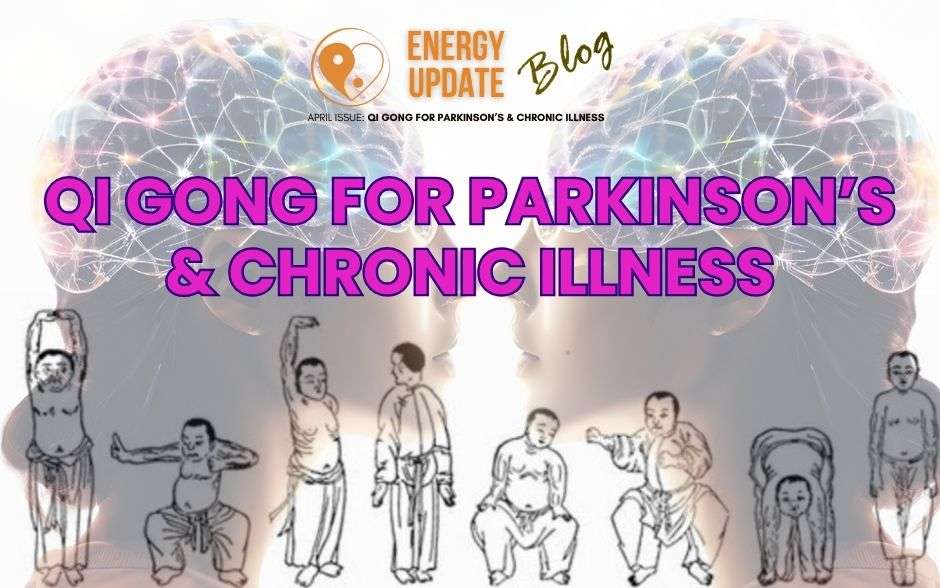
Qi Gong for Parkinson’s & Chronic Illness

Qi Gong for Parkinson’s & Chronic Illness

8 Brocades, Draw the Bow Explained

If you live with Parkinson’s, chronic illness, fatigue, stiffness, or simply feel that your body needs kind reconditioning, this is where the Eight Brocades Qi Gong practice becomes powerful.

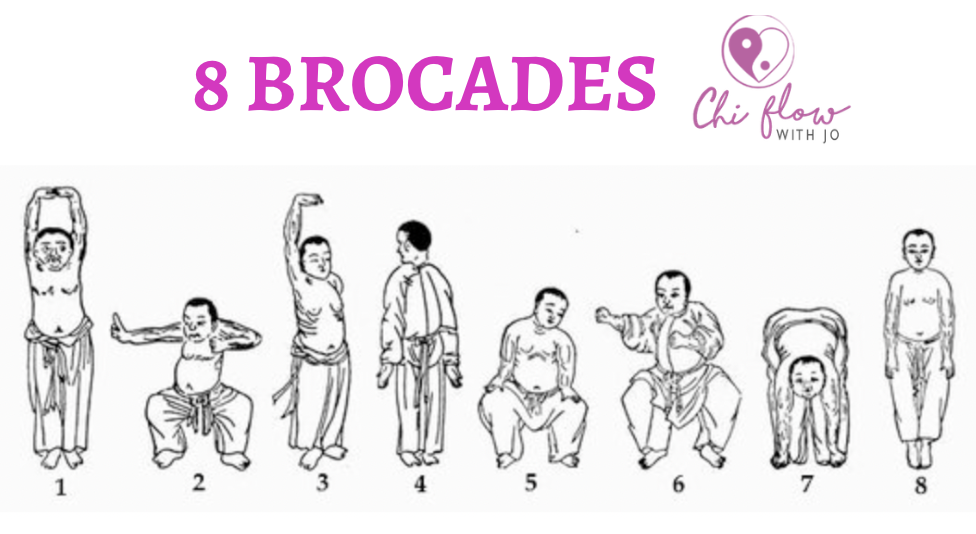
Inside Chi Flow with Jo, April is dedicated to the classical practice known as Ba Duan Jin, the Eight Brocades, a sequence believed to be over 1000 years old

These movements are simple, accessible, and deeply restorative.

If you have ever thought, “I know I should move more, but I don’t want to exhaust myself,” you are in the right place.

Why the 8 Brocades Are Ideal for Parkinson’s and Chronic Illness

The Eight Brocades act like a daily system check for the body.

They support:

  • Circulation and joint mobility
  • Upright posture and spinal strength
  • Nervous system regulation
  • Gentle, sustainable muscle activation
  • Mental clarity and emotional steadiness

For people living with Parkinson’s, consistency is more important than intensity. Small, repeated movements retrain coordination and rebuild confidence. For those managing chronic fatigue, autoimmune conditions, or recovery phases, this practice strengthens without draining.

Over time, this shows up as:

  • Easier mornings
  • Less tension in shoulders and neck
  • Greater steadiness when standing
  • Calmer evenings
  • Feeling present in your body again

One of our members of Chi Flow with Jo recently shared that after a few weeks of steady practice, she stopped bracing herself every time she stood up. Her shoulders softened. Her breath deepened. She noticed she was less reactive at home.

That is the real medicine.

The Anchor Movement, Draw the Bow, Fire the Arrow

One of the most empowering movements from the Eight Brocades is called Draw the Bow.

It is simple, grounding, and deeply regulating.

You stand with feet steady and rooted.
One hand draws back as though holding a bow.
The other extends forward as if gently aiming an arrow.

You inhale as you draw back.
You exhale as you release.

It is not about range.
It is about direction.

Benefits of Draw the Bow

  • Opens the chest and shoulders
  • Improves posture
  • Strengthens upper back muscles
  • Encourages coordinated breath and movement
  • Builds focus and quiet confidence
  • Supports emotional resilience

For those feeling collapsed, protective, or mentally foggy, this movement reminds the body,
I am here. I have direction.

In Parkinson’s, posture can gradually become flexed forward. Movements that open the chest and activate the back body are essential for maintaining upright presence. In chronic stress states, the chest often tightens. This movement restores expansion without force.

For Davy, living with Parkinson’s for over a decade, the Eight Brocades have become an anchor. On low energy days, he returns to simple repetition. Familiar rhythm. Breath. One movement at a time.

Some days are small. Some days are strong. Both count.

That mindset is powerful medicine.

Why Daily Live Practice Makes the Difference

The movement itself is important. The consistency is transformational.

Inside Chi Flow with Jo, members join:

  • Weekday live Qi Gong classes

  • Replays for flexible practice

  • Monthly health talks

  • Acupressure guidance

  • Food medicine support

  • Community reflection gatherings

When you know there is a space to show up, something shifts. Structure creates energy. Connection creates purpose.

And if you miss a day, there is no guilt. Just an open door.

Can Qi Gong Help Parkinson’s Symptoms?

Research and lived experience suggest that regular Qi Gong practice may support:

  • Balance and coordination
  • Reduced rigidity
  • Improved posture
  • Nervous system regulation
  • Better sleep
  • Emotional steadiness

The key is consistency. Not intensity.


The Eight Brocades are particularly effective because they combine:

  • Breath regulation
  • Bilateral movement
  • Gentle resistance
  • Coordinated focus

This integrated approach supports both physical and neurological resilience.

Join the Free Class

If you are curious about Qi Gong for Parkinson’s, chronic illness, fatigue, or healthy ageing, you are warmly invited to try a free class.

You do not need experience. You do not need flexibility. You simply begin where you are.

👉 Join the Free Class and experience the Eight Brocades for yourself.

Continue the Journey

If you would like ongoing support, Chi Flow with Jo offers:

  • Weekday live classes
  • Full Eight Brocades training
  • Acupressure guidance
  • Food medicine insights
  • Monthly health talks
  • Community gatherings

It is €39 per month, reducing to €20 per month after three months. Just €1 per class.

👉 Join Chi Flow with Jo HERE.

Go Deeper with Our Books

For those wanting to understand how movement, breath, and Chinese Medicine principles support living well with Parkinson’s, our books provide practical guidance rooted in lived experience and clinical wisdom.

👉 Buy the books and explore how to Find Your Flow and Live Well with Parkinson’s.

Movement does not need to be extreme to be powerful.
Small daily expansion reshapes the body.
Steady breath reshapes the nervous system.
Gentle repetition rebuilds confidence.

Every human body carries extraordinary capacity for renewal when given the right rhythm.

If April is asking you to soften into strength, come and practice with us.

Self-administered acupressure or Chinese Medicine is not a substitute for visits to qualified healthcare practitioners.

Knowing how to treat yourself and your loved ones with complimentary therapies like acupressure can be greatly beneficial and convenient. However, for serious and chronic conditions, you’ll want to visit an Shiatsu therapist / Acupuncturist or other qualified healthcare practitioner who can develop a treatment plan based on your unique medical history and combination of symptoms.

The information provided should not be considered medical advice.
Bone Health and Balance with Thérèse Cosgrove

Bone Health and Balance with Thérèse Cosgrove

Bone Health and Balance with
Thérèse Cosgrove

As the year folds into its quietest season, the energy of Bone Health rises to the surface.

In Traditional Chinese Medicine, winter and the kidneys are linked to our bones, balance, and nervous system.

This is the perfect time to nourish our structure and inner stillness — and that’s exactly what this month’s Energy Update explores with Thérèse Cosgrove, homeopath, nutritional therapist, and Feldenkrais practitioner.

Listening to the Body through Movement

Thérèse describes Feldenkrais as a way of using small, subtle movements to awaken the nervous system’s awareness. Through this awareness, we uncover patterns of tension and rediscover new, more efficient ways of moving.

“Rather than me telling you how to move,” she says, “your nervous system is intelligent enough to find the best way itself.”

These gentle explorations improve skeletal alignment, balance, and joint integrity, helping us move with ease and confidence — vital for bone health, especially in menopause, post-menopause, and chronic conditions such as Parkinson’s.

Even the pauses between movements matter:

“That’s when the nervous system learns and integrates — the same way we rest between breaths.”

When the brain stops bracing and begins organising the skeleton more efficiently, three bone-loving things happen:

Better load through bone: Bones remodel when they’re loaded. Efficient alignment means forces travel through the skeleton (not just muscles), stimulating bone.

Joint integrity & balance: Micro-adjustments reduce “overwork” in hips, knees, spine and shoulder girdle, improving confidence and decreasing fear of falling.

Down-regulated pain: When the nervous system feels safe, pain signals calm and movement becomes possible again — the virtuous cycle for recovery.

Feldenkrais is exploration, not achievement. Curiosity and playfulness are the fastest way to teach your bones and brain new options.

Yin, Stillness, and the Bone Season

As Joanne points out, the yin energy of winter invites quietness and grounding.

Just as the earth rests before spring, we too can pause, aligning our bones, slowing our breath, and reconnecting to what truly supports us.

Yet, in the rush toward Christmas, that stillness is often lost. Feldenkrais offers a way back into the body, a return to inner listening and calm.

Use the space between Christmas and New Year to be still of mind and quiet movements of body.

The Inner Chemistry of Strength

In her homeopathic and nutritional work, Thérèse looks at bone density not just as a matter of calcium, but of hormonal balance, mineral status, and heavy-metal detoxification.

Using gentle testing and homeopathic supports, she tailors treatment to each person:

“We might look at supporting estrogen, the parathyroid, or trace minerals like boron, all essential for strong, flexible bones.”

Joanne draws the parallel in Chinese Medicine: seaweeds in small amounts can help clear heavy metals and nourish the kidneys — though, as she reminds us, not everyone should take them.

What matters most is listening to your own body and finding what nourishes your unique system.

In Traditional Chinese Medicine, winter belongs to the Kidney system, which governs bones, marrow, ears (balance/vestibular), and the nervous system. Practical Kidney-nourishing ideas:

Flavours & foods: the salty flavour in moderation supports Kidney, think miso, mineral broths, black sesame, adzuki/black beans, and small amounts of seaweeds if appropriate.
Caveat: Seaweeds are iodine-rich; avoid or use cautiously if you have thyroid issues or are on certain meds.

Gentle, consistent practice: slow standing, breath-led spirals, and ankle-calf work “pump” fluids and stabilise balance, perfect winter medicine.

Stillness as medicine: quiet, warm, early nights rebuild Yin (think lubrication and reserves), the foundation for hormone balance post-menopause.

A Morning of Yin and Gratitude

When asked how she begins her day, Thérèse shares a simple ritual that reflects the essence of Chi Flow:

Hydrate with structured, living water to awaken the body. “Structured water”: what we mean (and what to do about it) Thérèse will expand on this in her Mid-Monthly Health Talk, but here’s the practical, controversy-free middle ground: Structured Water inside the body doesn’t behave like plain tap water. Near proteins, fascia, and cell membranes it forms ordered layers that help signaling and flow.

Step outside into morning light, facing east to reset circadian rhythm and hormones. Move gently, perhaps Chi Flow with Jo, Feldenkrais, or a mindful walk. Gentle vibration & movement (walking, bouncing, fascia spirals) appear to improve fluid distribution in connective tissue, exactly what we do in Chi Flow.

“These practices really helped me through difficult times,” she says. “My morning Chi Flow with Jo was one of the things that carried me.”

For Parkinson’s & chronic conditions

Hydration and gentle nervous-system work are especially helpful when autonomic regulation or muscle stiffness makes dehydration and bracing more likely. Short, frequent “micro-moves,” mineral-aware hydration, and morning light can noticeably improve steadiness and energy without fatigue.

WATCH THE PODCAST

In the full podcast, learn more about sound healing and how it affects our hormonal balance below: 

Join us inside Chi Flow (and get Thérèse’s talk free)

Thérèse’s Mid-Monthly Health Talk will go hands-on with Feldenkrais explorations, hydration you can feel, and a deeper look at “structured water” in everyday practice. It’s free for Chi Flow members.

👉 Join Chi Flow with Jo to access:

  • Daily live morning classes (with replays)

  • Seasonal recipes & self-acupressure

  • This month’s Mid-Monthly Health Talk with Thérèse Cosgrove — free for members

Start here: Join Chi Flow with Jo — Build strength, balance, and deep yin this winter.

💗 Ready to Join?

Click here to become a member of Chi Flow with Jo → CLICK HERE

Or drop in for a class and feel it for yourself (sign up below).


Join the Chi Flow with Jo community for live sessions, practice, and support on your journey to an emotionally healthy heart and attend Caroline’s live talk and sound bath for FREE.
To work with Caroline click HERE

Self-administered acupressure or Chinese Medicine is not a substitute for visits to qualified healthcare practitioners.

Knowing how to treat yourself and your loved ones with complimentary therapies like acupressure can be greatly beneficial and convenient. However, for serious and chronic conditions, you’ll want to visit an Shiatsu therapist / Acupuncturist or other qualified healthcare practitioner who can develop a treatment plan based on your unique medical history and combination of symptoms.  The information provided should not be considered medical advice.
.
Balance Allergies with Chinese Medicine: The Triple Burner Approach

Balance Allergies with Chinese Medicine: The Triple Burner Approach

Why Allergies Are On the Rise—and What Chinese Medicine Can Do

From sneezing fits to food sensitivities and itchy skin, allergies can feel like an invisible assault on your body. But in Traditional Chinese Medicine (TCM), these reactions aren’t random—they’re signs of imbalance, especially within a vital but lesser-known energy system: the Triple Burner (San Jiao).

This July in Chi Flow with Jo, we’re focusing on core strength, immunity, and emotional resilience—the same foundational systems affected by the Triple Burner. Let’s dive into how understanding and harmonizing this energy pathway can help you feel clear, strong, and allergy-free.

What Is the Triple Burner in Chinese Medicine?

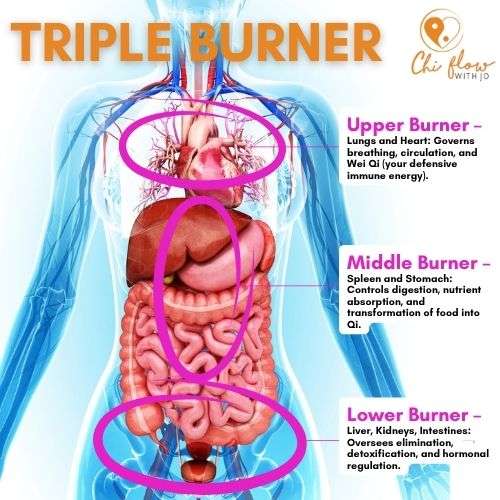
Unlike a physical organ, the Triple Burner is a functional system. It regulates the smooth flow of fluids and energy (Qi) across three key areas of the body:

  • Upper Burner – Lungs and Heart: Governs breathing, circulation, and Wei Qi (your defensive immune energy).


  • Middle Burner – Spleen and Stomach: Controls digestion, nutrient absorption, and transformation of food into Qi.


  • Lower Burner – Liver, Kidneys, Intestines: Oversees elimination, detoxification, and hormonal regulation.

When the Triple Burner is in balance, the whole body works in harmony. When it’s blocked or overwhelmed—especially by stress, excess heat, or poor diet—allergies, inflammation, and immune hypersensitivity can arise.  

How Allergies Disrupt the Triple Burner

In TCM, allergies are often a combination of:

  • – Stagnation – Qi isn’t flowing smoothly between the Burners.


  • – Excess Heat – Inflammatory responses go unchecked.


  • – Weak Wei Qi – The body’s defense energy can’t fight off invaders.

Your body might overreact to harmless stimuli—pollen, dust, food—as if they were threats. The result? Runny noses, red eyes, brain fog, bloating, and skin flare-ups.

And don’t forget the emotional triggers. Stress, anxiety, and even unprocessed grief can weaken the immune system and further disrupt the Triple Burner.

Acupressure to Balance the Triple Burner

One of the simplest and most effective ways to restore balance is acupressure. Here’s a meridian-clearing technique you can try anytime.

Triple Burner Meridian Clearing

  1. Eyebrows to Temples: Gently stroke from the outer edges of your eyebrows to your temples. 
  2. Ear Line: Massage over the ears and down behind them to the jawline. 
  3. Neck and Shoulders: Stroke down to the shoulder grooves (just behind the top of your shoulders). 
  4. Down the Arms: Follow the outer arm to the ring finger with a flicking motion. 
  5. Repeat on the other side.

This boosts lymphatic flow, clears heat, and promotes detoxification.  Read this study to learn more: NIH: Immunomodulatory effects of acupuncture in allergic diseases.

  • Triple Burner 5 (Outer Gate) – Immune Boost Point

    • – Location: Three finger-widths above the outer wrist crease.


    • – Technique: Hold or massage gently for 30 seconds to 3 minutes.


    • Benefits: Clears heat, reduces inflammation, and enhances immunity.


  • Use this point daily during allergy season or when feeling run down.

Eat to Cool and Clear: Chinese Dietary Tips for Allergies

To support the Triple Burner, especially when it’s overwhelmed by dampness and heat, try adjusting your diet:

❌ Foods to Avoid

  • – Processed snacks and sugars (increase inflammation)
  • – Excess dairy (contributes to mucus and dampness)
  • – Warming fruits like strawberries and grapes


✅ Foods to Emphasize

  • Cooling foods: cucumber, lettuce, watermelon, seaweed
  • High-fiber fruits: apples, pears, cherries (help reduce heat)
  • Hydrating infusions: cucumber-mint water
  • Healing combo: ginger + mint + pineapple for digestion and inflammation relief 

These foods nourish Yin, clear heat, and help regulate allergic responses from the inside out.

Qigong for Allergy Relief and Triple Burner Harmony

Daily Qigong supports the Triple Burner by improving fluid circulation, calming the nervous system, and balancing immune responses.

Triple Burner Flow Exercise

  • Inhale: Sweep one hand up, palm facing the sky.
  • Exhale: Guide the hand down the front of your body—passing the chest (upper burner), the solar plexus (middle), and the lower belly (lower burner).
  • Repeat with the other hand in a continuous, flowing motion.

This gentle sequence anchors the breath and calms overactivity in both the immune and nervous systems. Practice daily to shift from stress mode into “rest, digest, and restore.”

The Wisdom of Chinese Medicine

As the ancient TCM saying goes, “When Qi flows, health follows; when Qi stagnates, disease occurs.” By nourishing your Kidney Qi with food, activating key acupressure points, and practicing Qi Gong, you’ll not only improve your immune function but also restore a sense of vitality and balance to your life.

So, whether you’re battling winter colds or looking for relief from that awkward sweaty discomfort, these simple practices can make a profound difference. May your days be filled with warmth, health, and joy.

Final Thoughts – Core Strength isn’t just physical

 Just like we build core muscle to support our spine, we also need energetic core strength—grounded breath, stable emotions, and smooth Qi flow through all three burners.

This month in Chi Flow with Jo, we’re diving into how core strength links to bladder health, hormonal balance, and yes, even allergies.

By working with the Triple Burner, you’re not just addressing symptoms—you’re transforming the terrain. So breathe deep, eat cooling foods, press your points, and come flow with us.

DO YOU HAVE A QUESTION?

The Ask Me Anything podcast series has been created to answer your questions using my knowledge of Chinese medicine, Qi Gong, Qi Food therapy and Shiatsu. 

You can ask a question by clicking on THIS LINK, or you can watch past episodes to see if your question has already been answered.

Join the Chi Flow online community today!

Also, join me in Chi Flow with Jo every weekday morning for live online Qi Gong where we will practise Qi Gong, as well as self-acupressure, delicious healthy recipes, Traditional Chinese Medicine (TCM) tips and Meridian stretches.  

You can sign up for a FREE online qi gong class with the form below.

Hope to see you in the Chi Flow!

Self-administered acupressure or Chinese Medicine is not a substitute for visits to qualified healthcare practitioners.

Knowing how to treat yourself and your loved ones with complimentary therapies like acupressure can be greatly beneficial and convenient. However, for serious and chronic conditions, you’ll want to visit an Shiatsu therapist / Acupuncturist or other qualified healthcare practitioner who can develop a treatment plan based on your unique medical history and combination of symptoms.

The information provided should not be considered medical advice.

Understanding Tremors and Parkinson’s in Chinese Medicine

Understanding Tremors and Parkinson’s in Chinese Medicine

Today, we’re addressing a heartfelt question from a listener undergoing evaluation for Parkinson’s disease, seeking guidance on reducing spontaneous body tremors.  Remember, the insights I share are complementary and should harmonize with your personal health journey and any advice from your healthcare providers.

Understanding Tremors in Chinese Medicine

In Traditional Chinese Medicine (TCM), tremors are seen as manifestations of internal imbalances, particularly involving the liver and kidney energy systems. These systems are not just organs but represent a holistic network of functions. Disruptions in the smooth flow of Qi (chi), your vital energy and blood can create what is known as internal wind. This isn’t flatulence, but rather a chaotic climactic condition that can lead to spasms and tremors throughout the body.

Involuntary movements such as tremors, twitches, and spasms, including conditions like Bell’s Palsy, Dystonic tremor, Essential tremor, Parkinsons, and stroke can be addressed by nourishing the body’s yin energy and calming excessive yang. We want a smooth flow of blood, governed by the liver, and a grounded essential energy, governed by the kidneys. Supporting these systems through dietary choices is an excellent place to start.

Dietary Recommendations for Reducing Tremors

To support yin and anchor the body’s energy, incorporate foods with yin-nourishing properties:

To support yin and anchor the body’s energy, incorporate specific foods into your diet that encourage yin-nourishing properties.

Walnuts are a really great yin food. What do they look like? They look like brains, and they have such a complex range of minerals within them, making them excellent for supporting kidney energy and yin. The kidney governs the winter of the body, that still, quiet, deep time where everything is in transition, just waiting for the rising of spring. So, any foods that nourish kidney energy in Chinese medicine help to calm spasms and tremors.

Find a full outline of Kidney and Liver foods in my 5 element Cook books

Seaweed is a fantastic yin-nourishing food, packed with minerals like magnesium, manganese, copper, iron, and calcium. These nutrients help relax tense, tight, spasming muscles. Barley is another grain that cools the body, often recommended for urinary tract infections, to cool the heat and irritation, super effective for nourishing yin.

Conversely, it’s important to limit yang foods such as refined carbohydrates, refined sugars, and alcohol. These introduce heat and agitation to the body. While some warming yang foods, like ginger, garlic, and chili, can be useful when fighting infections, they may exacerbate tremors. Hydration is also essential; drinking ample water helps nourish the kidneys and support overall balance.

Qi gong for Reducing Tremors

Qi gong (Qi = energy, Gong = work) is an ancient practice that aligns the mind and body to regulate energy. Sometimes, energy rises excessively, leading to heat, anxiety, or jitteriness.

Through gentle flowing movements, Qi gong helps restore the smooth flow of qi and blood, preventing energy stagnation, excess tension and movement.

I offer a free Qi gong class at the end of each month (sign up at the bottom of this blog post), it’s a great way to experience these practices firsthand.

My husband, Davey, has Parkinson’s, and together, we use Qigong to help him manage his symptoms. While Parkinson’s currently has no cure, there are ways to live well with the condition.

Davy shared that before he began practicing Qigong, he often felt as though the tremors were overwhelming his mind, making it difficult to think clearly. Through mindful movement and breathwork, he found that while the tremors may not disappear, they no longer dominated his focus.

Qi gong Practice for Tremors

Before practicing, it’s important to acknowledge the presence of tremors rather than resist them. Fighting against them can increase stress and exacerbate symptoms. Instead, mindful practices help create a deep state of acceptance and tranquility.

Shaking Qi gong Exercise

• Find your space: You can do this sitting or standing. If standing, place your feet hip-width apart, knees slightly bent, tailbone gently tucked under.
• Amplify the shaking: If you are already shaking, lean into it! Place your hands on your lower belly and shake from your core.
• Shift the weight: Move the shaking energy down your legs:
• Inhale deeply, exhale, and shake down one leg.
• Inhale deeply again, exhale, and shake down the other leg.
• Shake through the arms one at a time: Imagine the energy flowing to your fingertips as you shake out your hands.
• Full-body shake: Ensure there is space under your armpits, as Parkinson’s can often lead to excessive tension in the upper body.
• Release into stillness: Let the shaking subside and take a deep breath in through the nose as if smelling a rose, exhaling fully pressing the belly button to the spine, allowing the energy to settle.
• Take 3 breaths: one to land in the stillness, one to integrate the sensation into the whole body and one to let the body accept being here now.

Kidney and Bladder Meridian Qigong

• Rub your kidneys: Place your hands on your lower back and gently massage the area.
• Sweep down the hamstrings/bladder channel: Let your hands glide down the back of your legs, allowing your head to drop forward.

• Inhale, drawing energy up/kidney channel: Place your hands on the inner legs and sweep them up the body, over the pubic bone, and flick the energy off.
• Exhale, descending the energy: Bring your hands down with palms facing the earth, grounding your energy.
• Repeat: Continue this cycle to smooth the qi through the kidney and bladder meridians, which are vital for nervous system regulation.

Finding Peace Within

As you conclude your practice, place your hands over your lower belly and take a moment to connect inward. You may still feel tremors, but you might also notice a newfound sense of stability. This practice isn’t just about reducing shaking, it’s about reclaiming your sense of self and balance.

You may have Parkinson’s, but Parkinson’s doesn’t have you.

May you be happy, safe, and well. May I be happy, safe, and well. May all beings everywhere be happy, safe, and well.


DO YOU HAVE A QUESTION?

The Ask Me Anything podcast series has been created to answer your questions using my knowledge of Chinese medicine, Qi Gong, Qi Food therapy and Shiatsu. 

You can ask a question by clicking on THIS LINK, or you can watch past episodes to see if your question has already been answered.

Join the Chi Flow online community today!

Also, join me in Chi Flow with Jo every weekday morning for live online Qi Gong where we will practise Qi Gong, as well as self-acupressure, delicious healthy recipes, Traditional Chinese Medicine (TCM) tips and Meridian stretches.  

You can sign up for a FREE online qi gong class with the form below.

Hope to see you in the Chi Flow!

Self-administered acupressure or Chinese Medicine is not a substitute for visits to qualified healthcare practitioners.

Knowing how to treat yourself and your loved ones with complimentary therapies like acupressure can be greatly beneficial and convenient. However, for serious and chronic conditions, you’ll want to visit an Shiatsu therapist / Acupuncturist or other qualified healthcare practitioner who can develop a treatment plan based on your unique medical history and combination of symptoms.  

The information provided should not be considered medical advice.
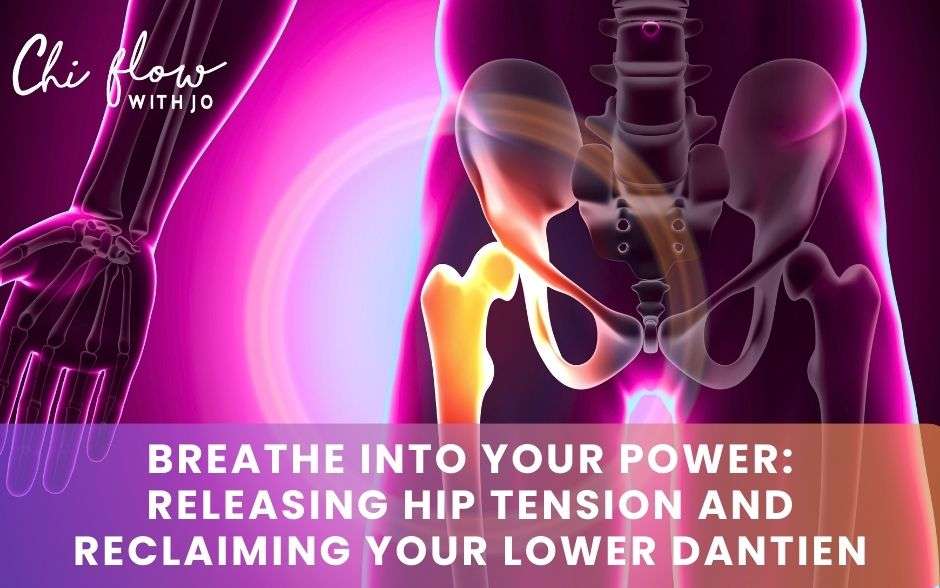
Breathe into Your Power: Releasing Hip Tension and Reclaiming Your Lower Dantien

Breathe into Your Power: Releasing Hip Tension and Reclaiming Your Lower Dantien

When we move stiffly, when our hips feel locked or our lower back aches, it’s more than just physical, it’s emotional, energetic, and ancestral. This month in Chi Flow with Jo, we’re bringing loving attention to the lower Dantien, the energetic centre in the pelvis that is key to vitality, power, and fluid movement.

Together with the incredible Julie Williams, practitioner of Consciousness Medicine and Family Constellations, who will give our Mid Monthly Health talk, we explore how trauma, rigidity, and emotional wounds, especially those from early childhood, can get stored in the sacral chakra and hips, creating tightness in both body and mind.

Emotional Baggage in the Hips

Julie shared from the Ayurvedic tradition, the sacral chakra, located in the lower abdomen, becomes active between the ages of five and eight. Any emotional upheaval or trauma during this period can create a dense energetic “wobble.” It doesn’t spin smoothly, and this disruption shows up as tension in the hips, lower back pain, stiffness, or even a sense of disconnection from joy, pleasure, and creativity.

Julie reminded us during our conversation that this trauma isn’t always ours alone. Much of what we carry is ancestral—deeply rooted emotional patterns passed down through generations. As we age, these patterns can harden not only in our beliefs but also in our bodies. Hips tighten. Shoulders stiffen. We become less flexible—not just physically, but emotionally and mentally too.

But here’s the good news: we can shift it. We can release the trauma. And we can restore flow.

Two Simple Practices to Unlock Hip Flexibility and Emotional Flow

Here are two powerful solutions from our Podcast that you can try today to soften your hips, boost your mobility, and breathe life into your lower Dantien:

1. Creative Expression

Creativity heals. Whether it’s cooking, painting, singing, dancing, or even choosing to wear a joyful colour, creative acts unblock the sacral chakra and invite movement into areas that feel frozen.

You don’t have to be an artist—simply engage in something playful and expressive.

Even something as gentle as pushing a pebble around on a blank page with a pen, letting your hand follow the flow, opens channels of expression. You’re giving yourself permission to move differently—physically and emotionally.

“Whatever we focus on grows. So focus on creation, not just consumption.” – Julie Williams

Start your morning with this mantra: Create first. Consume second. Before you reach for your phone, create something. Morning pages, a smoothie, a sketch. It sets the tone for presence, not reaction.

2. Breath into the Pelvis

Many of us have never been taught to consciously breathe into our sexual organs, the very space where life begins. But this area is a powerhouse of energy, and it’s often shrouded in shame, fear, or disconnection.

By simply placing your hands over the lower belly and breathing deeply into this space, you begin to reconnect with your power. The lower Dantien is where Qi gathers and transforms. It’s the energetic furnace of the body.

Try this:
• Sit or lie comfortably.
• Place both hands over your lower abdomen.
• Inhale deeply through the nose, imagining the breath travelling down to the pelvic bowl.
• Exhale through the mouth with a sigh.
• Repeat for several minutes, sending loving attention to this sacred centre.

Over time, this restores the flow of life force energy, allowing you to access joy, creativity, and mobility in the hips.

Trauma Needs Tenderness

As Julie shared, trauma release must be done with care. Working with a trauma-informed therapist ensures you don’t accidentally retraumatize your nervous system. It’s not about diving deep into the wound. It’s about gently acknowledging it, locating it in the body, and giving it permission to move and heal.

In Consciousness Medicine, practices like timelines, family constellation work, and NLP reframing help you see that you are not your trauma. You are the one who experienced it, and you have the power to transform it.

This Month in Chi Flow with Jo

In our daily Qi Gong practice, we’ll be focusing on hip mobility, pelvic breathing, and cultivating lower Dantien energy. These movements and breath practices help us connect with our power, release stored emotions, and move with grace and ease.

Later this month, Julie Williams will offer a Mid-Month Member Health Talk, diving even deeper into Consciousness Medicine techniques to support emotional release, creativity, and energetic resilience. Her work brings beautiful depth to what we practice each morning in Chi Flow.

You Are Not Just the Trauma

You are a radiant being, creative, powerful, and whole. The emotional body can expand and contract, but the spiritual self remains untouched, always intact. When you move, breathe, and create from this knowing, healing unfolds.

Come move with us. Come soften. Come reclaim your flow.  Sign up for the LIVE Free Class at the end of the month and we’ll send you the recording too.


Self-administered acupressure or Chinese Medicine is not a substitute for visits to qualified healthcare practitioners.

Knowing how to treat yourself and your loved ones with complimentary therapies like acupressure can be greatly beneficial and convenient. However, for serious and chronic conditions, you’ll want to visit an Shiatsu therapist / Acupuncturist or other qualified healthcare practitioner who can develop a treatment plan based on your unique medical history and combination of symptoms.  

The information provided should not be considered medical advice.
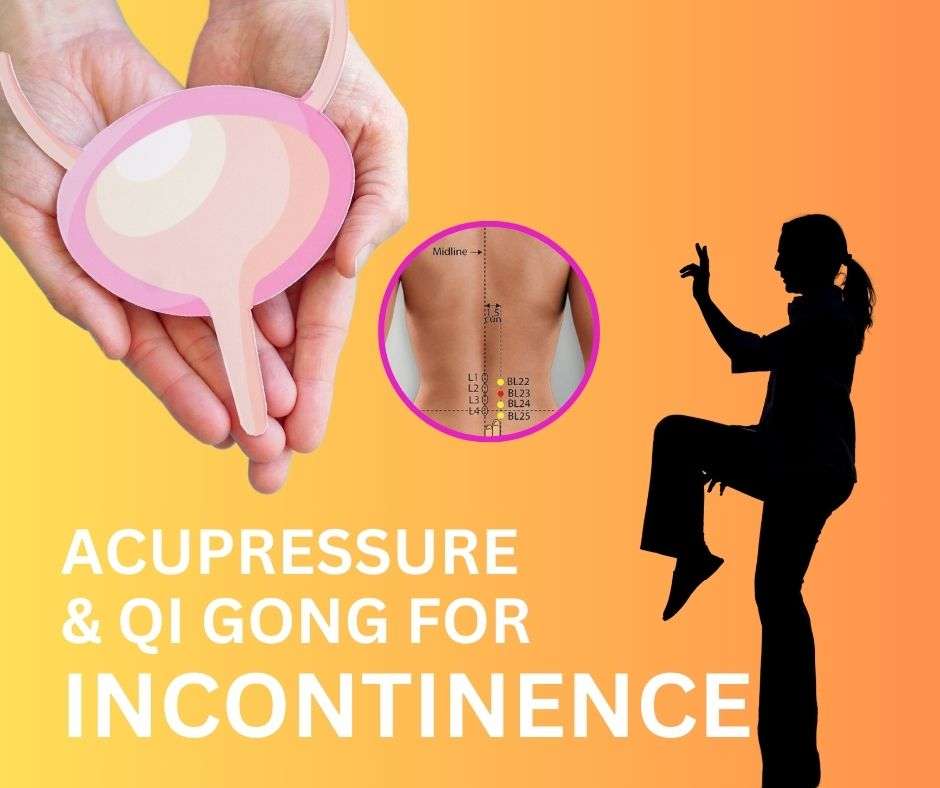
How can Acupressure and Qi Gong Can Help Women Over 40 Manage Incontinence?

How can Acupressure and Qi Gong Can Help Women Over 40 Manage Incontinence?

How can Acupressure and Qi Gong Can Help Women Over 40 Manage Incontinence?

This was a question submitted in the latest Ask Me Anything Podcast.

Incontinence is a common but often frustrating challenge, particularly for women over 40. Hormonal changes, life stressors, and even past medical treatments like those for breast cancer can impact bladder health and kidney energy. 

Traditional Chinese Medicine (TCM) offers an empowering solution through the practices of acupressure and Qi Gong, which address not only physical symptoms but also emotional well-being.

Below, we explore how these techniques can strengthen kidney energy and improve incontinence while incorporating specific tips, exercises, and foods for holistic healing.

Understanding Kidney Energy and Incontinence

In TCM, the kidneys are considered the source of our vitality. Weak kidney energy, or kidney chi, can lead to poor bladder control, causing the urgency and frequency characteristic of incontinence. This weakening often results from ageing, stress, hormonal shifts, and even dehydration. Strengthening kidney energy helps regulate urinary flow, manage stress, and support hormonal balance.

Common Symptoms of Weak Kidney Energy

– Urgency or frequent urination
– Hormonal imbalances
– Weak bones or sore teeth
– Tinnitus or loss of balance
– Forgetfulness or mental fatigue
– Night sweats

The key to managing incontinence is not simply tightening the pelvic muscles but nourishing the kidneys and promoting a natural flow of energy.

Foods to Strengthen Kidney Energy

Incorporating kidney-nourishing foods into your diet can have a profound effect on your overall energy and bladder health. Here are some powerful options:

Barley Water

Make barley water and drink it each morning for two weeks to strengthen the kidneys. Over time, this will help regulate urination and support your nervous system. 

Find the recipe in Good Food cookbook and Shiatsu & Conscious cooking or in the Fatigue blog.

Nettle Tea

Nettle tea is highly beneficial for urinary health. You can pick fresh nettles in spring or purchase pre-made tea. This remedy works well for both men and women with urinary issues.

Kidney-Strengthening Teas

Incorporate Kukicha tea or nettle tea, both rich in minerals like calcium, to support bone health and kidney vitality.

Alkalizing Foods

Focus on foods that reduce acidity and strengthen the kidneys, such as leafy greens, seaweed, barley and pulses.

Acupressure Points for Incontinence

Acupressure is a gentle, effective way to stimulate energy flow and support kidney health. Below are key points to practice.  Combining them with the Qi Gong exercise will supercharge and invigorate the Kidney energy system.

1. CV6 (Conception Vessel 6)

  • Location: Two fingers below the belly button.
  • Technique: Massage this point to activate kidney yin energy. This helps regulate urinary flow and strengthen the core.

2. Ming Men (Gate of Life)

  • Location: On the spine, at waist level where your middle fingers meet.
  • Technique: Warm this point by rubbing very gently. Place one hand on your CV6 point and the other on your back over the Ming Men point. Visualize an energy connection between the two points to balance kidney yin and yang.

3. Bladder 31, 32, and 33

  • Location: A V shape following the line of the sacrum, near the crease of the buttocks.
  • Technique: Rub or tap these points to stimulate energy flow and improve bladder control.

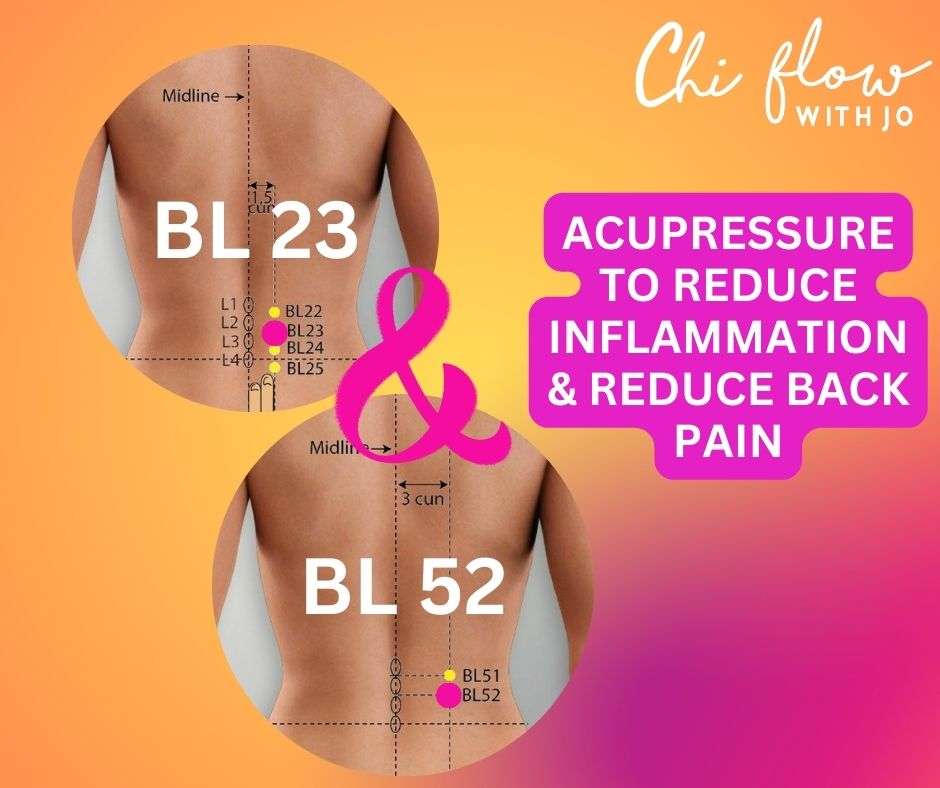
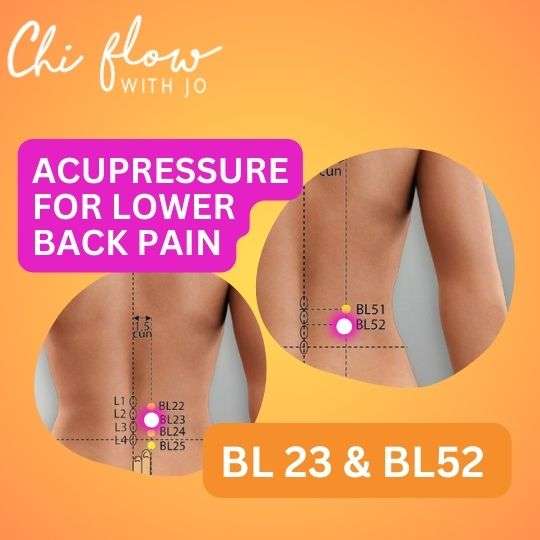
4. Bladder 23 and 52

  • Location: On either side of the spine, level with the kidneys.
  • Technique: Massage and warm these points to energize and protect the kidneys.

Qi Gong Exercises for Incontinence

Qi Gong integrates breath, movement, and focus to enhance chi flow. The following exercise targets bladder health:

Contraction and Expansion Exercise:

  1. Posture: Sit or stand comfortably.
  2. Exhale: Draw your belly button toward your spine, pull up the perineum (pelvic floor muscles), and imagine closing a gate.
  3. Inhale: Relax your belly, allowing it to expand naturally.
  4. Repeat: Perform this sequence 5-10 times, focusing on contraction and release. This mimics the natural rhythm of the body, promoting balance.

 Protecting the Kidneys

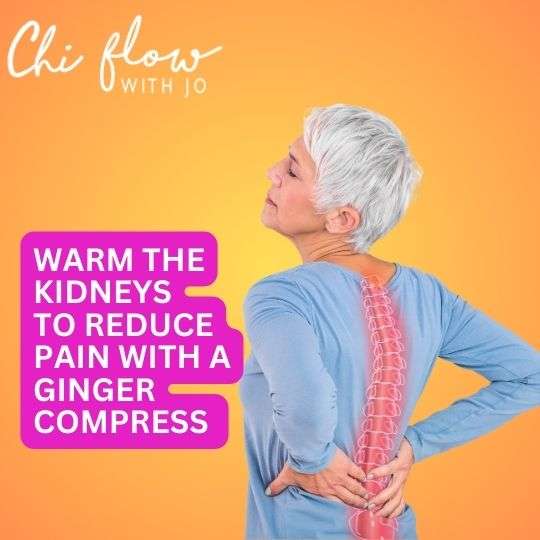
Kidneys thrive in warmth, so it’s essential to protect them from cold, especially during winter. Use these tips:

* Wear a scarf around your waist to keep the kidney area warm.

*Avoid drinking excessively cold beverages.

* Practice contracting and relaxing the pelvic flow and the Kua to allow energy to flow freely.

Emotional Healing and Trauma Release

For women recovering from past health challenges like breast cancer, emotional trauma may linger, affecting kidney energy, holding tension and fear in the Psoas muscle and the Kua (hips, soft tissues, sacrum and the perineum)  Practice Qi Gong movements that encourage letting go and use acupressure to remind your body it is safe and well. 

Shake out residual fear or tension and focus on cultivating joy and connection.

Final Thoughts

Acupressure and Qi Gong offer gentle, yet profound methods to manage incontinence by addressing its root causes. By nourishing the kidneys, stimulating chi flow, and balancing contraction with relaxation, you’ll find greater control and well-being.

Explore these practices further and incorporate the recommended foods into your daily routine. Remember, contraction and expansion, flow and stillness—this is the way of the body and life. Let Qi Gong guide you to health and joy.

For more tips, classes, and support, join Chi flow with Jo or contact Jo for individual support

DO YOU HAVE A QUESTION?

The Ask Me Anything podcast series has been created to answer your questions using my knowledge of Chinese medicine, Qi Gong, Qi Food therapy and Shiatsu. 

You can ask a question by clicking on THIS LINK, or you can watch past episodes to see if your question has already been answered.

Join the Chi Flow online community today!

Also, join me in Chi Flow with Jo every weekday morning for live online Qi Gong where we will practise Qi Gong, as well as self-acupressure, delicious healthy recipes, Traditional Chinese Medicine (TCM) tips and Meridian stretches.  

You can sign up for a FREE online qi gong class with the form below.

Hope to see you in the Chi Flow!

Self-administered acupressure or Chinese Medicine is not a substitute for visits to qualified healthcare practitioners.

Knowing how to treat yourself and your loved ones with complimentary therapies like acupressure can be greatly beneficial and convenient. However, for serious and chronic conditions, you’ll want to visit an Shiatsu therapist / Acupuncturist or other qualified healthcare practitioner who can develop a treatment plan based on your unique medical history and combination of symptoms.  

The information provided should not be considered medical advice.
Unlocking the Power of Qi Gong: How to Bring Energy, Balance, and Strength into Your Everyday Life

Unlocking the Power of Qi Gong: How to Bring Energy, Balance, and Strength into Your Everyday Life

Discovering the Magic of Qi Gong

What if you had a hidden superpower—an untapped energy source within you that could bring balance, strength, and clarity to your everyday life? That’s exactly what Qi Gong offers.

For women over 45, this ancient practice isn’t just about movement; it’s about reclaiming vitality, confidence, and inner peace. And the best part? You don’t need to be an expert. You just need to be willing to connect with your own energy, your Qi, and let it flow.

This month at Chi Flow with Jo, we’re honored to welcome Sheena Woods, founder of the Cork School of Shiatsu and an exceptional Qi Gong teacher. Sheena’s journey into Qi Gong is an inspiring one, rooted in her passion for martial arts and her deep understanding of the body’s natural energy systems.

Like many of us, she first encountered Qi—without even knowing it—long before she officially discovered the practice of Qi Gong.

Growing up with two older brothers, Sheena took up judo as a way to hold her own, quickly realizing that power wasn’t just about size—it was about energy. That same principle applies to Qi Gong.

You don’t have to be physically strong to feel powerful. Instead, by connecting with your breath, aligning your body, and moving with intention, you can cultivate an energy that makes you feel grounded, centered, and in control—whether you’re walking down the street or navigating the challenges of daily life.

Qi Gong isn’t just an exercise; it’s a way of being. As Sheena describes, the real magic happens when you take Qi Gong beyond your dedicated practice time and weave it into your everyday routine. Imagine feeling calm and balanced while hanging out the laundry, centered while cooking dinner, or relaxed while driving in traffic.

It’s about bringing mindfulness and flow into every moment, transforming ordinary tasks into opportunities for connection and self-care.

And here’s the secret: it’s easier than you think. By simply shifting your awareness, focusing on your breath, your posture, and your energy, you can begin to feel the profound effects of Qi Gong in your daily life. Whether you’re looking for relief from stress, a way to boost your vitality, or a practice that brings joy and ease into your body, Qi Gong is a tool that every woman should have in her wellness toolkit.

WuJi – The Art of Standing Still with Power

One of the most profound yet simplest Qi Gong practices is WuJi—the art of standing in effortless alignment. It may seem like ‘just standing,’ but WuJi is a powerhouse of energy cultivation. This foundational stance is the perfect way to recharge, reset, and realign your energy at any time of the day. Whether you’re waiting in a queue, standing in your kitchen, or taking a moment of stillness in your garden, WuJi allows you to tap into deep reservoirs of strength and balance.

Sheena describes WuJi as her go-to practice, something she returns to again and again. Why? Because it’s easy to do yet infinitely rich in its benefits. By standing with your feet hip-width apart, your shoulders relaxed, and your body soft yet aligned, you allow Qi to flow freely. Tension dissolves, stiffness melts away, and your energy moves with ease.

It’s a simple shift with profound results. When you soften your body and maintain an open posture, you create space for the Qi to move, preventing stagnation and blockages that lead to discomfort.

Often, our joints accumulate tension, making us feel heavy and sluggish.

But with WuJi, you allow everything to flow, reconnecting with the earth beneath you and the vast energy of the universe above.

The real challenge? Staying present. As Sheena explains, the mind will naturally wander—thinking about groceries, dinner plans, or a twinge in your back. But the power of WuJi lies in the practice of returning to stillness, again and again. Over time, this cultivates a deep reservoir of energy, like charging your inner battery, leaving you feeling vibrant and centered no matter what the day brings.

And then, from this stillness, all movement arises. WuJi is the foundation from which Qi Gong’s flowing forms and spontaneous movements emerge. It’s the birthplace of energy, intention, and flow.

Sheena shares a profound realization from her own journey, an ‘aha’ moment that confirmed Qi Gong’s power. During a deep meditation, she experienced a sensation of complete dissolution, as if she had expanded beyond her physical form, merging with the universe. In that moment, she understood that we are only as limited as we believe ourselves to be.

Qi Gong teaches us that we are more than just our thoughts, our routines, or even our bodies. We are energetic beings, capable of shifting, expanding, and reconnecting with the world in a deeply intuitive way. By practicing WuJi, by standing in alignment with both heaven and earth, we open ourselves to this powerful truth.

The Journey of Teaching and the Flow of Spring Energy

Teaching is one of the most powerful ways to deepen your own practice. This month, Sheena is committing to teaching Chi Flow with Jo, not only to share her wisdom but to deepen her own connection to Qi Gong. Rooting herself in this daily discipline, she embraces the structure of consistent practice—an experience she believes will bring growth and transformation.

Sheena’s approach to morning rituals has evolved over time. With fewer external demands, she now thrives in a fluid routine, consciously breaking old patterns to invite spontaneity. However, she acknowledges that a structured practice like Qi Gong creates a sense of wakefulness, alertness, and presence, qualities that enhance every aspect of life.

April’s practice will focus on the dynamic energy of wood, the element of growth and movement in Traditional Chinese Medicine.

But before diving into the wood element, Sheena will first check in with the water energy, ensuring a strong foundation.

Just as water nourishes the growth of trees, a balanced foundation supports effortless expansion.

A highlight of the month’s practice will be a powerful liver cleanse,  a Qi Gong remedy routine passed down by Master Zou. This gentle yet effective series of movements supports the liver, an organ closely tied to the wood element. When liver energy is stagnant, we may experience headaches, tension in the neck and shoulders, or emotional frustration. By opening up this energy pathway, we allow vitality to rise naturally, bringing clarity, flexibility, and ease.

Sheena’s invitation is simple: join her for a month of Chi Flow and experience the profound shifts that arise from consistent practice. Whether you’re new to Qi Gong or a seasoned practitioner, this journey offers the perfect opportunity to align with the energy of spring, embrace new beginnings, and cultivate lasting balance.

WATCH & LISTEN TO THE
ENERGY UPDATE PODCAST

ready to feel the flow?

Join us in April for Liver Cleanse Qi Gong and discover how a daily practice can transform your energy, your health, and your life.

Boost your health and vitality with Chi Flow with Jo—a holistic approach that integrates movement, acupressure, and food medicine. Scroll down to watch the podcast episode and sign up for a FREE online Qi Gong class.

Self-administered acupressure or Chinese Medicine is not a substitute for visits to qualified healthcare practitioners.

Knowing how to treat yourself and your loved ones with complimentary therapies like acupressure can be greatly beneficial and convenient. However, for serious and chronic conditions, you’ll want to visit an Shiatsu therapist / Acupuncturist or other qualified healthcare practitioner who can develop a treatment plan based on your unique medical history and combination of symptoms.  

The information provided should not be considered medical advice.
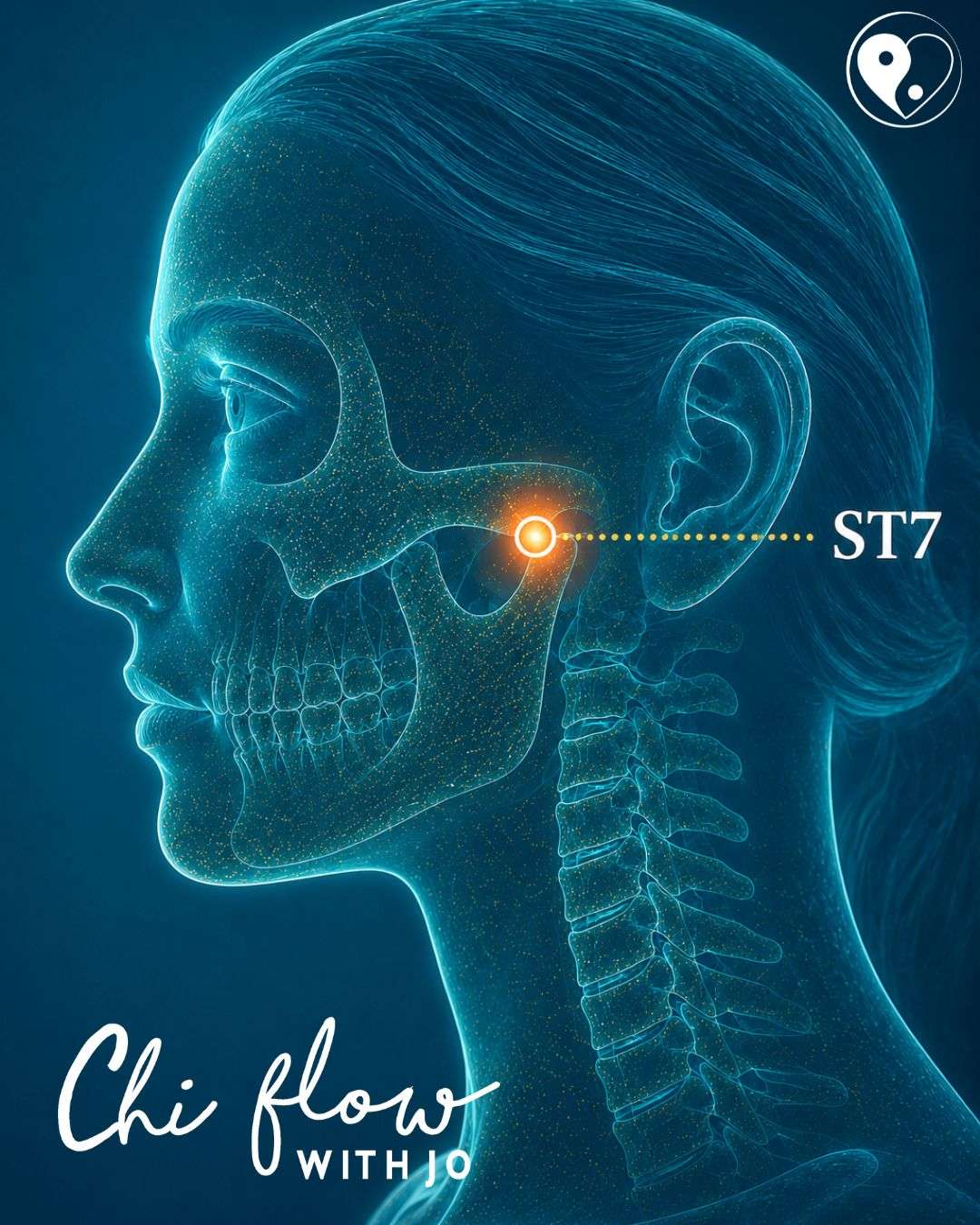
Back Pain Doesn’t Have to Hold You Back

Back Pain Doesn’t Have to Hold You Back

Back pain is an all-too-common struggle. Did you know it’s one of the leading reasons people miss work and the second most common reason for visiting the doctor? Shockingly, 80% of us will experience back pain at some point in our lives.

Whether it’s hours spent hunched over a desk, long drives, sports injuries, or simply the wear and tear of daily life, back pain can seem inevitable. But it doesn’t have to be. With the powerful tools of Qi Gong, Food Medicine, and Acupressure, you can take charge of your health and alleviate back pain—naturally and effectively.

Instead of accepting back pain as part of life, imagine addressing it head-on, restoring balance, and preventing it from progressing into a more debilitating issue.

Understanding Back Pain Through the Lens of Chinese Medicine

In Chinese Medicine, back pain is often rooted in Qi and Blood Stagnation.

Qi Stagnation:

Qi, the vital energy flowing through your body, moves along meridians (energy channels). When this flow is blocked, discomfort begins as a dull ache but can develop into sharp, fixed pain.

For example, women with painful periods often experience lower back pain due to stagnation of Qi, which prevents blood from circulating freely.

Another common culprit is the invasion of cold or dampness into the bladder meridians of the spine.

Think of Qi like water flowing through a river. When temperatures drop, water slows, thickens, and may even freeze, unable to move freely. Qi behaves the same way—cold or stagnation can stop its smooth flow, leading to pain and discomfort.

Moving the body with gentle exercise such as Qi Gong can create heat in the body, warming the meridians, the muscles and the fascia which in turn helps the Qi and blood to flow.

Blood Stagnation:

Trauma, injury, or sedentary habits can lead to poor blood flow. Like a bruise that lingers, blood stagnation can intensify pain.

A sedentary lifestyle without physical activity plus slouching or sitting slumped on your office chair or couch, hunching forward while weeding your garden or standing washing dishes for a long time, can cause Qi stagnation.

The good news? The treatment is the same: Get moving, stay warm, and stimulate circulation.

In Chi Flow with Jo, you’ll learn targeted exercises like spinal cord breathing and massage techniques for acupoints BL23 and BL52, which support back health and relieve pain.

Bladder 23 (Shenshu) and Bladder 52 (Zhishi) are pivotal acupoints along the Bladder meridian, renowned in Traditional Chinese Medicine (TCM) for alleviating back pain by enhancing Qi and blood circulation.

Locating Bladder 23 (Shenshu) Kidney Transporter: This point is situated on the lower back, level with the space between the second and third lumbar vertebrae, approximately two finger-widths (1.5 cun) lateral to the spine.

Locating Bladder 52 (Zhishi) Willpower room: Found at the same lumbar level as Bladder 23, Bladder 52 is positioned further outward, about four finger-widths (3 cun) lateral to the spine.

Benefits of Massaging and Warming These Points:

Enhancing Qi and Blood Flow: Gentle massage stimulates these acupoints, promoting the smooth flow of Qi and blood along the Bladder meridian, which can alleviate stagnation and reduce back pain.

Kidney Support: Bladder 23 is closely associated with kidney health. Massaging this point can strengthen the kidneys, which, in TCM, are vital for maintaining overall vitality and back strength. (See below)

Therapeutic Warmth: Applying warmth to these areas, such as using a warm compress or engaging in practices like ginger foot soaks, can further enhance circulation and provide relief from discomfort. (see the latest Ask Me Anything for further information) Grief & Back Pain

Supporting the Kidneys Through Food Medicine

In Chinese Medicine, the kidneys are the foundation of lower back health. When the kidney system is deficient, back pain and other symptoms, like fatigue, sweating, dizziness, or insomnia can arise.

Whenever there is back pain the Kidney system will be treated in Chinese medicine.
‘The Yellow Emperor’s Classic of Internal Medicine’ (206 BCE–220 CE) states;

If there is free flow, there is no pain;
If there is no free flow, there is pain.

We have already discussed the Qi and/or blood stagnation in the channel(s), if specifically through the region of the low back, there will be pain.

The kidneys relate to the water element so again return to the image or a river flowing unimpeded and suddenly a tree falls across the river, we see in our imagination the water no longer flowing freely, but getting blocked by the log, pushing into the banks of the river.
The basic concept of exercising the meridians in Qi Gong is to re-open the river, create a circulation so that the log lifts and normal flow is restored.

As I discussed. We can do this with Qi Gong and acupressure but within the five element system of Chinese medicine which I lay out clearly in my books we can also do this with food.

To nourish your kidneys enhancing the river flow of Qi, incorporate blue/black-colored foods, such as:

♥ Black sesame seeds
♥ Black beans/Adzuki Beans
♥ Seaweed
♥ Blueberries
♥ Black rice

These foods are rich in minerals and nutrients that support kidney health and overall vitality.
The salty flavour is associated with the kidneys so make sure you keep hydrated and take good quality salt, seaweed, walnuts, cashew nuts, chestnuts and goji berries which are packed full of minerals such as calcium, magnesium, manganese and zinc which are all brilliant to help muscles, ligaments and tendons relax, letting Qi flow.

In my books, I dive deeper into the 5 Element system and provide delicious recipes like Red Date and Goji Berry Tea, which strengthens the kidneys and spleen while enhancing your immune system. 

The Connection Between Digestive Health and Back Pain

Did you know that intestinal inflammation can contribute to back pain? The nerves of your digestive system run through your lower spine, meaning bloating, period pain, or other abdominal issues can trigger discomfort in the back.

Fascia plays a crucial role here. This connective tissue surrounds your organs and muscles, and when it becomes tight, it can restrict movement and cause pain. 

Qi Gong works to release these tensions, improve blood flow, and restore flexibility, creating a ripple effect of healing throughout the body.

Join us in Chi Flow with Jo as we focus on Dragon Qi Gong, a practice rooted in the Water Element of the 5 Element system. This ancient movement targets the Kidney Meridian, a key player in lower back health.

Benefits of Dragon Qi Gong:

♥ Fascia Health: Lengthens and softens fascia in the lower back, improving flexibility and reducing pain.

♥ Kidney Meridian Activation: Boosts Qi flow, essential for relieving back pain and promoting kidney health.

♥ Spinal Twist & Stretch: Counter-rotation combined with internal pressure from breath has an effect akin to wringing out a towel.

Simple Practices for Daily Kidney Care

♥  Stay Warm: Keep your back and feet cozy, especially during colder months.
♥ Hydrate & Nourish: Drink mineral-rich teas like Barley Water and Kukicha Tea to support digestion and kidney health.
♥ Try Ginger Soaks: Before bed, soak your feet in warm ginger-infused water to relax your body and promote warmth.
♥ Move Your Body: Gentle stretches, twists, and Qi Gong exercises prevent stagnation and enhance flexibility.

Empower Yourself with Chi Flow

You don’t have to suffer in silence or rely solely on conventional methods. Take responsibility for your health with Chi Flow with Jo—a holistic approach that integrates movement, acupressure, and food medicine.

Let’s get moving, healing, and flowing—together, every day in Chi flow with Jo.

Self-administered acupressure or Chinese Medicine is not a substitute for visits to qualified healthcare practitioners.

Knowing how to treat yourself and your loved ones with complimentary therapies like acupressure can be greatly beneficial and convenient. However, for serious and chronic conditions, you’ll want to visit an Shiatsu therapist / Acupuncturist or other qualified healthcare practitioner who can develop a treatment plan based on your unique medical history and combination of symptoms.  

The information provided should not be considered medical advice.
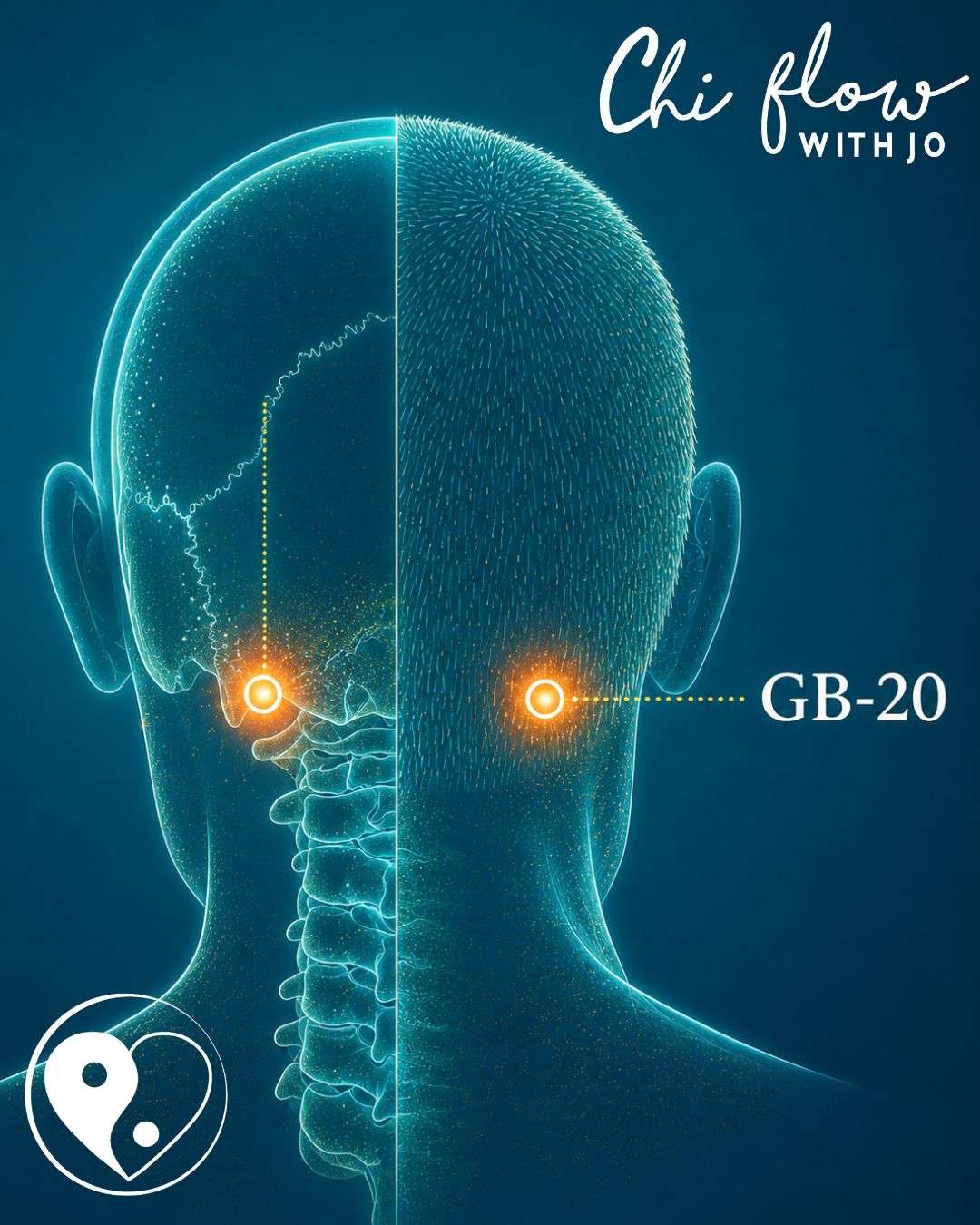
WATCH & LISTEN TO THE
ENERGY UPDATE PODCAST

How Acupressure and Qi Gong Can Help Relieve Back Pain and Heal the Trauma of Grief

How Acupressure and Qi Gong Can Help Relieve Back Pain and Heal the Trauma of Grief

As women over 40, we often find ourselves navigating unique physical and emotional challenges. Back pain, whether from posture, injuries, or even emotional trauma, can significantly impact our lives. If you’ve been carrying the heavy weight of grief; an emotion intimately tied to the lungs in Traditional Chinese Medicine (TCM), this blog will guide you on how acupressure and Qi Gong can help release that burden while easing your back pain.
Grief, according to TCM, is housed in the lungs, and unprocessed grief can stagnate the flow of Qi (energy) in the body.

As the ancient Chinese saying goes,

“When the Qi flows freely, the body is in balance; when Qi stagnates, disease and discomfort arise.”

This stagnation often manifests as physical tension, particularly in the upper back, neck, shoulders and lower back. Let’s explore how you can use acupressure, Qi Gong, and natural remedies to free up that energy and find relief.


Why Qi Stagnation from Grief Causes Back Pain

In Chinese Medicine, back pain is often rooted in two key imbalances: Qi and Blood Stagnation.

Qi Stagnation: Qi, the vital energy flowing through your body, moves along meridians (energy channels). When this flow is blocked or contracted, discomfort begins as a dull ache but can develop into sharp, fixed pain.  Another common culprit is the invasion of cold or dampness into the meridians of the spine, slowing Qi flow. 

Blood Stagnation: Trauma, injury, or sedentary habits can lead to poor blood flow. Like a bruise that lingers, blood stagnation can intensify pain.

When grief is not expressed or resolved becoming trapped in the body, it disrupts the smooth flow of Qi, particularly in the lung meridian, 

This stagnation creates a kind of energetic “logjam,” similar to how a blocked stream causes water to pool and stagnate. Over time, this buildup can lead to physical discomfort, especially in the neck, shoulders and back, 

The tension caused by stagnation restricts movement, reduces circulation, and exacerbates pain, making it vital to address both the emotional and physical aspects of grief to restore balance and alleviate discomfort.

The good news? The treatment can be the same: Get moving, stay warm, stimulate circulation and acupoints. 

Acupressure to Release Grief and Open Energy Pathways 

1. Lung 1 (Zhongfu) and Lung 2 (Yunmen)

These acupoints, located just below the collarbone, are instrumental in addressing grief and opening the lung meridian. Here’s how to find and use them:

♥ Locate the bony prominence of your collarbone. From there, move two fingers down to find Lung 1, and slightly above that is Lung 2.

♥ Gently massage these points on both sides of your chest. This helps release stuck grief and tension stored in the lungs and chest area.

2. Lung Meridian Tapping

The lung meridian travels down the inside of your arm to the edge of your thumb. Lightly tapping along this pathway further helps unblock emotional and energetic congestion.
Start at Lung 1, tapping down the inside of your arm to your thumb.
Repeat this on both arms to encourage Qi flow.

Qi Gong Exercises for Neck, Shoulders, and Back Pain

Gentle Neck and Shoulder Stretch

This Qi Gong exercise helps release tension and grief while supporting the upper back.

  1. Stand or sit comfortably with your hands by your sides.
  2. Imagine you’re holding small objects (like baguettes or ping pong balls) under your armpits to create space.
  3. Rotate your hands outward so your thumbs point behind you, opening the lung meridian.
  4. Slowly drop one ear toward your shoulder, then drop your chin to your chest, and move your other ear to the opposite shoulder. Repeat gently, enjoying the release in your neck and shoulders.

Wise Owl Turns Head to eliminate fatigue

The “Wise Owl Turns Head” Qigong exercise offers profound benefits for spinal health and emotional well-being. By gently rotating the head and neck, this movement stretches and massages the muscles and fascia along the spine, enhancing flexibility and relieving tension.

This action resembles wringing out a cloth, effectively dispersing Qi and blood stagnation, which can alleviate discomfort and promote energy flow.

Additionally, the exercise stimulates the lung meridian, facilitating the release of pent-up grief and sadness. Regular practice can lead to improved posture, reduced fatigue, and a more balanced emotional state.  Incorporating this exercise into your daily routine in Chi Flow with Jo, nurtures both physical and emotional health, fostering a harmonious flow of energy throughout the body.
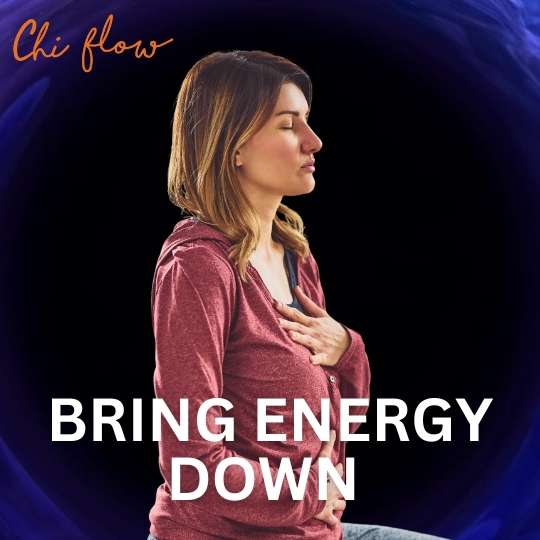
This movement releases tension along the spine and energizes the entire back.

– Step-by-Step Instructions for Wise Owl Turns Head 

♥ Stand Tall in a Relaxed Posture

  • – Stand with your feet shoulder-width apart.
  • – Keep your knees slightly bent and your spine upright but relaxed.
  • – Let your arms hang naturally by your sides.

♥ Engage Your Breath

  • – Inhale deeply through your nose and let your belly expand.
  • – Exhale squeeze the belly slowly, feeling grounded and present.

♥ Begin the Head Rotation

  • – Inhale and slowly turn your head to look over one shoulder, as if you’re an owl gazing behind. Rotate your hands outward so your thumbs point behind you, opening the lung meridian as in the previous exercise.
  • – Move gently, ensuring there’s no strain on your neck.
  • – Imagine plugging your feet firmly into the floor and imagine your spine gently twisting and stretching, as if “wringing out” tension. Exhale. Inhale deeply as you slowly bring your head back to the center.
  • – Allow your shoulders to relax into a neutral position.

♥ Repeat on the Other Side

    • – Turn your head to look over the opposite shoulder.
    • – Again, allow your spine to twist gently while keeping your movements smooth and deliberate.

♥ Complete with Centering Breath

    • – After a few repetitions on each side, return to the center.
    • – Place your hands over your lower abdomen and take three slow, deep breaths to conclude.

Acupressure for the Lower Back Pain

Bladder 23 (Shenshu) and Bladder 52 (Zhishi)

These points, located in the lower back near the kidneys, are vital for nourishing and warming the area. Rub these points gently to warm and activate them, releasing stagnant Qi.

This movement releases tension along the spine and energizes the entire back.

Kidney and Bladder Points on the Feet

The feet are home to powerful acupoints that can influence the back, including:

  • ♥ Kidney 1 (Bubbling Spring): On the sole of the foot.
  • ♥ Kidney 3: Between the inner ankle bone and the Achilles tendon.
  • ♥ Bladder 60: Between the outer ankle bone and the Achilles tendon.

Massage these points to improve Qi flow and reduce back pain before placing them into the ginger footbath below.

Warmth and Nourishment for Healing

Ginger Compress for the Kidneys

The kidneys are closely tied to the lower back in TCM. Warming them can help ease Qi and blood stagnation, reduce pain and support overall vitality.

♥ Grate fresh ginger and steep it in hot water for 20 minutes.

♥ Dip a towel in the ginger-infused water and apply it to your lower back. For sensitive skin, place a dry towel between the compress and your skin.

♥ Leave the compress on for 15-20 minutes to relax muscles and promote Qi flow.

Ginger Foot Bath

Relax and rejuvenate with a ginger foot bath.

♥ Use the leftover but still warm, ginger water from your compress.

♥ Soak your feet for 10-15 minutes before bed to warm your entire system, calm your mind, and ease back pain.

Why It Works

Grief and trauma can cause the body to contract, leading to physical stagnation and pain. Acupressure and Qi Gong work together to:

♥ Release stuck emotions, especially grief stored in the lungs.

♥ Open meridians to restore the natural flow of Qi.

♥ Stretch and strengthen the spine to alleviate tension and pain.

♥ Nourish the body with warmth and relaxation techniques like ginger compresses.

By incorporating these practices into your daily routine, you can transform pain into healing, grief into strength, and stagnation into vitality. Remember, your body has an innate ability to heal, sometimes, it just needs a little support and time to get there.

Join the Chi Flow community

May you be happy, safe, and well, and may your journey to balance and health bring you peace and joy. Let’s embrace the flow of Qi together!

 Join us in Chi Flow for a FREE CLASS❤️

With Love and Chi,

Self-administered acupressure or Chinese Medicine is not a substitute for visits to qualified healthcare practitioners.

Knowing how to treat yourself and your loved ones with complimentary therapies like acupressure can be greatly beneficial and convenient. However, for serious and chronic conditions, you’ll want to visit an Shiatsu therapist / Acupuncturist or other qualified healthcare practitioner who can develop a treatment plan based on your unique medical history and combination of symptoms.  

The information provided should not be considered medical advice.